. 2019 Nov 19;9(11):749.
doi: 10.3390/biom9110749.

The Steroidogenesis Inhibitor Finasteride Reduces the Response to Both Stressful and Rewarding Stimuli

Affiliations

The Steroidogenesis Inhibitor Finasteride Reduces the Response to Both Stressful and Rewarding Stimuli

Sean C Godar et al. Biomolecules. .

Abstract

Finasteride (FIN) is the prototypical inhibitor of steroid 5α-reductase (5αR), the enzyme that catalyzes the rate-limiting step of the conversion of progesterone and testosterone into their main neuroactive metabolites. FIN is clinically approved for the treatment of benign prostatic hyperplasia and male baldness; while often well-tolerated, FIN has also been shown to cause or exacerbate psychological problems in vulnerable subjects. Evidence on the psychological effects of FIN, however, remains controversial, in view of inconsistent clinical reports. Here, we tested the effects of FIN in a battery of tests aimed at capturing complementary aspects of mood regulation and stress reactivity in rats. FIN reduced exploratory, incentive, prosocial, and risk-taking behavior; furthermore, it decreased stress coping, as revealed by increased immobility in the forced-swim test (FST). This last effect was also observed in female and orchiectomized male rats, suggesting that the mechanism of action of FIN does not primarily reflect changes in gonadal steroids. The effects of FIN on FST responses were associated with a dramatic decrease in corticotropin release hormone (CRH) mRNA and adrenocorticotropic hormone (ACTH) levels. These results suggest that FIN impairs stress reactivity and reduces behavioral activation and impulsive behavior by altering the function of the hypothalamus-pituitary-adrenal (HPA) axis.

Keywords: 5α reductase; HPA axis; anxiety; depression; finasteride; impulsivity.


Conflict of interest statement

The authors confirm that there are no known conflicts of interest associated with this publication and there has been no significant financial support for this work that could have influenced its outcome.

Figures
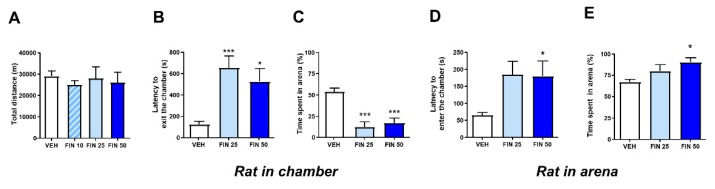
Figure 1
Figure 1
Finasteride (FIN) reduced exploratory drive in the defensive withdrawal paradigm. FIN did not affect locomotor activity in rats tested in an actometer under total darkness; n = 6–7/group (A). In the defensive withdrawal paradigm, FIN increased the latency to exit from a protected chamber and enter a brightly lit open arena (B), as well as the percentage of time spent in the arena itself, n = 12/group (C). However, when animals were first placed in the open arena, FIN increased the latency to enter the protected chamber (D) and prolonged the percentage of time spent in the open arena n = 8/group (E). * p < 0.05, *** p < 0.001 in comparison with rats treated with vehicle (VEH). Doses of finasteride are indicated in mg/kg (IP).
Figure 2
Figure 2
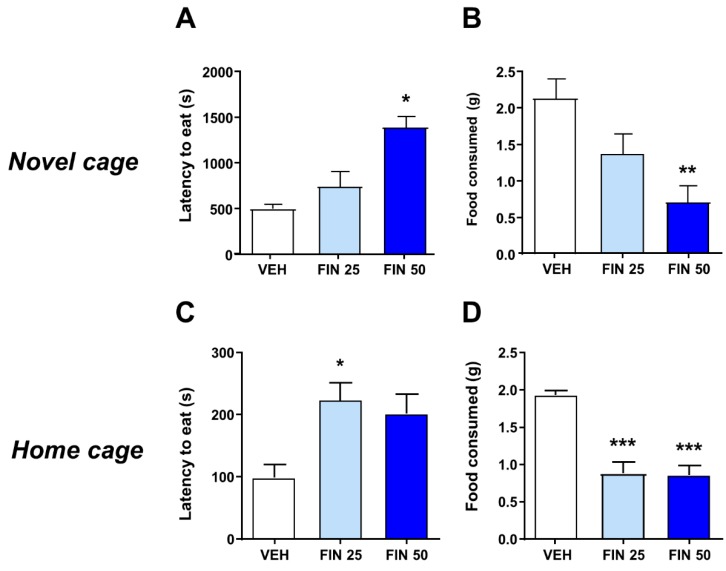
Finasteride (FIN) reduced appetitive motivation in the novelty-induced hypophagia test. In a novel cage, FIN-treated rats displayed an increased latency to consume palatable food (A) and reduced amounts of food consumed (B); n = 10–11/group. Similar outcomes, however, were also observed in home cages; n = 9/group (C,D). * p < 0.05, ** p < 0.01, *** p < 0.001 in comparison with rats treated with vehicle (VEH). Doses of FIN are indicated in mg/kg (IP).
Figure 3
Figure 3
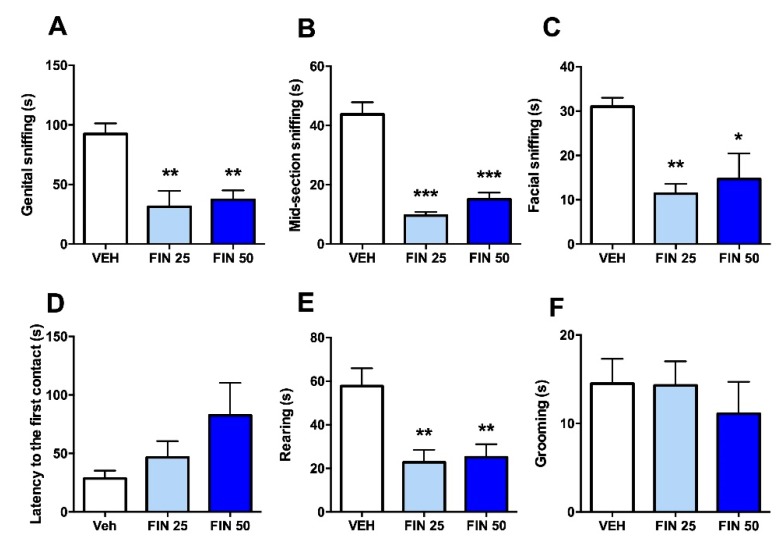
Finasteride (FIN) reduced social interaction with foreign social counterparts. When encountering foreign rats, FIN-treated rats exhibited significant reductions in the duration of genital (A), mid-section (B), and facial sniffing (C), but no changes in the latency to the first social approach, n = 9/10/group (D). In addition, FIN reduced rearing (E), but not grooming responses (F). * p < 0.05, ** p < 0.01, *** p < 0.001 in comparison to rats treated with vehicle (VEH). Doses of FIN are indicated in mg/kg (IP).
Figure 4
Figure 4
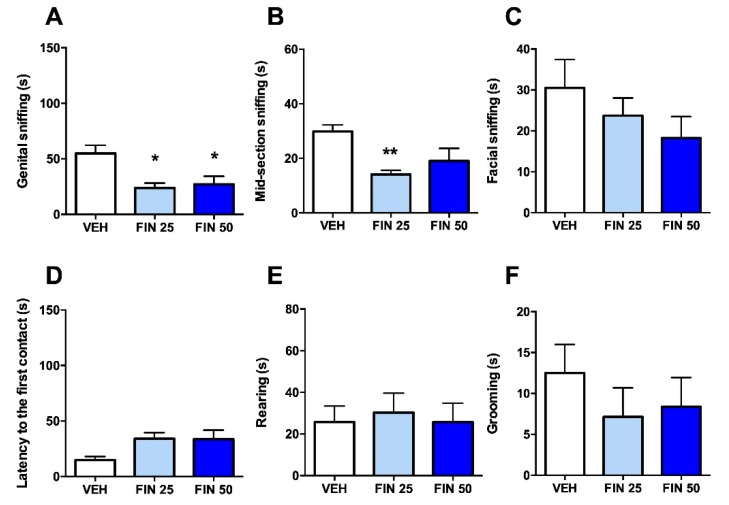
Finasteride (FIN) reduced social interaction with familiar social counterparts. FIN decreased the duration of the exploration of genital area (A) and mid-section (B), but not facial areas (C) of cage mates. Furthermore, FIN had no effect on the latency to the first social approach (D), duration of rearing behavior (E) and grooming; n = 7–8/group (F). * p < 0.05, ** p < 0.01 in comparison with rats treated with vehicle (VEH). Doses of FIN are indicated in mg/kg (IP).
Figure 5
Figure 5
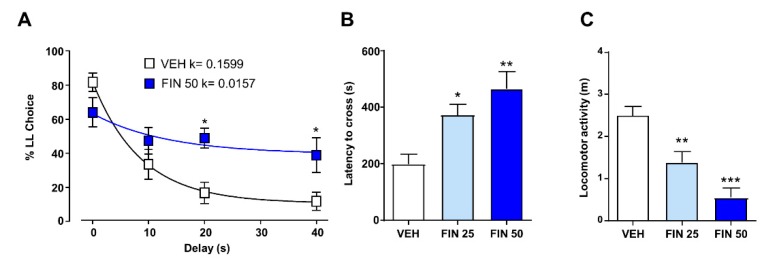
Finasteride (FIN) decreased impulsive and risk-taking responses. In the delay-discounting paradigm (A), FIN decreased the discounting rate corresponding to longer delays (20 and 40 s); n = 11–12/group. In the wire-beam bridge, FIN-treated rats showed longer latency to cross the bridge (B) and an overall reduction in the distance traveled on the apparatus (C); n = 10/group (C). * p < 0.05, ** p 0.01, *** p < 0.001 in comparison with rats treated with vehicle (VEH). Doses of FIN are indicated in mg/kg (IP).
Figure 6
Figure 6
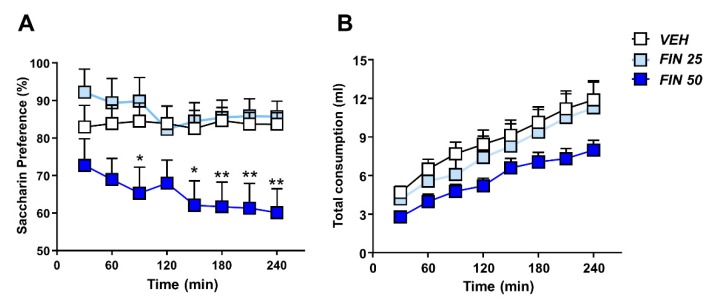
Finasteride reduced saccharin preference. The 50 mg/kg dose of FIN reduced saccharin preference in the saccharin preference test (A) without modifying total liquid consumption (B); n = 10–11/group; * p < 0.05, ** p < 0.01 in comparison with rats treated with vehicle (VEH). Doses of FIN are indicated in mg/kg (IP).
Figure 7
Figure 7
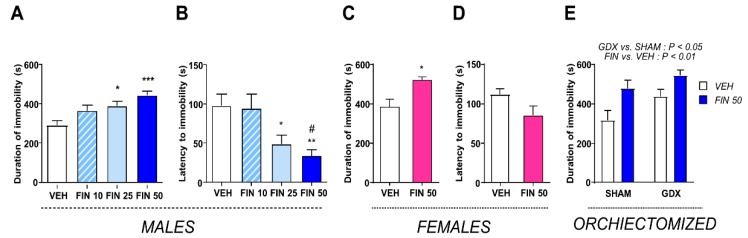
Finasteride (FIN) reduced stress coping behavior in the forced-swim test. In male rats, FIN increased the duration of immobility (A) and reduced the latency to immobility (B); n = 12/group. In female rats, FIN affected only the duration of immobility (C), but not the latency (D); n = 8–9/group. The depressogenic effect was not modified by gonadectomy (E); n = 9–11/group (GDX) (E). * p < 0.05, ** p 0.01, *** p < 0.001 in comparison with rats treated with vehicle (VEH); # p < 0.05 in comparison with FIN (10 mg/kg, IP). Doses of FIN are indicated in mg/kg (IP).
Figure 8
Figure 8
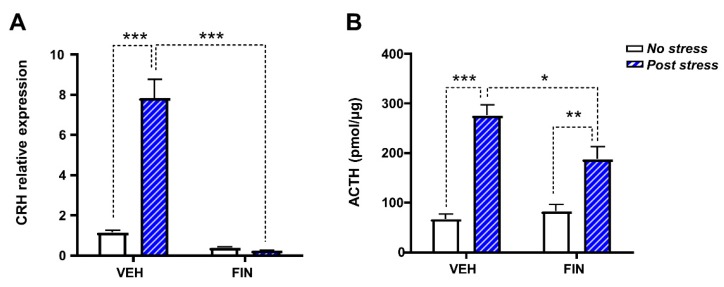
Finasteride (FIN, 50 mg/kg, IP) suppressed hypothalamus–pituitary–adrenal (HPA) axis responsiveness. (A) FIN completely suppressed the levels of transcript of corticotropin releasing hormone (CRH) in the paraventricular nucleus (PVN) of the hypothalamus, in rats subjected to forced-swim stress or non-stressful conditions (n = 4/group). (B) FIN also reduced plasma ACTH levels in stressed rats (n = 9–10/group). * p < 0.05, ** p 0.01, *** p < 0.001 for all comparisons indicated by dotted lines.

References

    1. Russell D. Steroid 5-alpha Reductase: Two Genes/Two Enzymes. Annu. Rev. Biochem. 1994;63:25–61. doi: 10.1146/annurev.bi.63.070194.000325. - DOI - PubMed
    1. Paba S., Frau R.C., Godar S., Devoto P., Marrosu F., Bortolato M. Steroid 5α-Reductase as a Novel Therapeutic Target for Schizophrenia and Other Neuropsychiatric Disorders. Curr. Pharm. Des. 2011;17:151–167. doi: 10.2174/138161211795049589. - DOI - PubMed
    1. Majewska M.D. Neurosteroids: Endogenous bimodal modulators of the GABAA receptor mechanism of action and physiological significance. Prog. Neurobiol. 1992;38:379–395. doi: 10.1016/0301-0082(92)90025-A. - DOI - PubMed
    1. Reddy D.S., Jian K. The testosterone-derived neurosteroid androstanediol is a positive allosteric modulator of GABAA receptors. J. Pharmacol. Exp. Ther. 2010;334:1031–1041. doi: 10.1124/jpet.110.169854. - DOI - PMC - PubMed
    1. Eser D., Schüle C., Baghai T.C., Romeo E., Rupprecht R. Neuroactive steroids in depression and anxiety disorders: Clinical studies. Neuroendocrinology. 2007;84:244–254. doi: 10.1159/000097879. - DOI - PubMed

Publication types

MeSH terms

Substances