


Clinical operations of academic versus non-academic emergency departments: a descriptive comparison of two large emergency department operations surveys
- PMID: 31752708
- PMCID: PMC6868754
- DOI: 10.1186/s12873-019-0285-7
Clinical operations of academic versus non-academic emergency departments: a descriptive comparison of two large emergency department operations surveys
Abstract
Background: Academic and non-academic emergency departments (EDs) are regularly compared in clinical operations benchmarking despite suggestion that the two groups may differ in their clinical operations characteristics. and outcomes. We sought to describe and compare clinical operations characteristics of academic versus non-academic EDs.
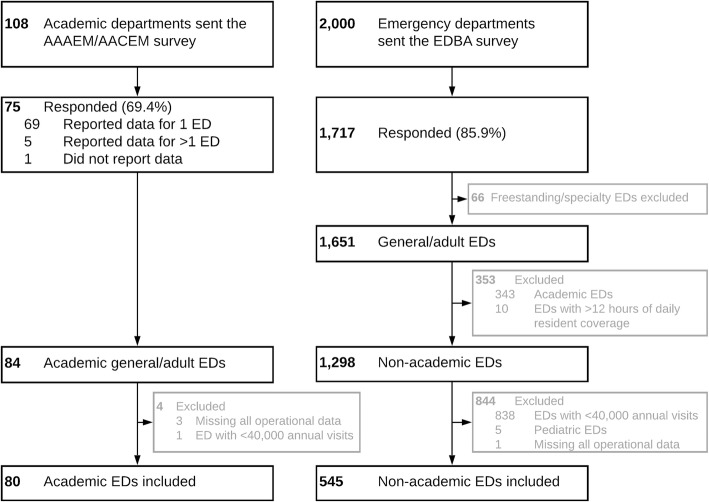
Methods: We performed a descriptive, comparative analysis of academic and non-academic adult and general EDs with 40,000+ annual encounters, using the Academy of Academic Administrators of Emergency Medicine (AAAEM)/Association of Academic Chairs of Emergency Medicine (AACEM) and Emergency Department Benchmarking Alliance (EDBA) survey results. We defined academic EDs as primary teaching sites for emergency medicine (EM) residencies and non-academic EDs as sites with minimal resident involvement. We constructed the academic and non-academic cohorts from the AAAEM/AACEM and EDBA surveys, respectively, and analyzed metrics common to both surveys.
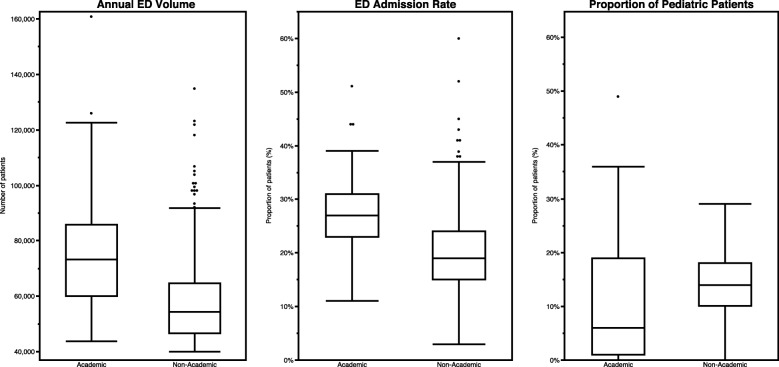
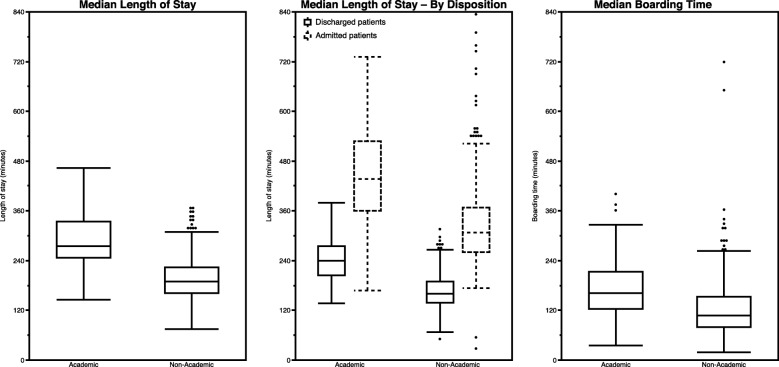
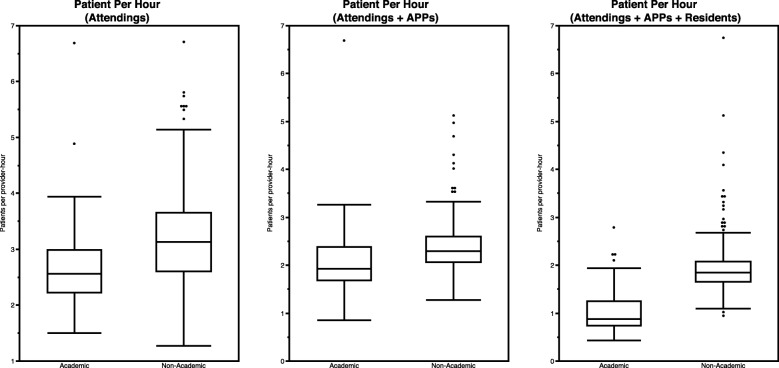
Results: Eighty and 454 EDs met inclusion criteria for academic and non-academic EDs, respectively. Academic EDs had more median annual patient encounters (73,001 vs 54,393), lower median proportion of pediatric patients (6.3% vs 14.5%), higher median proportion of EMS patients (27% vs 19%), and were more commonly designated as Level I or II Trauma Centers (94% vs 24%). Median patient arrival-to-provider times did not differ (26 vs 25 min). Median length-of-stay was longer (277 vs 190 min) for academic EDs, and left-before-treatment-complete was higher (5.7% vs 2.9%). MRI utilization was higher for academic EDs (2.2% patients with at least one MRI vs 1.0 MRIs performed per 100 patients). Patients-per-hour of provider coverage was lower for academic EDs with and without consideration for advanced practice providers and residents.
Conclusions: Demographic and operational performance measures differ between academic and non-academic EDs, suggesting that the two groups may be inappropriate operational performance comparators. Causes for the differences remain unclear but the differences appear not to be attributed solely to the academic mission.
Keywords: Academic; Benchmarking; Community; Emergency department; Operations.
Conflict of interest statement
The authors declare that they have no competing interests.
Figures
References
-
- Reznek MA, Scheulen JJ, Harbertson CA, et al. Contributions of academic emergency medicine programs to U.S. health care: summary of the AAAEM-AACEM benchmarking data. Acad Emerg Med. 2018;25(4):444–452. - PubMed
-
- Medicare.gov. Hospital Compare. https://www.medicare.gov/hospitalcompare/About/What-Is-HOS.html. Accessed 16 Feb 2019.
-
- The Joint Commision. Specifications Manual for National Hospital Inpatient Quality Measures. https://www.jointcommission.org/specifications_manual_for_national_hospi.... Accessed 16 Feb 2019.
-
- Valdes-Perez R. Smart benchmarking starts with knowing whom to compare yourself to. Harv Bus Rev 2015. https://hbr.org/2015/10/smart-benchmarking-starts-with-knowing-whom-to-c.... Accessed 20 Oct 2018.
-
- MGMA Provider Compensation and Production Report. Medical Group Management Association. Washington DC; 2017.
Publication types
MeSH terms
LinkOut - more resources
Full Text Sources
Miscellaneous
