


Distinct functions of AKT isoforms in breast cancer: a comprehensive review
- PMID: 31752925
- PMCID: PMC6873690
- DOI: 10.1186/s12964-019-0450-3
Distinct functions of AKT isoforms in breast cancer: a comprehensive review
Abstract
Background: AKT, also known as protein kinase B, is a key element of the PI3K/AKT signaling pathway. Moreover, AKT regulates the hallmarks of cancer, e.g. tumor growth, survival and invasiveness of tumor cells. After AKT was discovered in the early 1990s, further studies revealed that there are three different AKT isoforms, namely AKT1, AKT2 and AKT3. Despite their high similarity of 80%, the distinct AKT isoforms exert non-redundant, partly even opposing effects under physiological and pathological conditions. Breast cancer as the most common cancer entity in women, frequently shows alterations of the PI3K/AKT signaling.
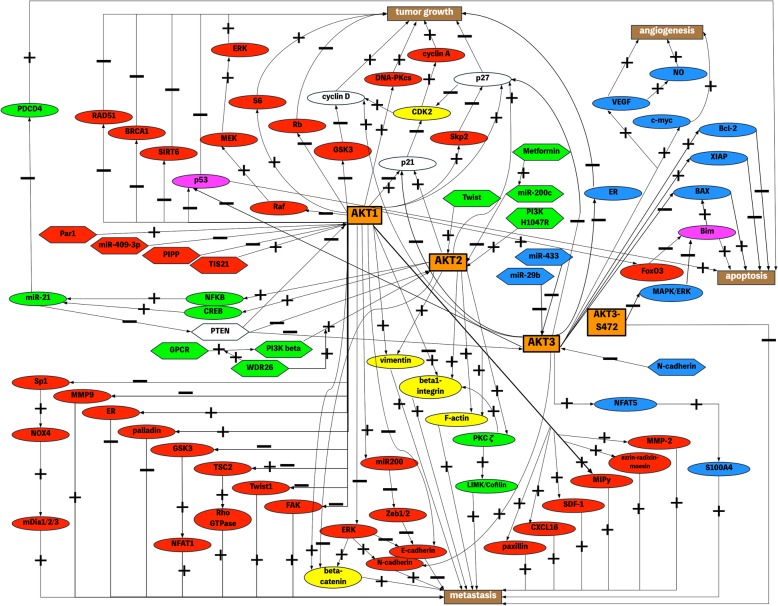
Main content: A plethora of studies addressed the impact of AKT isoforms on tumor growth, metastasis and angiogenesis of breast cancer as well as on therapy response and overall survival in patients. Therefore, this review aimed to give a comprehensive overview about the isoform-specific effects of AKT in breast cancer and to summarize known downstream and upstream mechanisms. Taking account of conflicting findings among the studies, the majority of the studies reported a tumor initiating role of AKT1, whereas AKT2 is mainly responsible for tumor progression and metastasis. In detail, AKT1 increases cell proliferation through cell cycle proteins like p21, p27 and cyclin D1 and impairs apoptosis e.g. via p53. On the downside AKT1 decreases migration of breast cancer cells, for instance by regulating TSC2, palladin and EMT-proteins. However, AKT2 promotes migration and invasion most notably through regulation of β-integrins, EMT-proteins and F-actin. Whilst AKT3 is associated with a negative ER-status, findings about the role of AKT3 in regulation of the key properties of breast cancer are sparse. Accordingly, AKT1 is mutated and AKT2 is amplified in some cases of breast cancer and AKT isoforms are associated with overall survival and therapy response in an isoform-specific manner.
Conclusions: Although there are several discussed hypotheses how isoform specificity is achieved, the mechanisms behind the isoform-specific effects remain mostly unrevealed. As a consequence, further effort is necessary to achieve deeper insights into an isoform-specific AKT signaling in breast cancer and the mechanism behind it.
Keywords: AKT; Breast cancer; Isoforms; PI3K/AKT signaling; Protein kinase B.
Conflict of interest statement
The authors declare that they have no competing interests.
Figures
References
-
- Siegel RL, Miller KD, Jemal A. Cancer statistics, 2019. CA Cancer J Clin. 2019;69(1):7–34. - PubMed
-
- Lobbezoo DJ, van Kampen RJ, Voogd AC, Dercksen MW, van den Berkmortel F, Smilde TJ, et al. Prognosis of metastatic breast cancer: are there differences between patients with de novo and recurrent metastatic breast cancer? Br J Cancer. 2015;112(9):1445–1451. doi: 10.1038/bjc.2015.127. - DOI - PMC - PubMed
Publication types
MeSH terms
Substances
LinkOut - more resources
Full Text Sources
Other Literature Sources
Medical
Research Materials
Miscellaneous
