


Prevalence and correlates of mild cognitive impairment among diverse Hispanics/Latinos: Study of Latinos-Investigation of Neurocognitive Aging results
- PMID: 31753701
- PMCID: PMC7318558
- DOI: 10.1016/j.jalz.2019.08.202
Prevalence and correlates of mild cognitive impairment among diverse Hispanics/Latinos: Study of Latinos-Investigation of Neurocognitive Aging results
Abstract
Introduction: We estimated the prevalence and correlates of mild cognitive impairment (MCI) among middle-aged and older diverse Hispanics/Latinos.
Methods: Middle-aged and older diverse Hispanics/Latinos enrolled (n = 6377; 50-86 years) in this multisite prospective cohort study were evaluated for MCI using the National Institute on Aging-Alzheimer's Association diagnostic criteria.
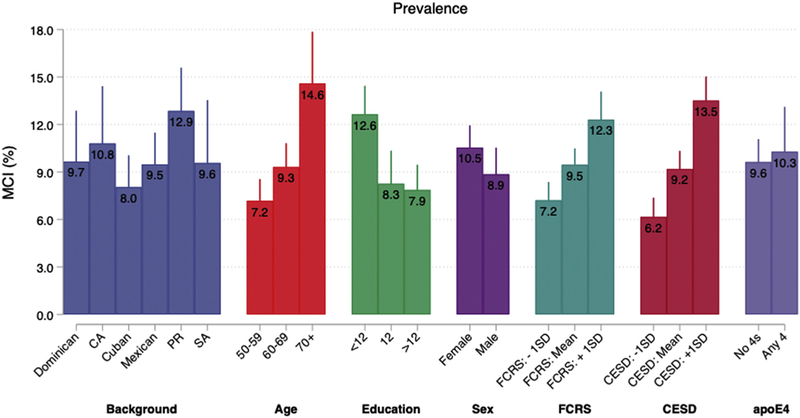
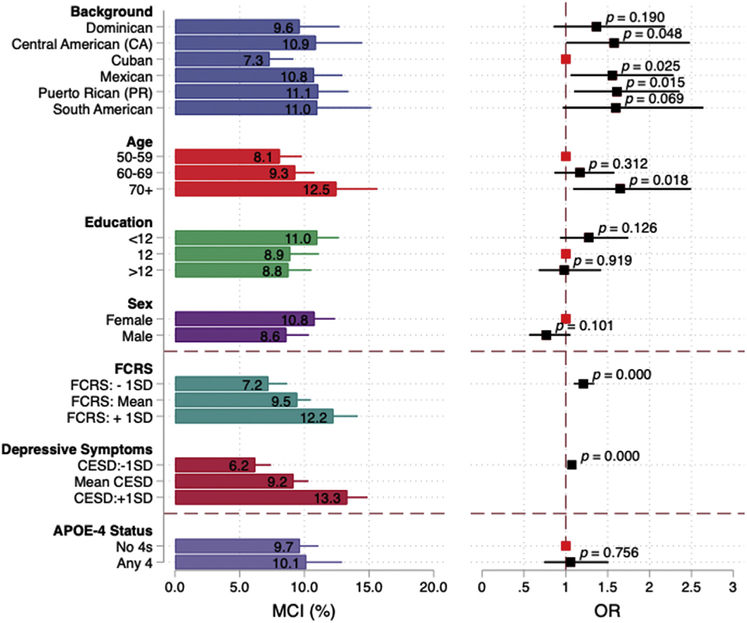
Results: The overall MCI prevalence was 9.8%, which varied between Hispanic/Latino groups. Older age, high cardiovascular disease (CVD) risk, and elevated depressive symptoms were significant correlates of MCI prevalence. Apolipoprotein E4 (APOE) and APOE2 were not significantly associated with MCI.
Discussion: MCI prevalence varied among Hispanic/Latino backgrounds, but not as widely as reported in the previous studies. CVD risk and depressive symptoms were associated with increased MCI, whereas APOE4 was not, suggesting alternative etiologies for MCI among diverse Hispanics/Latinos. Our findings suggest that mitigating CVD risk factors may offer important pathways to understanding and reducing MCI and possibly dementia among diverse Hispanics/Latinos.
Keywords: Alzheimer's disease; Cognitive decline; Cognitive function; Dementia; Epidemiology; Hispanics; Hispanics/Latinos; Latinos; Mild cognitive impairment; Neuroepidemiology; Neuropsychology; Population neuroscience.
Copyright © 2019 the Alzheimer's Association. Published by Elsevier Inc. All rights reserved.
Conflict of interest statement
Financial Disclosures: The authors report no conflicts of interest that could inappropriately influence, or be perceived to influence, this work.
Figures
References
-
- Census. American Community Survey. 2017. Available at: http://www.census.gov/programs-surveys/acs Accessed October 11, 2019.
-
- Colby SL, Ortman JM. Projections of the Size and Composition of the US Population: 2014 to 2060 Population Estimates and Projec-tions. Current Population Reports. US Census Bureau; 2015. p. 25–1143.
-
- Gurland BJ, Wilder DE, Lantigua R, Stern Y, Chen J, Killeffer EH, et al. Rates of dementia in three ethnoracial groups. Int J Geriatr Psychiatry 1999;14:481–93. - PubMed
-
- Haan MN, Mungas DM, González HM, Ortiz TA, Acharya A, Jagust WJ. Prevalence of dementia in older Latinos: the influence of type 2 diabetes mellitus, stroke and genetic factors. J Am Geriatr Soc 2003;51:169–77. - PubMed
