


CD8+ T cells exhaustion induced by myeloid-derived suppressor cells in myelodysplastic syndromes patients might be through TIM3/Gal-9 pathway
- PMID: 31756785
- PMCID: PMC6933355
- DOI: 10.1111/jcmm.14825
CD8+ T cells exhaustion induced by myeloid-derived suppressor cells in myelodysplastic syndromes patients might be through TIM3/Gal-9 pathway
Abstract
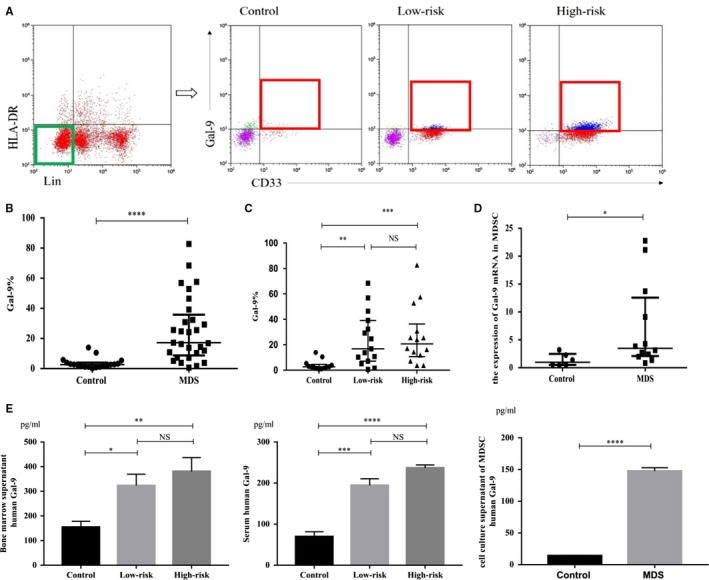
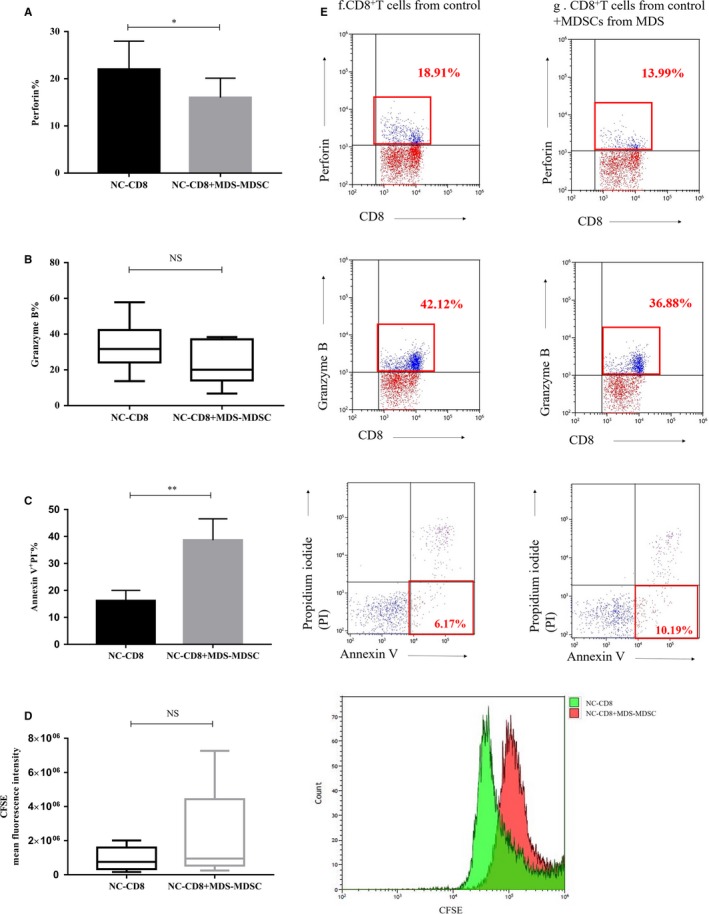
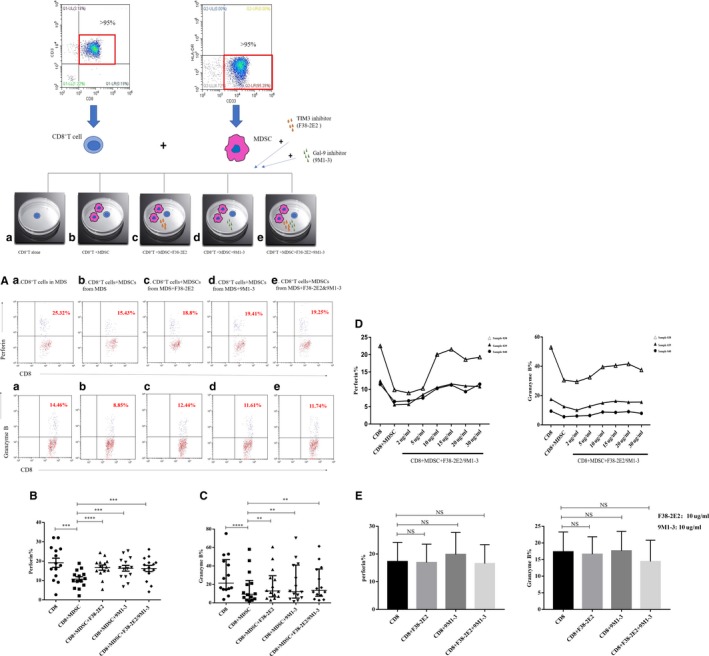
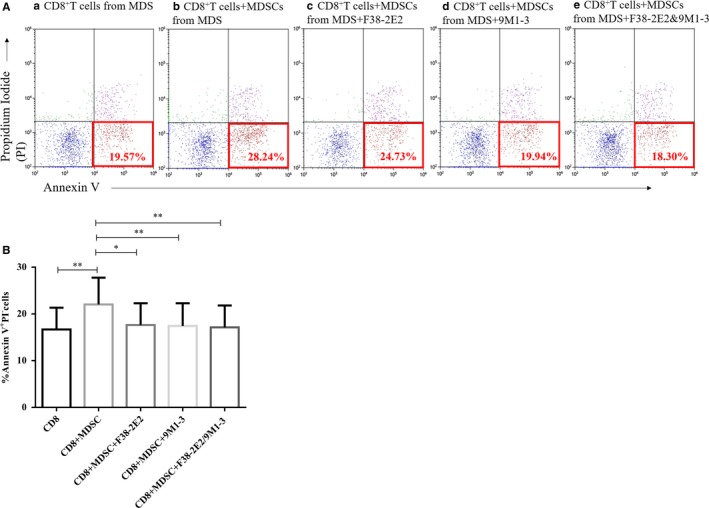
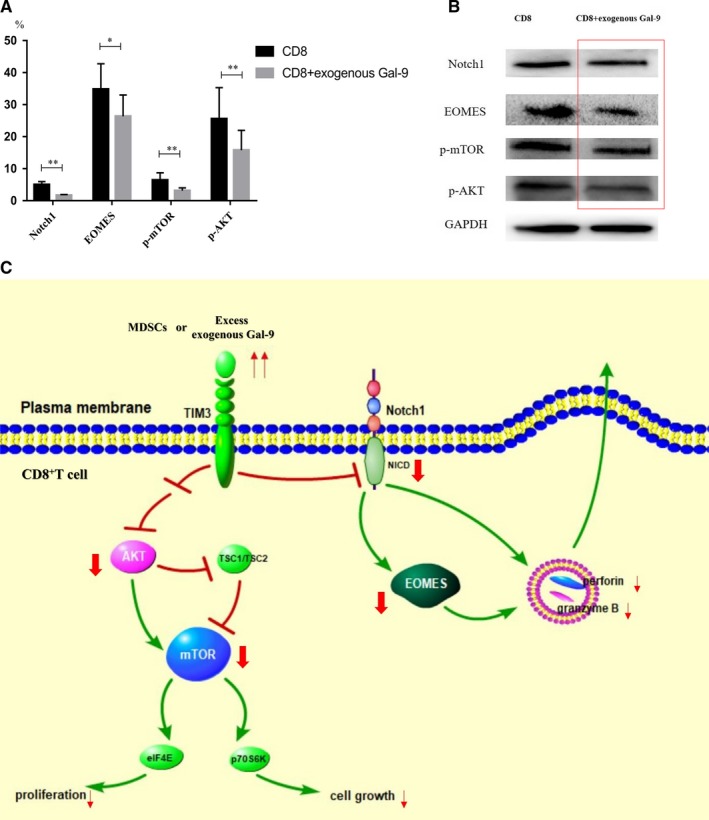
CD8+ T cells play a central role in antitumour immunity, which often exhibit 'exhaustion' in the setting of malignancy and chronic viral infection due to T cell immunoglobulin and mucin domain 3 (TIM3) and myeloid-derived suppressor cells (MDSCs). Our team previously found that overactive MDSCs and exhausted TIM3+ CD8+ T cells were observed in myelodysplastic syndromes (MDS) patients. However, it is not obvious whether MDSCs suppress CD8+ T cells through TIM3/Gal-9 pathway. Here, Gal-9, as the ligand of TIM3, was overexpressed in MDSCs. The levels of Gal-9 in bone marrow supernatants, serum and culture supernatants of MDSCs from MDS patients were elevated. CD8+ T cells from MDS or normal controls produced less perforin and granzyme B and exhibited increased early apoptosis after co-culture with MDSCs from MDS. Meanwhile, the cytokines produced by CD8+ T cells could be partially restored by TIM3/Gal-9 pathway inhibitors. Furthermore, CD8+ T cells produced less perforin and granzyme B after co-culture with excess exogenous Gal-9, and the function of CD8+ T cells was similarly restored by TIM3/Gal-9 pathway inhibitors. Expression of Notch1, EOMES (associated with perforin and granzyme B secretion), p-mTOR and p-AKT (associated with cell proliferation) was decreased in CD8+ T cells from MDS after co-culture with excess exogenous Gal-9. These suggested that MDSCs might be the donor of Gal-9, and TIM3/Gal-9 pathway might be involved in CD8+ T cells exhaustion in MDS, and that TIM3/Gal-9 pathway inhibitor might be the promising candidate for target therapy of MDS in the future.
Keywords: CD8+ T cells; exhaustion; myelodysplastic syndrome.
© 2019 The Authors. Journal of Cellular and Molecular Medicine published by Foundation for Cellular and Molecular Medicine and John Wiley & Sons Ltd.
Conflict of interest statement
The authors confirm that there are no conflicts of interest.
Figures

References
-
- Tao J, Li L, Wang Y, Fu R, Wang H, Shao Z. Increased TIM3+CD8+T cells in Myelodysplastic Syndrome patients displayed less perforin and granzyme B secretion and higher CD95 expression. Leuk Res. 2016;51:49‐55. - PubMed
-
- Tao JL, Li LJ, Fu R, et al. Elevated TIM3+ hematopoietic stem cells in untreated myelodysplastic syndrome displayed aberrant differentiation, overproliferation and decreased apoptosis. Leuk Res. 2014;38:714‐721. - PubMed
-
- Jiang H, Fu R, Wang H, Li L, Liu H, Shao Z. CD47 is expressed abnormally on hematopoietic cells in myelodysplastic syndrome. Leuk Res. 2013;37:907‐910. - PubMed
Publication types
MeSH terms
Substances
LinkOut - more resources
Full Text Sources
Medical
Research Materials
Miscellaneous
