


Emergence of SARM1 as a Potential Therapeutic Target for Wallerian-type Diseases
- PMID: 31761689
- PMCID: PMC6980728
- DOI: 10.1016/j.chembiol.2019.11.002
Emergence of SARM1 as a Potential Therapeutic Target for Wallerian-type Diseases
Abstract
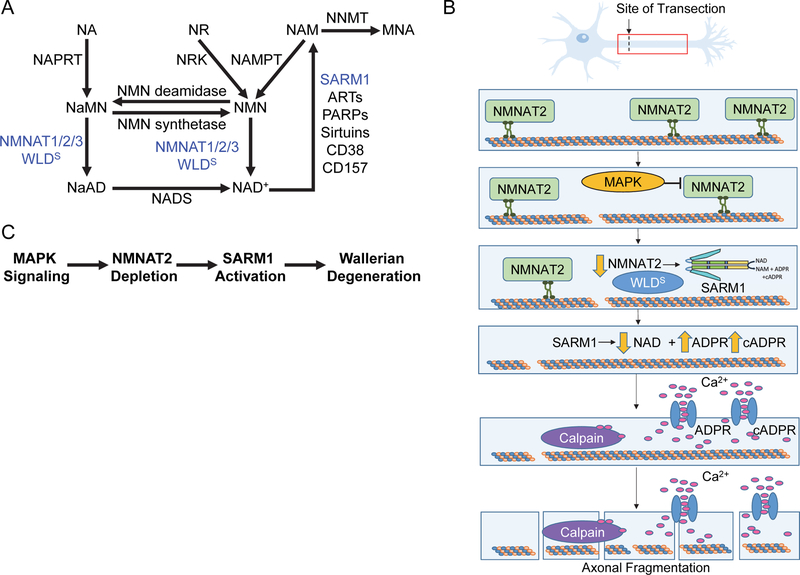
Wallerian degeneration is a neuronal death pathway that is triggered in response to injury or disease. Death was thought to occur passively until the discovery of a mouse strain, i.e., Wallerian degeneration slow (WLDS), which was resistant to degeneration. Given that the WLDS mouse encodes a gain-of-function fusion protein, its relevance to human disease was limited. The later discovery that SARM1 (sterile alpha and toll/interleukin receptor [TIR] motif-containing protein 1) promotes Wallerian degeneration suggested the existence of a pathway that might be targeted therapeutically. More recently, SARM1 was found to execute degeneration by hydrolyzing NAD+. Notably, SARM1 knockdown or knockout prevents neuron degeneration in response to a range of insults that lead to peripheral neuropathy, traumatic brain injury, and neurodegenerative disease. Here, we discuss the role of SARM1 in Wallerian degeneration and the opportunities to target this enzyme therapeutically.
Keywords: NAD(+); SARM1; neurodegeneration; therapeutics.
Copyright © 2019 Elsevier Ltd. All rights reserved.
Conflict of interest statement
DECLARATION OF INTERESTS
P.R.T. is a consultant for Disarm Therapeutics.
Figures



References
-
- Adalbert R, Morreale G, Paizs M, Conforti L, Walker SA, Roderick HL, Bootman MD, Siklos L, and Coleman MP (2012). Intra-axonal calcium changes after axotomy in wild-type and slow Wallerian degeneration axons. Neuroscience 225, 44–54. - PubMed
-
- Beirowski B, Babetto E, Coleman MP, and Martin KR (2008). The WldS gene delays axonal but not somatic degeneration in a rat glaucoma model. Eur J Neurosci 28, 1166–1179. - PubMed
Publication types
MeSH terms
Substances
Grants and funding
LinkOut - more resources
Full Text Sources
Other Literature Sources
Medical
Research Materials
