


Measurement Properties of Commonly Used Generic Preference-Based Measures in East and South-East Asia: A Systematic Review
- PMID: 31761995
- PMCID: PMC7081654
- DOI: 10.1007/s40273-019-00854-w
Measurement Properties of Commonly Used Generic Preference-Based Measures in East and South-East Asia: A Systematic Review
Abstract
Objectives: Our aim was to systematically review published evidence on the construct validity, test-retest reliability and responsiveness of generic preference-based measures (PBMs) used in East and South-East Asia.
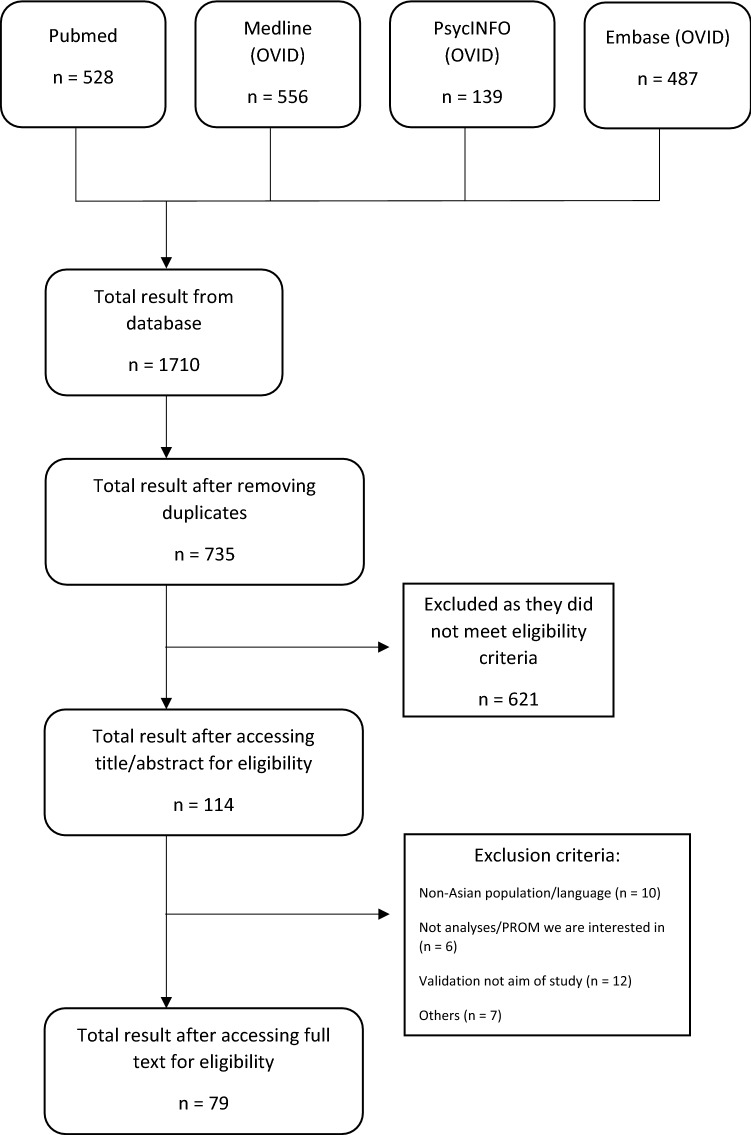
Methods: This systematic review was guided by the COSMIN guideline. A literature search on the MEDLINE, EMBASE, PsycINFO and PubMed databases up to August 2019 was conducted for measurement properties validation papers of the EuroQol-5 Dimensions (EQ-5D), Short Form-6 Dimensions (SF-6D), Health Utilities Index (HUI), Quality of Well-Being (QWB), 15-Dimensional (15D) and Assessment of Quality of Life (AQOL) in East and South-East Asian countries. Included papers were disaggregated into individual studies whose results and quality of design were rated separately. The population-specific measurement properties (construct validity, test-retest reliability and responsiveness) of each PBM were assessed separately using relevant studies. The overall methodological quality of the studies used in each of the assessments was also rated.
Results: A total of 79 papers containing 1504 studies were included in this systematic review. The methodological quality was 'very good' or 'adequate' for the majority of the construct validity studies (99%) and responsiveness studies (61%), but for only a small portion of the test-retest reliability studies (23%). EQ-5D was most widely assessed and was found to have 'sufficient' construct validity and responsiveness in many populations, while the SF-6D and EuroQol-Visual Analog Scale (EQ-VAS) exhibited 'inconsistent' construct validity in some populations. Scarce evidence was available on HUI and QWB, but current evidence supported the use of HUI.
Conclusions: This systematic review provides a summary of the quality of existing generic PBMs in Asian populations. The current evidence supports the use of EQ-5D as the preferred choice when a generic PBM is needed, and continuous testing of all PBMs in the region.
Conflict of interest statement
Xinyu Qian and Rachel Lee-Yin Tan have no conflicts of interest to declare. Nan Luo and Ling-Hsiang Chuang are members of the EuroQol Group.
Figures
References
-
- Neumann PJ, Goldie SJ, Weinstein MC. Preference-based measures in economic evaluation in health care. Annu Rev Public Health. 2000;21:587–611. - PubMed
-
- Longworth L, Yang Y, Young T, et al. Use of generic and condition-specific measures of health-related quality of life in NICE decision-making: a systematic review, statistical modelling and survey. Southampton: NIHR Journals Library. https://www.journalslibrary.nihr.ac.uk/hta/hta18090/#/abstract. Accessed Feb 2014 - PMC - PubMed
-
- Fayers PM, Machin D. Quality of life: the assessment, analysis and interpretation of patient-reported outcomes. 2. Chichester: Wiley; 2007.
-
- COSMIN methodology for systematic reviews of Patient-Reported Outcome Measures (PROMs). https://www.cosmin.nl/wp-content/uploads/COSMIN-syst-review-for-PROMs-ma.... Assessed 1 Jul 2018.
-
- The EuroQol Group EuroQol—a new facility for the measurement of health-related quality of life. Health Policy. 1990;16:199–208. - PubMed
Publication types
MeSH terms
LinkOut - more resources
Full Text Sources
