


Sinonasal Inverted Papilloma: Efficacy of Demucosation to Reduce Recurrence After Surgical Managements
- PMID: 31763318
- PMCID: PMC6848628
- DOI: 10.1007/s12070-019-01625-x
Sinonasal Inverted Papilloma: Efficacy of Demucosation to Reduce Recurrence After Surgical Managements
Abstract
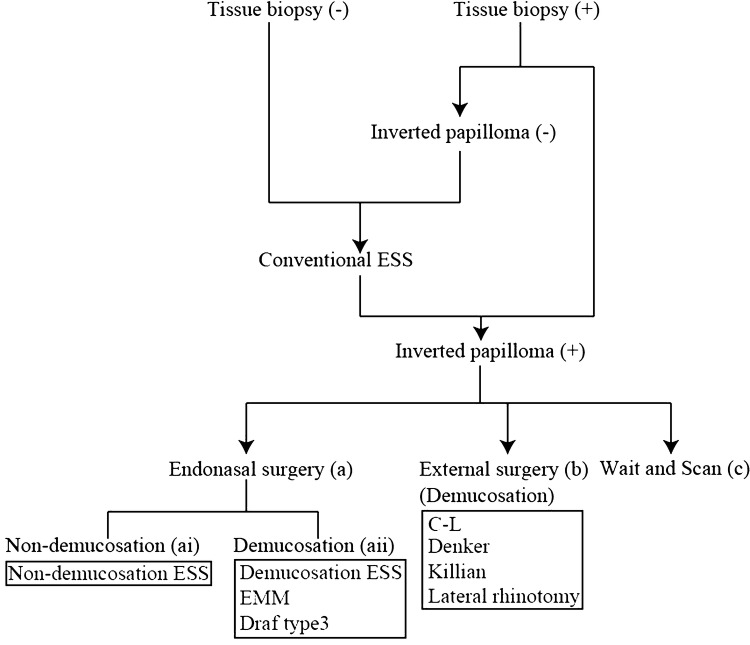
To compare the outcomes of various surgical approaches to resect sinonasal inverted papilloma and to discuss their advantages and disadvantages. A retrospective chart review of 61 consecutive patients with sinonasal inverted papilloma was performed. Surgical treatment included non-demucosation endoscopic sinus surgery (ESS), demucosation ESS, endonasal medial maxillectomy (EMM), Draf type 3, Caldwell-Luc surgery, Denker, Killian, and lateral rhinotomy. Recurrence rates were compared between endonasal and external approaches and between demucosation and non-demucosation. After the first curative surgery, the non-demucosation ESS, endonasal demucosation (demucosation ESS, EMM, and Draf type 3), and external surgery showed recurrence rates of 61.5%, (8/13), 0.0% (0/21), and 7.4% (2/27), respectively. A significantly lower recurrence rate was observed in the endonasal demucosation (p < 0.001) and in the demucosation ESS group (p < 0.001) in comparison with the non-demucosation ESS. However, as for recurrence rate, no statistically significant difference was observed between endonasal surgery and external surgery (p = 0.162). Demucosation is a better strategy for the treatment of inverted papilloma than is non-demucosation. Demucosation is the key procedure for preventing recurrence.
Keywords: Endonasal approach; External approach; Inverted papilloma; Krouse staging.
© Association of Otolaryngologists of India 2019.
Conflict of interest statement
Conflict of interestMasafumi Ohki and Shigeru Kikuchi declare that they have no conflict of interest.
Figures

References
LinkOut - more resources
Full Text Sources