


Difficult Intraoperative Heparinization Following Andexanet Alfa Administration
- PMID: 31763596
- PMCID: PMC6861054
- DOI: 10.5811/cpcem.2019.9.43650
Difficult Intraoperative Heparinization Following Andexanet Alfa Administration
Abstract
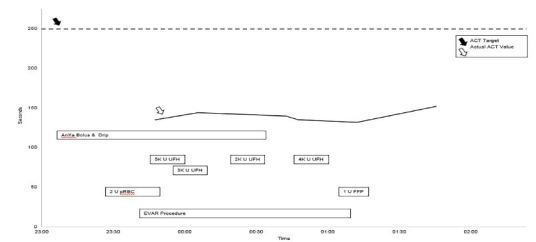
Direct oral anticoagulants are now commonplace, and reversal agents are recently becoming available. Andexanet alfa (AnXa), approved by the United States Food and Drug Administration in 2018, is a novel decoy molecule that reverses factor Xa inhibitors in patients with major hemorrhage. We present a case of a 70-year-old man taking rivaroxaban with hemodynamic instability from a ruptured abdominal aortic aneurysm. He received AnXa prior to endovascular surgery, and intraoperatively he could not be heparinized for graft placement. Consideration should be given to the risks and benefits of AnXa administration in patients who require anticoagulation after hemorrhage has been controlled.
Copyright: © 2019 Watson et al.
Conflict of interest statement
Conflicts of Interest: By the CPC-EM article submission agreement, all authors are required to disclose all affiliations, funding sources and financial or management relationships that could be perceived as potential sources of bias. The authors disclosed none.
Figures
References
-
- Granger CB, Alexander JH, McMurray JJV, et al. Apixaban versus warfarin in patients with atrial fibrillation. N Engl J Med. 2011;365(11):981–92. - PubMed
-
- Patel MR, Mahaffey KW, Garg J, et al. Rivaroxaban versus warfarin in nonvalvular atrial fibrillation. N Engl J Med. 2011;365(10):883–91. - PubMed
-
- The EINSTEIN–PE Investigators. Oral rivaroxaban for the treatment of symptomatic pulmonary embolism. N Engl J Med. 2012;366(14):1287–97. - PubMed
-
- Agnelli G, Buller HR, Cohen A, et al. Apixaban for extended treatment of venous thromboembolism. N Engl J Med. 2013;368(8):699–708. - PubMed