


Animal-assisted therapy for dementia
- PMID: 31763689
- PMCID: PMC6953240
- DOI: 10.1002/14651858.CD013243.pub2
Animal-assisted therapy for dementia
Abstract
Background: Dementia is a chronic condition which progressively affects memory and other cognitive functions, social behaviour, and ability to carry out daily activities. To date, no treatment is clearly effective in preventing progression of the disease, and most treatments are symptomatic, often aiming to improve people's psychological symptoms or behaviours which are challenging for carers. A range of new therapeutic strategies has been evaluated in research, and the use of trained animals in therapy sessions, termed animal-assisted therapy (AAT), is receiving increasing attention.
Objectives: To evaluate the efficacy and safety of animal-assisted therapy for people with dementia.
Search methods: We searched ALOIS: the Cochrane Dementia and Cognitive Improvement Group's Specialised Register on 5 September 2019. ALOIS contains records of clinical trials identified from monthly searches of major healthcare databases, trial registries, and grey literature sources. We also searched MEDLINE (OvidSP), Embase (OvidSP), PsycINFO (OvidSP), CINAHL (EBSCOhost), ISI Web of Science, ClinicalTrials.gov, and the WHO's trial registry portal.
Selection criteria: We included randomised controlled trials (RCTs), cluster-randomised trials, and randomised cross-over trials that compared AAT versus no AAT, AAT using live animals versus alternatives such as robots or toys, or AAT versus any other active intervention.
Data collection and analysis: We extracted data using the standard methods of Cochrane Dementia. Two review authors independently assessed the eligibility and risk of bias of the retrieved records. We expressed our results using mean difference (MD), standardised mean difference (SMD), and risk ratio (RR) with their 95% confidence intervals (CIs) where appropriate.
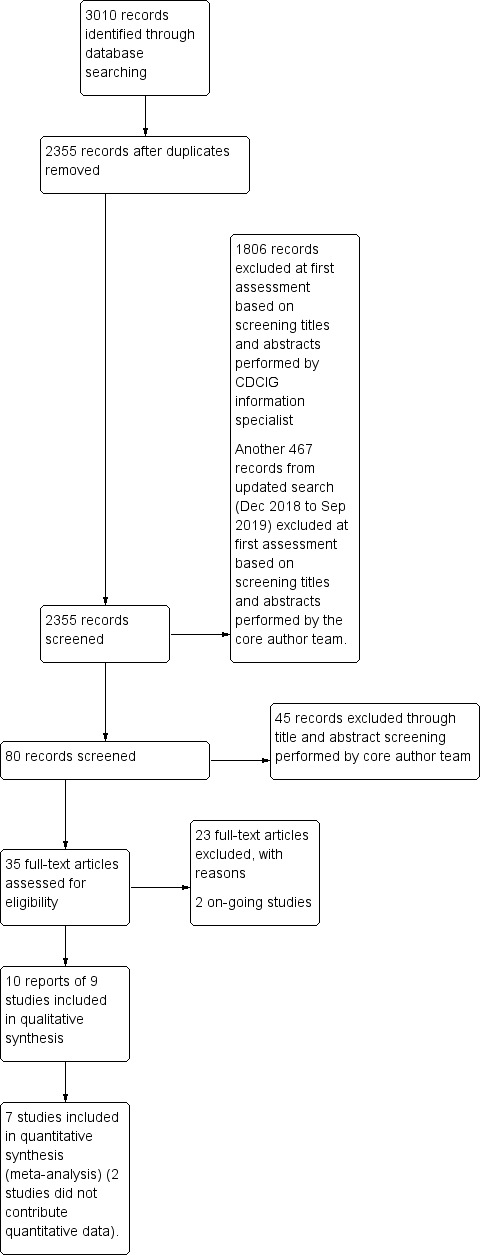
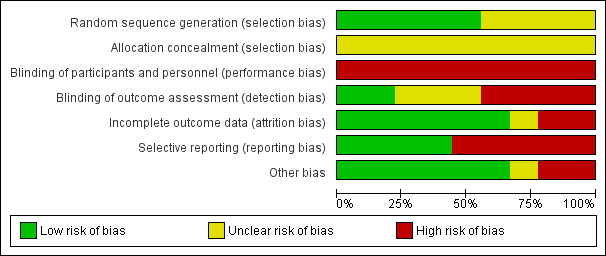
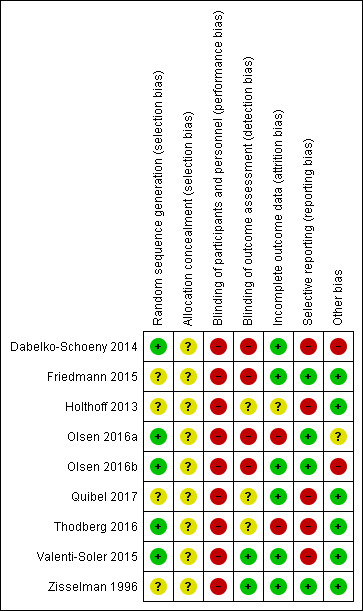
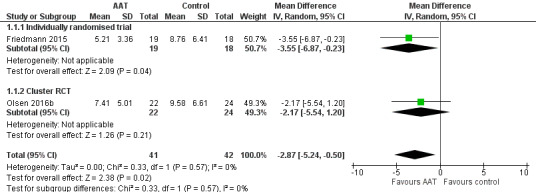
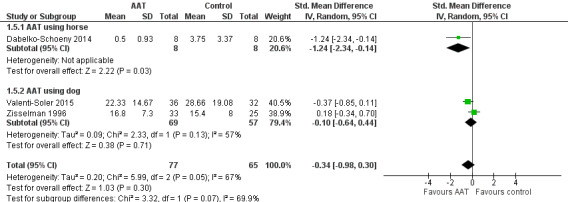
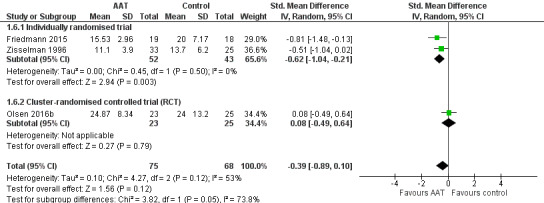
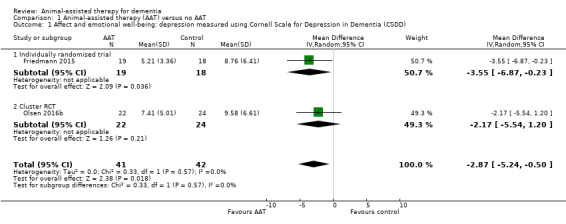
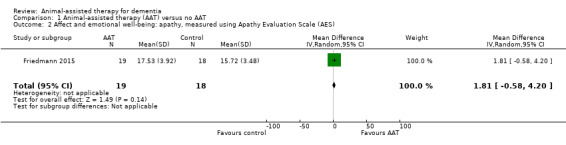
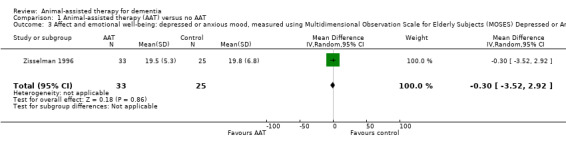
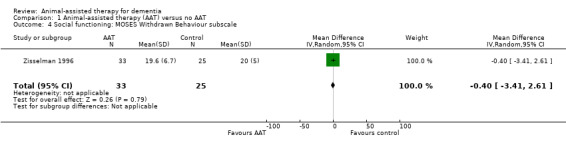
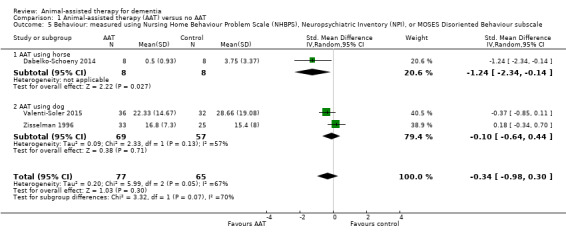
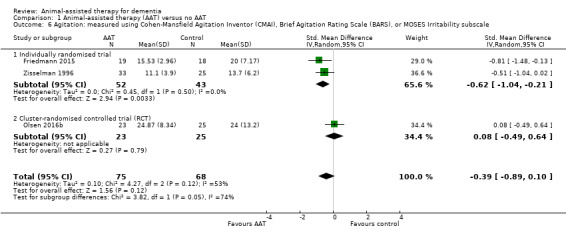
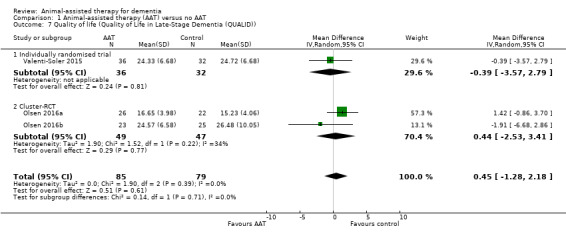
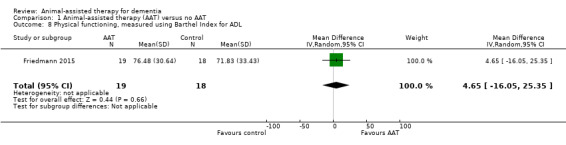
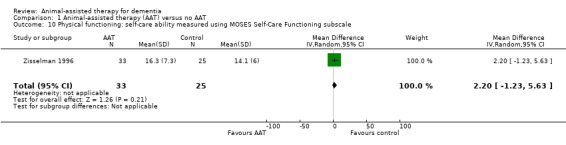
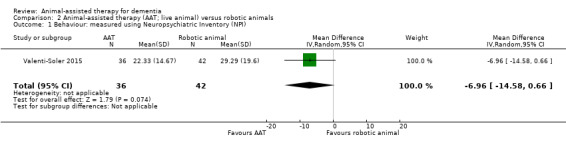
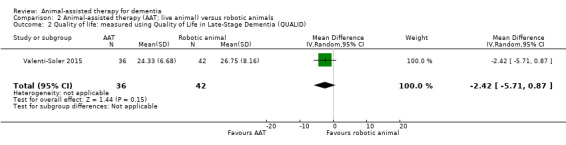
Main results: We included nine RCTs from 10 reports. All nine studies were conducted in Europe and the US. Six studies were parallel-group, individually randomised RCTs; one was a randomised cross-over trial; and two were cluster-RCTs that were possibly related where randomisation took place at the level of the day care and nursing home. We identified two ongoing trials from trial registries. There were three comparisons: AAT versus no AAT (standard care or various non-animal-related activities), AAT using live animals versus robotic animals, and AAT using live animals versus the use of a soft animal toy. The studies evaluated 305 participants with dementia. One study used horses and the remainder used dogs as the therapy animal. The duration of the intervention ranged from six weeks to six months, and the therapy sessions lasted between 10 and 90 minutes each, with a frequency ranging from one session every two weeks to two sessions per week. There was a wide variety of instruments used to measure the outcomes. All studies were at high risk of performance bias and unclear risk of selection bias. Our certainty about the results for all major outcomes was very low to moderate. Comparing AAT versus no AAT, participants who received AAT may be slightly less depressed after the intervention (MD -2.87, 95% CI -5.24 to -0.50; 2 studies, 83 participants; low-certainty evidence), but they did not appear to have improved quality of life (MD 0.45, 95% CI -1.28 to 2.18; 3 studies, 164 participants; moderate-certainty evidence). There were no clear differences in all other major outcomes, including social functioning (MD -0.40, 95% CI -3.41 to 2.61; 1 study, 58 participants; low-certainty evidence), problematic behaviour (SMD -0.34, 95% CI -0.98 to 0.30; 3 studies, 142 participants; very-low-certainty evidence), agitation (SMD -0.39, 95% CI -0.89 to 0.10; 3 studies, 143 participants; very-low-certainty evidence), activities of daily living (MD 4.65, 95% CI -16.05 to 25.35; 1 study, 37 participants; low-certainty evidence), and self-care ability (MD 2.20, 95% CI -1.23 to 5.63; 1 study, 58 participants; low-certainty evidence). There were no data on adverse events. Comparing AAT using live animals versus robotic animals, one study (68 participants) found mixed effects on social function, with longer duration of physical contact but shorter duration of talking in participants who received AAT using live animals versus robotic animals (median: 93 seconds with live versus 28 seconds with robotic for physical contact; 164 seconds with live versus 206 seconds with robotic for talk directed at a person; 263 seconds with live versus 307 seconds with robotic for talk in total). Another study showed no clear differences between groups in behaviour measured using the Neuropsychiatric Inventory (MD -6.96, 95% CI -14.58 to 0.66; 78 participants; low-certainty evidence) or quality of life (MD -2.42, 95% CI -5.71 to 0.87; 78 participants; low-certainty evidence). There were no data on the other outcomes. Comparing AAT using live animals versus a soft toy cat, one study (64 participants) evaluated only social functioning, in the form of duration of contact and talking. The data were expressed as median and interquartile ranges. Duration of contact was slightly longer in participants in the AAT group and duration of talking slightly longer in those exposed to the toy cat. This was low-certainty evidence.
Authors' conclusions: We found low-certainty evidence that AAT may slightly reduce depressive symptoms in people with dementia. We found no clear evidence that AAT affects other outcomes in this population, with our certainty in the evidence ranging from very-low to moderate depending on the outcome. We found no evidence on safety or effects on the animals. Therefore, clear conclusions cannot yet be drawn about the overall benefits and risks of AAT in people with dementia. Further well-conducted RCTs are needed to improve the certainty of the evidence. In view of the difficulty in achieving blinding of participants and personnel in such trials, future RCTs should work on blinding outcome assessors, document allocation methods clearly, and include major patient-important outcomes such as affect, emotional and social functioning, quality of life, adverse events, and outcomes for animals.
Copyright © 2019 The Cochrane Collaboration. Published by John Wiley & Sons, Ltd.
Conflict of interest statement
NML: none.
SMWC: none.
SSN: none.
SLT: none.
NC: none.
FS: none.
Figures
Update of
References
References to studies included in this review
Dabelko‐Schoeny 2014 {published data only}
-
- Dabelko‐Schoeny H, Phillips G, Darrough E, DeAnna S, Jarden M, Johnson D, et al. Equine‐assisted intervention for people with dementia. Anthrozoos 2014;27(1):141‐55.
Friedmann 2015 {published data only}
-
- Friedmann E, Galik E, Thomas SA, Hall PS, Chung SY, McCune S. Evaluation of a pet‐assisted living intervention for improving functional status in assisted living residents with mild to moderate cognitive impairment: a pilot study. American Journal of Alzheimer's Disease and Other Dementias 2015;30(3):276‐89. [PUBMED: 25118333] - PMC - PubMed
Holthoff 2013 {published data only}
-
- Holthoff V, Beckmann A, Gerner A, Wesenberg S, Werner J, Marschner K, et al. Dog‐assisted therapy for people with dementia: a randomized, controlled trial. Alzheimer's & Dementia 2013;9(4):P297.
Olsen 2016a {published data only}
-
- NCT02008630. Animal‐assisted interventions in health promotion for elderly with dementia. clinicaltrials.gov/show/nct02008630 (first received 11 December 2013). [NCT02008630]
-
- Olsen C, Pedersen I, Bergland A, Enders‐Slegers MJ, Ihlebaek C. Effect of animal‐assisted activity on balance and quality of life in home‐dwelling persons with dementia. Geriatric Nursing 2016;37(4):284‐91. [PUBMED: 27155968] - PubMed
Olsen 2016b {published data only}
-
- NCT01998490. Animal‐assisted or robot‐assisted interventions in health promotion for elderly with dementia. clinicaltrials.gov/show/nct01998490 (first received 29 November 2013). [NCT01998490]
-
- Olsen C, Pedersen I, Bergland A, Enders‐Slegers MJ, Patil G, Ihlebaek C. Effect of animal‐assisted interventions on depression, agitation and quality of life in nursing home residents suffering from cognitive impairment or dementia: a cluster randomized controlled trial. International Journal of Geriatric Psychiatry 2016;31(12):1312‐21. [PUBMED: 26807956] - PubMed
Quibel 2017 {published data only}
-
- Quibel C, Bonin M, Bonnet M, Gaimard M, Mourey F, Moesch I, et al. Evaluation of the animal‐assisted therapy in Alzheimer's disease [Evaluation de l'effet therapeutique de la mediation animale dans la maladie d'Alzheimer]. Soins Gerontologie 2017;22(125):35‐8. [PUBMED: 28533045] - PubMed
Thodberg 2016 {published data only}
-
- Thodberg K, Sorensen LU, Videbech PB, Poulsen PH, Houbak B, Damgaard V, et al. Behavioral responses of nursing home residents to visits from a person with a dog, a robot seal or a toy cat. Anthrozoos 2016;29(1):107‐21.
Valenti‐Soler 2015 {published data only}
Zisselman 1996 {published data only}
-
- Zisselman MH, Rovner BW, Shmuely Y, Ferrie P. A pet therapy intervention with geriatric psychiatry inpatients. American Journal of Occupational Therapy 1996;50(1):47‐51. [PUBMED: 8644836] - PubMed
References to studies excluded from this review
ACTRN12609000564257 {published data only}
-
- ACTRN12609000564257. Personalised, one‐to‐one interaction using Montessori‐type activities as a treatment of challenging behaviours in people with dementia: a pilot controlled trial. anzctr.org.au/Trial/Registration/TrialReview.aspx?id=308163 (first received 9 July 2009). [ACTRN12609000564257]
Antonelli 2012 {published data only}
-
- Antonelli E, Cusinato E. Animal‐assisted activities: effects on subjective well‐being of elderly women attending a day care service. Giornale di Gerontologia 2012;60(4):215‐23.
Boehmer 2016 {published data only}
-
- Boehmer EE. Effect of a residential dog on quality of life and loneliness in veterans living at the North Florida/South Georgia VAMC, Community Living Center Lake City Division; CAPC National Seminar; 2016 Oct 26‐29; Orlando (US);A24‐A25. 2016.
Borges 2019 {published data only}
-
- Borges de Araujo T, Martins WR, Freitas MP, Camargos E, Mota J, Safons MP. An exploration of equine‐assisted therapy to improve balance, functional capacity, and cognition in older adults with Alzheimer disease. Journal of Geriatric Physical Therapy (2001) 2019;42(3):E155‐60. - PubMed
Cesari 2014 {published data only}
Churchill 1999 {published data only}
-
- Churchill M, Safaoui J, McCabe BW, Baun MM. Using a therapy dog to alleviate the agitation and desocialization of people with Alzheimer's disease. Journal of Psychosocial Nursing and Mental Health Services 1999;37(4):16‐22. [PUBMED: 10218187] - PubMed
Colombo 2006 {published data only}
-
- Colombo G, Buono MD, Smania K, Raviola R, Leo D. Pet therapy and institutionalized elderly: a study on 144 cognitively unimpaired subjects. Archives of Gerontology and Geriatrics 2006;42(2):207‐16. [PUBMED: 16191447] - PubMed
Farid 2019 {published data only}
-
- Farid A. Review of animal assisted therapy with visiting dogs in dementia. Age and Ageing 2019;48 (Suppl 1):i32.
Gocheva 2018 {published data only}
-
- Gocheva V, Hund‐Georgiadis M, Hediger K. Effects of animal‐assisted therapy on concentration and attention span in patients with acquired brain injury: a randomized controlled trial. Neuropsychology 2018;32(1):54‐64. [PUBMED: 29035068] - PubMed
Hu 2018b {published data only}
-
- Hu M, Zhang P, Leng M, Li C, Chen L. Animal‐assisted intervention for individuals with cognitive impairment: a meta‐analysis of randomized controlled trials and quasi‐randomized controlled trials. Psychiatry Research 2018;260:418‐27. - PubMed
ISRCTN31919196 {published data only}
-
- ISRCTN31919196. Protected Engagement Time (PET) for people with dementia. www.isrctn.com/ISRCTN31919196 (first received 16 October 2013). [ISRCTN31919196]
Kanamori 2001 {published data only}
Ko 2016 {published data only}
-
- Ko HJ, Youn CH, Kim SH, Kim SY. Effect of pet insects on the psychological health of community‐dwelling elderly people: a single‐blinded, randomized, controlled trial. Gerontology 2016;62(2):200‐9. [PUBMED: 26383099] - PubMed
Majic 2013 {published data only}
-
- Majic T, Gutzmann H, Heinz A, Lang UE, Rapp MA. Animal‐assisted therapy and agitation and depression in nursing home residents with dementia: a matched case‐control trial. American Journal of Geriatric Psychiatry 2013;21(11):1052‐9. [PUBMED: 23831177] - PubMed
Menna 2016 {published data only}
-
- Menna LF, Santaniello A, Gerardi F, Maggio A, Milan G. Evaluation of the efficacy of animal‐assisted therapy based on the reality orientation therapy protocol in Alzheimer's disease patients: a pilot study. Psychogeriatrics 2016;16(4):240‐6. [PUBMED: 26370064] - PubMed
Moretti 2011 {published data only}
-
- Moretti F, Bernabei V, Marchetti L, Bonafede R, Forlani C, Ronchi D, et al. P01‐364 – a pet therapy intervention on elderly inpatients: an epidemiological study. 18th European Congress of Psychiatry; 2010 Feb 27‐Mar 2; Munich (Germany);577. 2010.
-
- Moretti F, Ronchi D, Bernabei V, Marchetti L, Ferrari B, Forlani C, et al. Pet therapy in elderly patients with mental illness. Psychogeriatrics 2011;11(2):125‐9. [PUBMED: 21707862] - PubMed
Nordgren 2014 {published data only}
-
- Nordgren L, Engstrom G. Effects of dog‐assisted intervention on behavioural and psychological symptoms of dementia. Nursing Older People 2014;26(3):31‐8. [PUBMED: 24673326] - PubMed
NTR5026 {published data only}
-
- NTR5026. The ABIDE‐PET study. www.trialregister.nl/trial/4924 (first received 5 January 2015).
Peluso 2018 {published data only}
-
- Peluso S, Rosa A, Lucia N, Antenora A, Illario M, Esposito M, et al. Animal‐assisted therapy in elderly patients: evidence and controversies in dementia and psychiatric disorders and future perspectives in other neurological diseases. Journal of Geriatric Psychiatry and Neurology 2018;31(3):149‐57. - PubMed
Richeson 2003 {published data only}
Scanes 2018 {published data only}
-
- Scanes Colin G. Chapter 10 – animals in entertainment. In: Scanes CG, Toukhsati SR editor(s). Animals and Human Society. Cambridge (MA): Academic Press, 2018:225‐55.
Spattini 2018 {published data only}
-
- Spattini L, Mattei G, Raisi F, Ferrari S, Pingani L, Galeazzi GM. Efficacy of animal assisted therapy on people with mental disorders: an update on the evidence. Minerva Psichiatrica 2018;59(1):54‐66.
References to ongoing studies
ISRCTN93568533 {published data only}
-
- ISRCTN93568533. A study into the effects of activities with animals on the well‐being of Dutch nursing home patients with dementia. www.isrctn.com/ISRCTN93568533 (first received 23 August 2017). [ISRCTN93568533]
NCT02829801 {published data only}
-
- NCT02829801. Evaluation of the animal intervention used as therapy. clinicaltrials.gov/show/nct02829801. Clinicaltrial.gov.org, (first received 12 July 2016). [ NCT02829801]
Additional references
Alexopoulos 1988
-
- Alexopoulos GS, Abrams RC, Young RC, Shamoian CA. Cornell scale for depression in dementia. Biological Psychiatry 1988;23(3):271‐84. [PUBMED: 3337862] - PubMed
ALZ 2018
-
- Alzheimer's Association. Alzheimer's and dementia: types of Alzheimer's. 2018. alz.org/ (accessed 18 January 2018).
APA 2013
-
- American Psychiatric Association. Diagnostic and Statistical Manual of Mental Disorders. 5th Edition. Washington (DC): American Psychiatric Publishing, 2013.
AVMA 2018
-
- American Veterinary Medical Association. Animal‐assisted interventions: guidelines. 2018. AVMA.org (accessed 18 January 2018).
Banks 2002
-
- Banks MR, Banks WA. The effects of animal‐assisted therapy on loneliness in an elderly population in long‐term care facilities. Journal of Gerontology 2002;57A(7):M428‐32. - PubMed
Behling 2011
-
- Behling RJ, Haefner J, Stowe M. Animal programs and animal assisted therapy in Illinois long‐term care facilities twenty years later (1990–2010). Academy of Health Care Management Journal 2011;7(2):109‐17.
Berget 2011
-
- Berget B, Braastad BO. Animal‐assisted therapy with farm animals for persons with psychiatric disorders. Annali dell'Istituto Superiore di Sanità 2011;47(4):384‐90. - PubMed
Bråne 2001
-
- Bråne G, Gottfries CG, Winblad B. The Gottfries‐Bråne‐Steen scale: validity, reliability and application in anti‐dementia drug trials. Dementia and Geriatric Cognitive Disorders 2001;12(1):1‐14. - PubMed
Campbell 2001
-
- Campbell MK, Mollison J, Grimshaw JM. Cluster trials in implementation research: estimation of intracluster correlation coefficients and sample size. Statistics in Medicine 2001;20(3):391‐9. - PubMed
Chau 2016
-
- Chau SA, Liu CS, Ruthirakuhan M, Lanctôt KL, Herrmann N. Pharmacotherapy of dementia. In: Chiu H, Shulman K editor(s). Mental Health and Illness of the Elderly. Singapore: Springer, 2016. [DOI: 10.1007/978-981-10-0370-7_20-1] - DOI
CIDG 2016
-
- Cochrane Infectious Diseases Group. Developing logic models: an introduction to using logic models in CIDG reviews. September 2016. cidg.cochrane.org/sites/cidg.cochrane.org/files/public/uploads/cidg_logi... (accessed 1 March 2018).
Cohen‐Mansfield 1989
-
- Cohen‐Mansfield J, Marx MS, Rosenthal AS. A description of agitation in a nursing home. Journal of Gerontology 1989;44(3):M77‐84. [PUBMED: 2715584] - PubMed
Cummings 1994
-
- Cummings JL, Mega M, Gray K, Rosenberg‐Thompson S, Carusi DA, Gornbein J. The Neuropsychiatric Inventory: comprehensive assessment of psychopathology in dementia. Neurology 1994;44(12):2308‐14. - PubMed
Darrah 1996
-
- Darrah JP. A pilot survey of animal‐facilitated therapy in Southern California and South Dakota nursing homes. Occupational Therapy International 1996;3(2):105‐21. [DOI: 10.1002/oti.31] - DOI
de Jong Gierveld 2006
-
- Jong Gierveld J, Tilburg T. A 6‐item scale for overall, emotional, and social loneliness: confirmatory tests on survey data. Research on Aging 2006;28(5):582‐98.
Downes 2013
-
- Downes MJ, Dean R, Bath‐Hextall FJ. Animal‐assisted therapy for people with serious mental illness. Cochrane Database of Systematic Reviews 2013, Issue 12. [DOI: 10.1002/14651858.CD010818] - DOI
Ebener 2017
-
- Ebener J, Oh H. A review of animal‐assisted interventions in long‐term care facilities. Activities, Adaptation & Aging 2017;41(2):107‐28.
Edwards 2002
Egger 1997
Ein 2018
-
- Ein N, Li L, Vickers K. The effect of pet therapy on the physiological and subjective stress response: a meta‐analysis. Stress Health 2018;34(4):477‐89. - PubMed
El Fadl 2004
-
- Fadl KA. Dogs in the Islamic tradition and nature. Encyclopedia of Religion and Nature. New York (NY): Continuum International, 2004.
Filan 2006
Folstein 1975
-
- Folstein MF, Folstein SE, McHugh PR. "Mini‐mental state". A practical method for grading the cognitive state of patients for the clinician. Journal of Psychiatric Research 1975;12(3):189‐98. - PubMed
Galasko 1997
-
- Galasko D, Bennett D, Sano M, Ernesto C, Thomas R, Grundman M, et al. An inventory to assess activities of daily living for clinical trials in Alzheimer's disease. The Alzheimer's Disease Cooperative Study. Alzheimer Disease and Associated Disorders 1977;11(Suppl 2):S33‐9. - PubMed
Glenk 2014
-
- Glenk LM, Kothgassner OD, Stetina BU, Palme R, Kepplinger B, Baran H. Salivary cortisol and behavior in therapy dogs during animal‐assisted interventions: a pilot study. Journal of Veterinary Behavior 2014;9(3):98‐106. [DOI: 10.1016/j.jveb.2014.02.005] - DOI
Glenk 2017
GRADEpro GDT 2015 [Computer program]
-
- McMaster University (developed by Evidence Prime). GRADEpro GDT. Version accessed 1 March 2018. Hamilton (ON): McMaster University (developed by Evidence Prime), 2015.
Hatch 2007
-
- Hatch A. The view from all fours: a look at an animal‐assisted activity program from the animals' perspective. Anthrozoos 2007;20(1):37‐50.
Helmes 1987
-
- Helmes E, Csapo KG, Short JA. Standardization and validation of the Multidimensional Observation Scale for Elderly Subjects (MOSES). Journal of Gerontology 1987;42(4):395‐405. [PUBMED: 3598087] - PubMed
Higgins 2011a
-
- Higgins JP, Green S, editor(s). Cochrane Handbook for Systematic Reviews of Interventions, Version 5.1.0 (updated March 2011). The Cochrane Collaboration, 2011. Available from handbook.cochrane.org.
Higgins 2011b
-
- Higgins JP, Altman DG, Sterne JA. Chapter 7: Selecting studies and collecting data. In: Higgins JP, Green S, editor(s). Cochrane Handbook for Systematic Reviews of Interventions Version 5.1.0 (updated March 2011). The Cochrane Collaboration, 2011. Available from handbook.cochrane.org.
Higgins 2011c
-
- Higgins JP, Deeks J, Altman DG. Chapter 16: Special topics in statistics. In: Higgins JP, Green S, editor(s). Cochrane Handbook for Systematic Reviews of Interventions Version 5.1.0 (updated March 2011). The Cochrane Collaboration, 2011. Available from handbook.cochrane.org.
Higgins 2011d
-
- Higgins JP, Altman DG, Sterne JA. Chapter 9: Analysing data and undertaking meta‐analysis. In: Higgins JP, Green S, editor(s). Cochrane Handbook for Systematic Reviews of Interventions Version 5.1.0 (updated March 2011). The Cochrane Collaboration, 2011. Available from handbook.cochrane.org.
Higgins 2011e
-
- Higgins JP, Altman DG, Sterne JA. Chapter 8: Assessing risk of bias in included studies. In: Higgins JP, Green S, editor(s). Cochrane Handbook for Systematic Reviews of Interventions Version 5.1.0 (updated March 2011). The Cochrane Collaboration, 2011. Available from handbook.cochrane.org.
Higgins 2011f
-
- Higgins JP, Altman DG, Sterne JA. Chapter 11: Presenting results and "Summary of findings" table. In: Higgins JP, Green S, editor(s). Cochrane Handbook for Systematic Reviews of Interventions Version 5.1.0 (updated March 2011). The Cochrane Collaboration, 2011. Available from handbook.cochrane.org.
Higgins 2019
-
- Higgins JP, Savovic J, Page MJ, Elbers RG, Sterne JA. Chapter 8: Assessing risk of bias in a randomised trial. In: Higgins JP, Thomas J, Chandler J, Cumpston M, Li T, Page MJ, et al (editor(s). Cochrane Handbook for Systematic Reviews of Interventions Version 6.0 (updated July 2019). Cochrane, 2019. Available from www.training.cochrane.org/handbook.
Hu 2018a
-
- Hu M, Zhang P, Leng M, Li C, Chen L. Animal‐assisted intervention for individuals with cognitive impairment: a meta‐analysis of randomized controlled trials and quasi‐randomized controlled trials. Psychiatry Research 2018;260:418‐27. - PubMed
IAHAIO 2014
-
- Jegatheesan B, Beetz A, Ormerod E, Johnson R, Fine A, Yamazaki K, et al. The IAHAIO definitions for animal‐assisted intervention and guidelines for wellness of animals involved. 2014. iahaio.org/wp/wp‐content/uploads/2017/05/iahaio‐white‐paper‐final‐nov‐24... (accessed 15 January 2018).
Jacobs 2013
-
- Jacobs CI. Animal‐assisted therapy and the child‐animal bond: children's well‐being and behavior. Research Papers 2013;427:opensiuc.lib.siu.edu/gs_rp/427.
Jelicic Kadic 2016
-
- Jelicic Kadic A, Vucic K, Dosenovic S, Sapunar D, Puljak L. Extracting data from figures with software was faster, with higher interrater reliability than manual extraction. Journal of Clinical Epidemiology 2016;74:119‐23. - PubMed
Kawamura 2007
-
- Kawamura N, Niiyama M, Niiyama H. Long‐term evaluation of animal‐assisted therapy for institutionalized elderly people: a preliminary result. Psychogeriatrics 2007;7(1):8‐13.
Kneale 2015
Lawton 1969
-
- Lawton MP, Brody EM. Assessment of older people: self‐maintaining and instrumental activities of daily living. Gerontologist 1969;9(3):179‐86. [PUBMED: 5349366] - PubMed
Lefebvre 2008
LeRoux 2009
-
- LeRoux MC, Kemp R. Effects of a companion dog on depression and anxiety levels of elderly residents in a long‐term care facility. Psychogeriatrics 2009;9(1):23‐6.
Levinson 1969
-
- Levinson BM. Pet‐Oriented Child Psychotherapy. 1st Edition. Michigan (MI): Thomas CC, 1969.
Lust 2007
Maber‐Aleksandrowicz 2016
-
- Maber‐Aleksandrowicz S, Avent C, Hassiotis A. A systematic review of animal‐assisted therapy on psychosocial outcomes in people with intellectual disability. Research in Developmental Disabilities 2016;49‐50:322‐38. - PubMed
Marino 2012
-
- Marino L. Construct validity of animal‐assisted therapy and activities: how important is the animal in AAT?. Anthrozoös 2012;25(Suppl 1):s139‐51. [DOI: 10.2752/175303712X13353430377219] - DOI
Maujean 2015
-
- Maujean A, Pepping CA, Kendall E. A systematic review of randomized controlled trials of animal‐assisted therapy on psychosocial outcomes. Anthrozoös 2015;28(1):23‐36.
McCulloch 1986
-
- McCulloch MJ. Animal‐facilitated therapy. Overview and future direction. National Forum 1986;66(1):19.
McKhann 2011
-
- McKhann GM, Knopman DS, Chertkow H, Hyman BT, Jack CR Jr, Kawas CH, et al. The diagnosis of dementia due to Alzheimer's disease: recommendations from the National Institute on Aging‐Alzheimer's Association workgroups on diagnostic guidelines for Alzheimer's disease. Alzheimer's & Dementia 2011;7(3):263‐9. - PMC - PubMed
Motomura 2004
-
- Motomura N, Yagi T, Ohyama H. Animal assisted therapy for people with dementia. Psychogeriatrics 2004;4(2):40‐2. [DOI: 10.1111/j.1479-8301.2004.00062.x] - DOI
NHS 2015
-
- National Health Service UK. Dementia guide: is there a cure for dementia? 17 June 2015. www.nhs.uk/conditions/dementia/cure/ (accessed 28 January 2018).
Nimer 2007
-
- Nimer J, Lundahl B. Animal‐assisted therapy: a meta‐analysis. Anthrozoös 2007;20(3):225‐38.
O'Bryant 2008
Ohtani 2015
-
- Ohtani N, Narita S, Yoshihara E, Ohta M, Iwahashi K. Psychological evaluation of animal‐assisted intervention (AAI) programs involving visiting dogs and cats for alcohol dependents: a pilot study. Nihon Arukoru Yakubutsu Igakkai Zasshi [Japanese Journal of Alcohol Studies & Drug Dependence] 2015;50(6):289‐95. [PUBMED: 26964290] - PubMed
Prince 2015
-
- Prince M, Wimo A, Guerchet M, Ali GC, Wu Y, Prina M. World Alzheimer Report 2015. The global impact of dementia: an analysis of prevalence, incidence, cost and trends. www.alz.co.uk/research/world‐report‐2015. London: Alzheimer’s Disease International;, (accessed 15 January 2018).
Review Manager 2014 [Computer program]
-
- Nordic Cochrane Centre, The Cochrane Collaboration. Review Manager 5 (RevMan 5). Version 5.3. Copenhagen: Nordic Cochrane Centre, The Cochrane Collaboration, 2014.
Román 1993
-
- Román GC, Tatemichi TK, Erkinjuntti T, Cummings JL, Masdeu JC, Garcia JH, et al. Vascular dementia: diagnostic criteria for research studies. Report of the NINDS‐AIREN International Workshop. Neurology 1993;43(2):250‐60. - PubMed
Rosen 1984
-
- Rosen WG, Mohs RC, Davis KL. A new rating Scale for Alzheimer’s disease. American Journal of Psychiatry 1984;141:1356‐64. - PubMed
Sakairi 2004
-
- Sakairi K. Research of robot‐assisted activity for the elderly with senile dementia in a group home. SICE 2004 Annual Conference; 2004 Aug 4‐6; Sapporo (Japan). 2005.
Schneider 1997
-
- Schneider LS, Olin JT, Doody RS, Clark CM, Morris JC, Reisberg B, et al. Validity and reliability of the Alzheimer's Disease Cooperative Study‐Clinical Global Impression of Change. The Alzheimer's Disease Cooperative Study. Alzheimer Disease and Associated Disorders 1997;11(Suppl 2):S22‐32. - PubMed
Schwarz 2012
Schünemann 2011
-
- Schünemann HJ, Oxman AJ, Vist GE, Higgins JP, Deeks JJ, Glasziou P, et al. Chapter 12: Interpreting results and drawing conclusions. In: Higgins JP, Green S, editor(s). Cochrane Handbook for Systematic Reviews of Interventions Version 5.1.0 (updated March 2011). The Cochrane Collaboration, 2011. Available from handbook.cochrane.org.
Sellers 2006
-
- Sellers DM. The evaluation of an animal assisted therapy intervention for elders with dementia in long‐term care. Activities, Adaptation & Aging 2006;30(1):61‐77. [DOI: 10.1300/J016v30n01_04] - DOI
Souter 2007
-
- Souter MA, Miller MD. Do animal‐assisted activities effectively treat depression? A meta‐analysis. Anthrozoös 2007;20(2):167‐80.
Stergiou 2017
-
- Stergiou A, Tzoufi M, Ntzani E, Varvarousis D, Beris A, Ploumis A. Therapeutic effects of horseback riding interventions: a systematic review and meta‐analysis. American Journal of Physical Medicine and Rehabilitation 2017;96(10):717‐25. - PubMed
Tamura 2004
Travers 2013
-
- Travers C, Perkins J, Rand J, Barlett H, Morton J. An evaluation of dog‐assisted therapy for residents of aged care facilities with dementia. Anthrozoös 2013;26(2):213‐25. [DOI: 10.2752/175303713X13636846944169] - DOI
Tripathi 2009
Tseng 2013
-
- Tseng SH, Chen HC, Tam KW. Systematic review and meta‐analysis of the effect of equine assisted activities and therapies on gross motor outcome in children with cerebral palsy. Disability and Rehabilitation 2013;35(2):89‐99. - PubMed
Vucic 2015
-
- Vucic K, Jelicic Kadic A, Puljak L. Survey of Cochrane protocols found methods for data extraction from figures not mentioned or unclear. Journal of Clinical Epidemiology 2015;68(10):1161‐4. - PubMed
Wada 2008
-
- Wada K, Shibata T, Musha T, Kimura S. Robot therapy for elders affected by dementia. IEEE Engineering in Medicine and Biology Magazine 2008;27(4):53‐60. [DOI: 10.1109/MEMB.2008.919496] - DOI
Waite 2018
-
- Waite TC, Hamilton L, O'Brien W. A meta‐analysis of animal assisted interventions targeting pain, anxiety and distress in medical settings. Complementary Therapies in Clinical Practice 2018;33:49‐55. - PubMed
Walsh 1995
-
- Walsh PG, Mertin PG, Verlander DF, Pollard CF. The effects of a 'pets as therapy' dog on persons with dementia in a psychiatric ward. Australian Occupational Therapy Journal 1995;42(4):161‐6. [DOI: 10.1111/j.1440-1630.1995.tb01331.x] - DOI
WHO 2015
-
- World Health Organization. The epidemiology and impact of dementia: current state and future trends. 2015. www.who.int/mental_health/neurology/dementia/dementia_thematicbrief_epid... (accessed 15 January 2018). [WHO/MSD/MER/15.3]
WHO 2016
-
- World Health Organisation. International Statistical Classification of Diseases and Related Health Problems 10th Revision (ICD‐10)‐WHO Version for 2016. https://icd.who.int/browse10/2016/en#/XX (accessed 19 November 2019).
WHO 2017a
-
- World Health Organization. Dementia. Factsheet updated December 2017. www.who.int/news‐room/fact‐sheets/detail/dementia. Geneva: World Health Organization, (accessed 18 January 2018).
WHO 2017b
-
- World Health Organization. Overview of the global situation. Global Action Plan on the Public Health Response to Dementia 2017–2025. Geneva: World Health Organization, 2017:2.
Yamauchi 2008
-
- Yamauchi T, Pipkin E. Six years experience with animal‐assisted therapy in a children's hospital: is there patient risk?. American Journal of Infection Control 2008;36(5):E117. [DOI: 10.1016/j.ajic.2008.04.132] - DOI
Yesavage 1982
-
- Yesavage JA, Brink TL, Rose TL, Lum O, Huang V, Adey M, et al. Development and validation of a geriatric depression screening scale: a preliminary report. Journal of Psychiatric Research 1982;17(1):37‐49. [PUBMED: 7183759] - PubMed
Zadnikar 2011
-
- Zadnikar M, Kastrin A. Effects of hippotherapy and therapeutic horseback riding on postural control or balance in children with cerebral palsy: a meta‐analysis. Developmental Medicine and Child Neurology 2011;53(8):684‐91. - PubMed
Publication types
MeSH terms
LinkOut - more resources
Full Text Sources
Medical
Research Materials
Miscellaneous
