


Cardiorespiratory Fitness, Physical Activity, and Insulin Resistance in Children
- PMID: 31764464
- PMCID: PMC7358077
- DOI: 10.1249/MSS.0000000000002216
Cardiorespiratory Fitness, Physical Activity, and Insulin Resistance in Children
Abstract
Purpose: Few studies have investigated the independent and joint associations of cardiorespiratory fitness (CRF) and body fat percentage (BF%) with insulin resistance in children. We investigated the independent and combined associations of CRF and BF% with fasting glycemia and insulin resistance and their interactions with physical activity (PA) and sedentary time among 452 children age 6 to 8 yr.
Methods: We assessed CRF with a maximal cycle ergometer exercise test and used allometrically scaled maximal power output (Wmax) for lean body mass (LM) and body mass (BM) as measures of CRF. The BF% and LM were measured by dual-energy X-ray absorptiometry, fasting glycemia by fasting plasma glucose, and insulin resistance by fasting serum insulin and Homeostatic Model Assessment for Insulin Resistance (HOMA-IR). The PA energy expenditure, moderate-to-vigorous PA (MVPA), and sedentary time were assessed by combined movement and heart rate sensor.
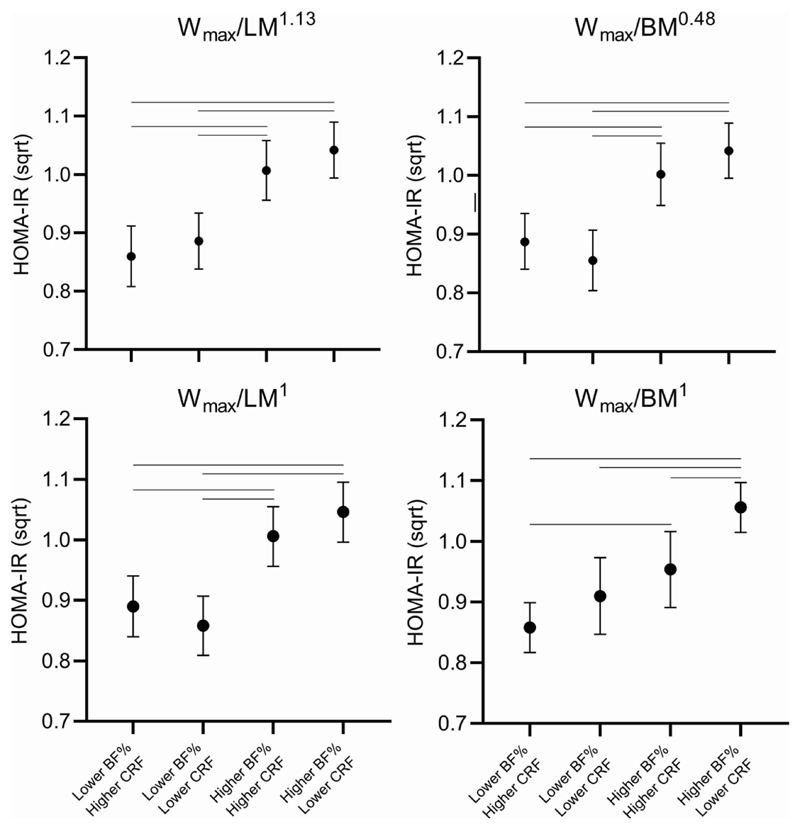
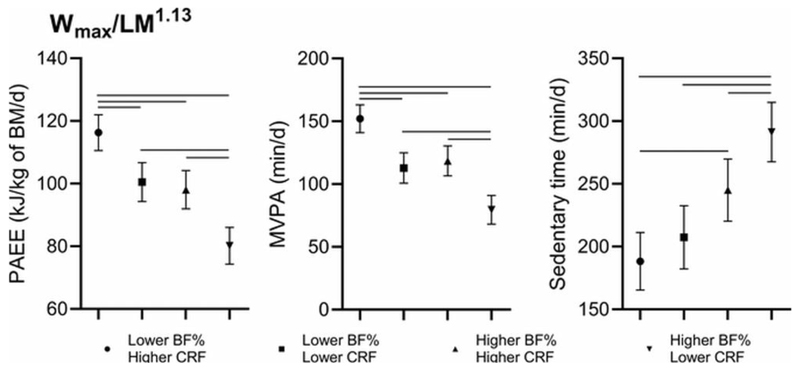
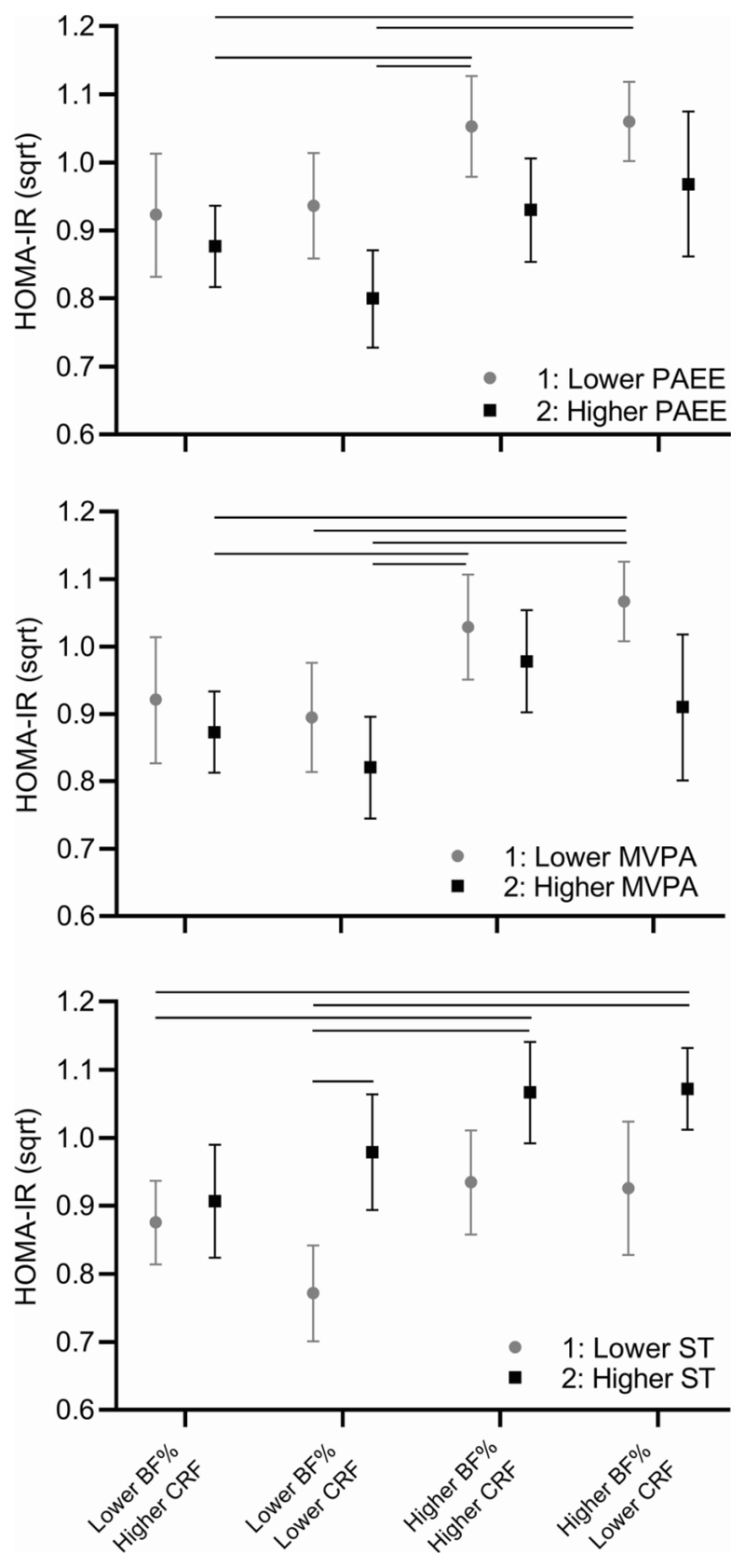
Results: Wmax/LM was not associated with glucose (β = 0.065, 95% confidence interval [CI] = -0.031 to 0.161), insulin (β = -0.079, 95% CI = -0.172 to 0.015), or HOMA-IR (β = -0.065, 95% CI = -0.161 to 0.030). Wmax/BM was inversely associated with insulin (β = -0.289, 95% CI = -0.377 to -0.200) and HOMA-IR (β = -0.269, 95% CI = -0.359 to -0.180). The BF% was directly associated with insulin (β = 0.409, 95% CI = 0.325 to 0.494) and HOMA-IR (β = 0.390, 95% CI = 0.304 to 0.475). Higher Wmax/BM, but not Wmax/LM, was associated with lower insulin and HOMA-IR in children with higher BF%. Children with higher BF% and who had lower levels of MVPA or higher levels of sedentary time had the highest insulin and HOMA-IR.
Conclusions: Children with higher BF% together with less MVPA or higher levels of sedentary time had the highest insulin and HOMA-IR. Cardiorespiratory fitness appropriately controlled for body size and composition using LM was not related to insulin resistance among children.
Conflict of interest statement
Authors declare no conflicts of interest,
The results of the present study do not constitute endorsement by ACSM.
Authors declare that the results of the study are presented clearly, honestly, and without fabrication, falsification, or inappropriate data manipulation.
Figures
Comment in
-
Best Practice Model for Pediatric Research.Med Sci Sports Exerc. 2021 Feb 1;53(2):453. doi: 10.1249/MSS.0000000000002484. Med Sci Sports Exerc. 2021. PMID: 33416272 No abstract available.
-
Response.Med Sci Sports Exerc. 2021 Feb 1;53(2):454. doi: 10.1249/MSS.0000000000002485. Med Sci Sports Exerc. 2021. PMID: 33416273 No abstract available.
References
-
- Reaven GM. Insulin Resistance: The Link Between Obesity and Cardiovascular Disease. Med Clin North Am. 2011;95(5):875–92. - PubMed
-
- Steinberger J, Daniels SR, Eckel RH, et al. Progress and challenges in metabolic syndrome in children and adolescents: a scientific statement from the American Heart Association Atherosclerosis, Hypertension, and Obesity in the Young Committee of the Council on Cardiovascular Disease in the Young. Circulation. 2009;119(4):628–47. - PubMed
Publication types
MeSH terms
Substances
Grants and funding
LinkOut - more resources
Full Text Sources
Medical
Miscellaneous
