Review
. 2020 May 1;37(5):634-652.
doi: 10.1039/c9np00053d. Epub 2019 Nov 25.

Targeting and extending the eukaryotic druggable genome with natural products: cytoskeletal targets of natural products

Affiliations
Review

Targeting and extending the eukaryotic druggable genome with natural products: cytoskeletal targets of natural products

April L Risinger et al. Nat Prod Rep. .

Abstract

Covering: 2014-2019We review recent progress on natural products that target cytoskeletal components, including microtubules, actin, intermediate filaments, and septins and highlight their demonstrated and potential utility in the treatment of human disease. The anticancer efficacy of microtubule targeted agents identified from plants, microbes, and marine organisms is well documented. We highlight new microtubule targeted agents currently in clinical evaluations for the treatment of drug resistant cancers and the accumulating evidence that the anticancer efficacy of these agents is not solely due to their antimitotic effects. Indeed, the effects of microtubule targeted agents on interphase microtubules are leading to their potential for more mechanistically guided use in cancers as well as neurological disease. The discussion of these agents as more targeted drugs also prompts a reevaluation of our thinking about natural products that target other components of the cytoskeleton. For instance, actin active natural products are largely considered chemical probes and non-selective toxins. However, studies utilizing these probes have uncovered aspects of actin biology that can be more specifically targeted to potentially treat cancer, neurological disorders, and infectious disease. Compounds that target intermediate filaments and septins are understudied, but their continued discovery and mechanistic evaluations have implications for numerous therapeutic indications.


Conflict of interest statement

Conflicts of interest

There are no conflicts to declare.

Figures
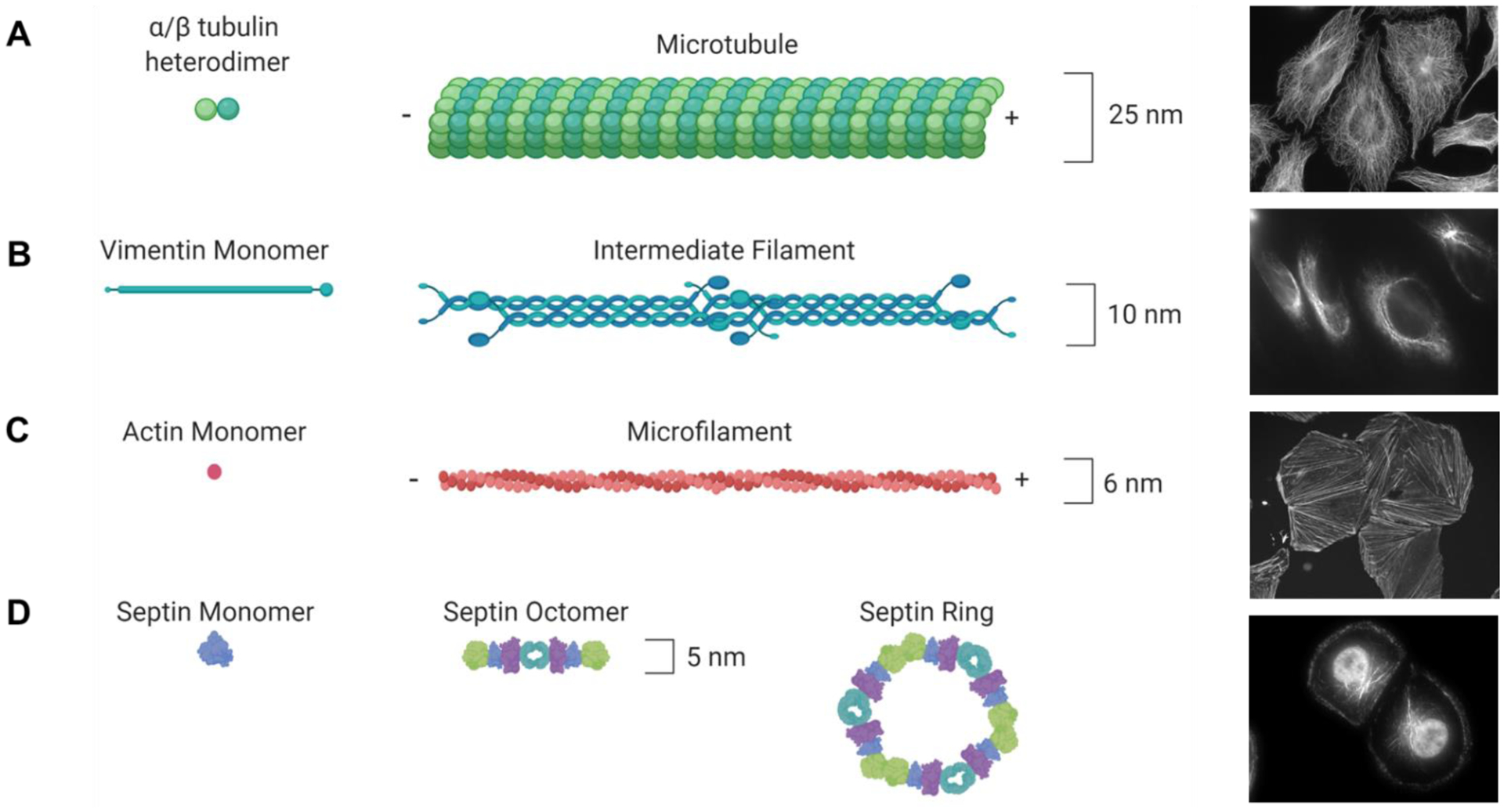
Figure 1.
Figure 1.
Schematic and actual representation of cytoskeletal proteins. (A) α/β-tubulin heterodimers are cotranslated to form the basic building blocks of the microtubule cytoskeleton. Cellular microtubule localization is visualized by β-tubulin immunofluorescence in HeLa cells. (B) Monomers of intermediate filament proteins, including vimentin, dimerize and then form head-to-tail tetramers that form intermediate filament structures. Cellular vimentin localization is visualized by immunofluorescence in MDA-MB-231 cells. (C) Actin monomers polymerize in a head-to-tail fashion to form microfilaments. Cellular F-actin localization is visualized by imaging TRITC-labeled phalloidin treated A10 cells. (D) Individual septin proteins come together to form linear and ringed cytoskeletal structures. Cellular localization of septin 9 is visualized by immunofluorescence in HCC1937 cells. Microtubule and microfilament structures have polarity depicted as + and − ends.
Figure 2.
Figure 2.
Binding sites of microtubule destabilizing agents. (A) Superimposition of the binding sites of colchicine (orange, PDB ID: 4O2B), maytansine (green, PDB ID: 4TV8), pironetin (pink, PDB ID: 5LA6), and vinblastine (purple, PDB ID: 1Z2B) on a single α/β tubulin heterodimer. (B) Superimposition of vinblastine (red, PDB ID: 1Z2B) and the peptide soblidotin (blue, PDB ID: 3E22) in their respective tubulin binding sites between two heterodimers, which together define the “vinca domain” (pink, α-tubulin; green, β-tubulin). GTP is depicted in purple.
Figure 3.
Figure 3.
Binding sites of microtubule stabilizing agents. (A) Superimposition of paclitaxel (green, PDB ID: 1JFF) and laulimalide (orange, PDB ID: 4O4H) in their respective binding sites on β-tubulin. (B) Superimposition of the binding sites of covalent microtubule stabilizers zampanolide (blue, PDB ID: 4I4T), cyclostreptin (gold, PDB ID: 6QTN), and taccalonolide AJ (green, PDB ID: 5EZY) in the taxane binding pocket on β-tubulin. (C) Individual views of the covalent binding linkages of zampanolide (blue), cyclostreptin (gold), and taccalonolide AJ (green) with β-tubulin.
Figure 4.
Figure 4.
Binding sites of actin active agents. (A) Superimposition of the actin destabilizers latrunculin (PDB ID: 1ESV) and kabiramide C (PDB ID: 1QZ5) on actin. (B) Cryo-EM structure of three phalloidin molecules (green, PDB ID: 6D8C), each bridging three actin monomers, to stabilize the actin microfilament structure.

References

    1. Shelanski ML and Taylor EW, J Cell Biol, 1967, 34, 549–554. - PMC - PubMed
    1. Ravelli RB, Gigant B, Curmi PA, Jourdain I, Lachkar S, Sobel A and Knossow M, Nature, 2004, 428, 198–202. - PubMed
    1. Schiff PB, Fant J and Horwitz SB, Nature, 1979, 277, 665–667. - PubMed
    1. Moudi M, Go R, Yien CY and Nazre M, Int J Prev Med, 2013, 4, 1231–1235. - PMC - PubMed
    1. Martino E, Casamassima G, Castiglione S, Cellupica E, Pantalone S, Papagni F, Rui M, Siciliano AM and Collina S, Bioorg Med Chem Lett, 2018, 28, 2816–2826. - PubMed

Publication types

MeSH terms