. 2019 Nov 13;8(4):222.
doi: 10.3390/antibiotics8040222.

First Report and Comparative Genomics Analysis of a blaOXA-244-Harboring Escherichia coli Isolate Recovered in the American Continent

Affiliations

First Report and Comparative Genomics Analysis of a blaOXA-244-Harboring Escherichia coli Isolate Recovered in the American Continent

Deisy Abril et al. Antibiotics (Basel). .

Abstract

The carbapenemase OXA-244 is a derivate of OXA-48, and its detection is very difficult in laboratories. Here, we report the identification and genomic analysis of an Escherichia coli isolate (28Eco12) harboring the blaOXA-244 gene identified in Colombia, South America. The 28Eco12 isolate was identified during a retrospective study, and it was recovered from a patient treated in Colombia. The complete nucleotide sequence was established using the PacBio platform. A comparative genomics analysis with other blaOXA-244-harboring Escherichia coli strains was performed. The 28Eco12 isolate belonged to sequence type (ST) 38, and its genome was composed of two molecules, a chromosome of 5,343,367 bp and a plasmid of 92,027 bp, which belonged to the incompatibility group IncY and did not harbor resistance genes. The blaOXA-244 gene was chromosomally encoded and mobilized by an ISR1-related Tn6237 composite transposon. Notably, this transposon was inserted and located within a new genomic island. To our knowledge, this is the first report of a blaOXA-244-harboring Escherichia coli isolate in America. Our results suggest that the introduction of the OXA-244-producing E. coli isolate was through clonal expansion of the ST38 pandemic clone. Other isolates producing OXA-244 could be circulating silently in America.

Keywords: Colombia; Escherichia coli; blaOXA-244; carbapenems; resistance.


Conflict of interest statement

The authors declare no conflict of interest.

Figures
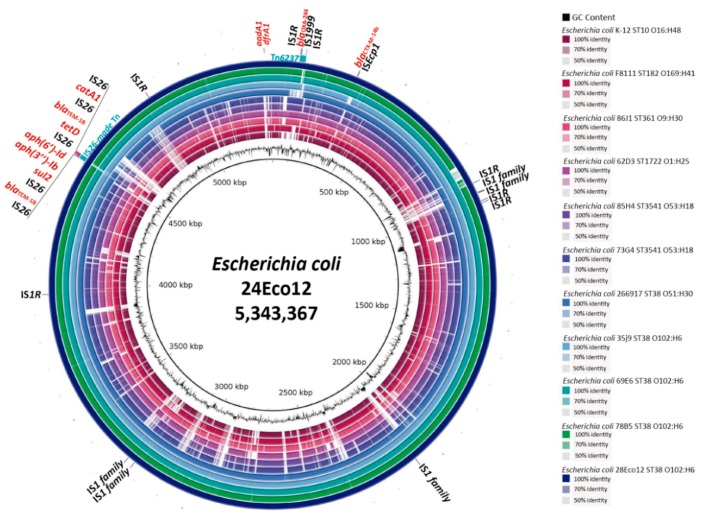
Figure 1
Figure 1
BLASTn comparison of the blaOXA-244-containing Escherichia coli chromosomes. The K-12 (GenBank accession number NC_000913), F8111-1SC3 (GenBank accession number NZ_CP024269), and 266917_2 (GenBank accession number NZ_CP026723.1) strains were used as references. At the more external circle is shown the localization of the resistance genes and their putative genetic platforms of mobilization. The positions of the seven identical ISR1 and five IS1-family (89% of identity) sequences are also indicated. The strain positions on the figure are as follow (internal to external) (sequence type/serotype): K12 (ST10/O16:H48), F8111-1SC3 (ST182/O169:H41), 86J1 (ST361/O9:H30) MKGU01, 62D3 (ST1722/O1:H25) MKGY01, 85H4 (ST3541/O53:H18) MKGW01, 73G4 (ST3541/O53:H18) MKGV01, 266917_2 (ST38/O51:H30), 35J9 (ST38/O102:H6) MKGX01, 69E6 (ST38/O102:H6) MKGZ01, 78B5 (ST38/O102:H6) MKGT01, and 28Eco12 (ST38/O102:H6) NZ_CP038505.
Figure 2
Figure 2
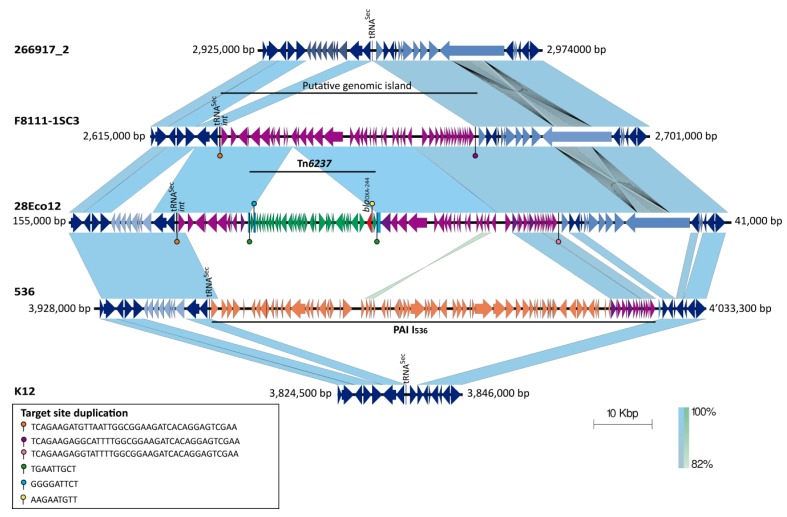
Comparison of the region where the blaOXA-244 gene was inserted within Escherichia coli 28Eco12 isolate. The red arrow corresponds to the blaOXA-244 gene. The mobile genetics elements are shown in different colors. The putative genomic island is shown in purple and its insertion within the tRNA-sec gene is indicated respect to the E. coli strain 266917_2 (GenBank accession number CP026723.1), F8111-1SC3 (GenBank accession number NZ_CP024269), 536-EC15 (GenBank accession number HG977710.1), and K-12 (GenBank accession number NC_000913). The blue rectangles correspond to the gene where the Tn6237 transposon was inserted (green arrows). The pallets represent the target-site duplications. The int gene that encodes the phage integrase protein is shown. Blue shading between pairs of sequences indicates >90% of identity in a window of 400 bp. The scale bar indicates sequence length.

References

    1. Tacconelli E., Carrara E., Savoldi A., Harbarth S., Mendelson M., Monnet D.L., Pulcini C., Kahlmeter G., Kluytmans J., Carmeli Y., et al. Discovery, research, and development of new antibiotics: The WHO priority list of antibiotic-resistant bacteria and tuberculosis. Lancet Infect. Dis. 2018;18:318–327. doi: 10.1016/S1473-3099(17)30753-3. - DOI - PubMed
    1. Oteo J., Hernandez J.M., Espasa M., Fleites A., Saez D., Bautista V., Perez-Vazquez M., Fernandez-Garcia M.D., Delgado-Iribarren A., Sanchez-Romero I., et al. Emergence of OXA-48-producing Klebsiella pneumoniae and the novel carbapenemases OXA-244 and OXA-245 in Spain. J. Antimicrob. Chemother. 2013;68:317–321. doi: 10.1093/jac/dks383. - DOI - PubMed
    1. Valenza G., Nickel S., Pfeifer Y., Eller C., Krupa E., Lehner-Reindl V., Holler C. Extended-spectrum-beta-lactamase-producing Escherichia coli as intestinal colonizers in the German community. Antimicrob. Agents Chemother. 2014;58:1228–1230. doi: 10.1128/AAC.01993-13. - DOI - PMC - PubMed
    1. Potron A., Poirel L., Dortet L., Nordmann P. Characterisation of OXA-244, a chromosomally-encoded OXA-48-like beta-lactamase from Escherichia coli. Int. J. Antimicrob. Agents. 2016;47:102–103. doi: 10.1016/j.ijantimicag.2015.10.015. - DOI - PubMed
    1. Hoyos-Mallecot Y., Naas T., Bonnin R.A., Patino R., Glaser P., Fortineau N., Dortet L. OXA-244-Producing Escherichia coli Isolates, a Challenge for Clinical Microbiology Laboratories. Antimicrob. Agents Chemother. 2017;61:e00818-17. doi: 10.1128/AAC.00818-17. - DOI - PMC - PubMed

LinkOut - more resources