Review
. 2019 Nov 13;9(11):735.
doi: 10.3390/biom9110735.

Role of Reactive Oxygen Species in Cancer Progression: Molecular Mechanisms and Recent Advancements

Affiliations
Review

Role of Reactive Oxygen Species in Cancer Progression: Molecular Mechanisms and Recent Advancements

Vaishali Aggarwal et al. Biomolecules. .

Abstract

Reactive oxygen species (ROS) play a pivotal role in biological processes and continuous ROS production in normal cells is controlled by the appropriate regulation between the silver lining of low and high ROS concentration mediated effects. Interestingly, ROS also dynamically influences the tumor microenvironment and is known to initiate cancer angiogenesis, metastasis, and survival at different concentrations. At moderate concentration, ROS activates the cancer cell survival signaling cascade involving mitogen-activated protein kinase/extracellular signal-regulated protein kinases 1/2 (MAPK/ERK1/2), p38, c-Jun N-terminal kinase (JNK), and phosphoinositide-3-kinase/ protein kinase B (PI3K/Akt), which in turn activate the nuclear factor kappa-light-chain-enhancer of activated B cells (NF-κB), matrix metalloproteinases (MMPs), and vascular endothelial growth factor (VEGF). At high concentrations, ROS can cause cancer cell apoptosis. Hence, it critically depends upon the ROS levels, to either augment tumorigenesis or lead to apoptosis. The major issue is targeting the dual actions of ROS effectively with respect to the concentration bias, which needs to be monitored carefully to impede tumor angiogenesis and metastasis for ROS to serve as potential therapeutic targets exogenously/endogenously. Overall, additional research is required to comprehend the potential of ROS as an effective anti-tumor modality and therapeutic target for treating malignancies.

Keywords: angiogenesis; inflammation; metastasis; miRNA; oxidative stress; reactive oxygen species (ROS).


Conflict of interest statement

The authors declare no conflict of interests.

Figures

Figure 1
Figure 1
Oxidative stress and production of reactive oxygen species. Intracellular ROS and environmental factors (exogenous ROS) initiates ROS production leading to oxidative stress which in turn leads to DNA/lipid/protein degradation resulting in apoptosis, autophagy, necrosis and production of pro-inflammatory cytokines.
Figure 2
Figure 2
Schematic illustration of mechanism of action of reactive oxygen species (ROS) leading to inflammation. ADAM17 (ADAM metallopeptidase domain 17); ASC (Activating signal co-integrator 1); BMP4 (Bone morphogenetic protein 4); IKB-α (Inhibitor of nuclear factor kappa B kinase regulatory subunit alpha); IKK (Inhibitor of nuclear factor kappa-B kinase); IP3R (Inositol 1,4,5-trisphosphate receptor type 3); JNK (c-Jun N-terminal kinase); LPC (Lysophosphatidylcholine); LPS (Lipopolysaccharide); NF-кB (Nuclear factor kappa subunit B); NLRP3 (NLR family pyrin domain containing 3); NOX (NADPH oxidase); OxPL (Oxidized phospholipids); PAR (Par family cell polarity regulator); PAK (p21 (RAC1) activated kinase); SOD (Superoxide dismutase); TLR4 (Toll like receptor 4); TNF-α (Tumor necrosis factor alpha); TNFR (TNF receptor superfamily); TNFR1 (TNF receptor superfamily 1); TXNIP (Thioredoxin interacting protein); Ub (Ubiquitin).
Figure 3
Figure 3
Reactive oxygen species and metastasis. High levels of reactive oxygen species leads to metastasis through the stimulation of phosphoinositide-3-kinase regulatory subunit/AKT serine/threonine kinases/mechanistic target of rapamycin kinase (PI3K/Akt/mTOR), and MAPK (Mitogen-activated protein kinases) signaling pathways which activates downstream SNAIL, MMP2 (metalloproteinase 2), and MMP9 (metalloproteinase 9) enzymes initiating epithelial-mesenchymal transition (EMT) leading to metastasis.
Figure 4
Figure 4
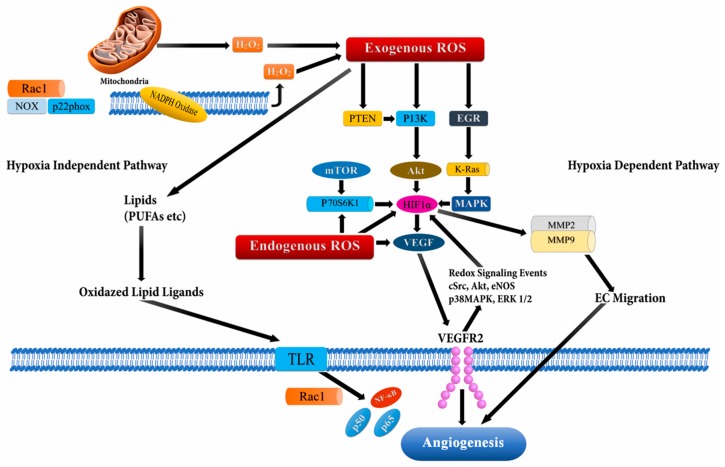
Angiogenesis activation through reactive oxygen species (ROS) via hypoxia dependent and hypoxia independent pathways. The hypoxia dependent pathway increases vascular endothelial growth factor (VEGF) expression via the phosphoinositide-3-kinase regulatory subunit/AKT serine/threonine kinases/mechanistic target of rapamycin kinase (PI3K/Akt/mTOR), PTEN (phosphatase and tensin homolog), and MAPK (Mitogen-activated protein kinases) signaling cascades via HIF-1α (Hypoxia-inducible factor1-alpha) and p70S6K1 (ribosomal protein S6 kinase B1), which release various cytokines, growth factors, and up-regulation of MMPs (matrix metalloproteinases) leading to angiogenesis. The hypoxia independent pathway leads to angiogenesis through oxidative lipid ligands which activates NF-кB (Nuclear factor kappa subunit B) via Toll-like receptors (TLRs).
Figure 5
Figure 5
Exogenously or endogenously produced reactive oxygen species (ROS) activates extrinsic and intrinsic apoptosis pathways. ROS modulated cell-signaling activation of MAPK (Mitogen-activated protein kinases), Bcl-2 (BCL2 Apoptosis Regulator), and Bax (BCL2 Associated X, Apoptosis Regulator) which activates the downstream caspase cascade, leading to apoptotic cell death.
Figure 6
Figure 6
Regulation of microRNA biogenesis through reactive oxygen species (ROS): Complex I/III in mitochondria leads to elevated superoxide anion (O2-) production. Superoxide dismutase (SOD) converts O2- to H2O2 (hydrogen peroxide), which is acted upon by glutathione peroxidase (GSHPx)/ catalase (CATs) and converted to H2O (water). H2O2 leads to Hydroxyl radicals (OH) production leading to DNA/RNA/lipid/protein degradation.

References

    1. The Lancet GLOBOCAN 2018: Counting the toll of cancer. Lancet. 2018;392 doi: 10.1016/S0140-6736(18)32252-9. - DOI - PubMed
    1. Saikolappan S., Kumar B., Shishodia G., Koul S., Koul H.K. Reactive oxygen species and cancer: A complex interaction. Cancer Lett. 2019;452:132–143. doi: 10.1016/j.canlet.2019.03.020. - DOI - PubMed
    1. Nourazarian A.R., Kangari P., Salmaninejad A. Roles of oxidative stress in the development and progression of breast cancer. Asian Pac. J. Cancer Prev. 2014;15:4745–4751. doi: 10.7314/APJCP.2014.15.12.4745. - DOI - PubMed
    1. Zhang J., Ahn K.S., Kim C., Shanmugam M.K., Siveen K.S., Arfuso F., Samym R.P., Deivasigamanim A., Lim L.H.K., Wang L., et al. Nimbolide-induced oxidative stress abrogates STAT3 signaling cascade and inhibits tumor growth in transgenic adenocarcinoma of mouse prostate model. Antioxid. Redox Signal. 2016;24:575–589. doi: 10.1089/ars.2015.6418. - DOI - PubMed
    1. Morgan M.J., Liu Z.-g. Crosstalk of reactive oxygen species and NF-κB signaling. Cell Res. 2011;21:103–115. doi: 10.1038/cr.2010.178. - DOI - PMC - PubMed