Review
. 2019 Nov 21;11(12):1834.
doi: 10.3390/cancers11121834.

Overcoming Ibrutinib Resistance in Chronic Lymphocytic Leukemia

Affiliations
Review

Overcoming Ibrutinib Resistance in Chronic Lymphocytic Leukemia

Bartosz Puła et al. Cancers (Basel). .

Abstract

Ibrutinib is the first Bruton's tyrosine kinase (BTK) inhibitor, which showed significant clinical activity in chronic lymphocytic leukemia (CLL) and small lymphocytic lymphoma (SLL) patients regardless of cytogenetic risk factors. Recent results of phase III clinical trials in treatment-naïve CLL patients shift the importance of the agent to frontline therapy. Nevertheless, beside its clinical efficacy, ibrutinib possesses some off-target activity resulting in ibrutinib-characteristic adverse events including bleeding diathesis and arrhythmias. Furthermore, acquired and primary resistance to the drug have been described. As the use of ibrutinib in clinical practice increases, the problem of resistance is becoming apparent, and new methods of overcoming this clinical problem arise. In this review, we summarize the mechanisms of BTK inhibitors' resistance and discuss the post-ibrutinib treatment options.

Keywords: Bruton’s tyrosine kinase; chronic lymphocytic leukemia; ibrutinib; resistance; treatment.


Conflict of interest statement

The authors declare no conflict of interest

Figures
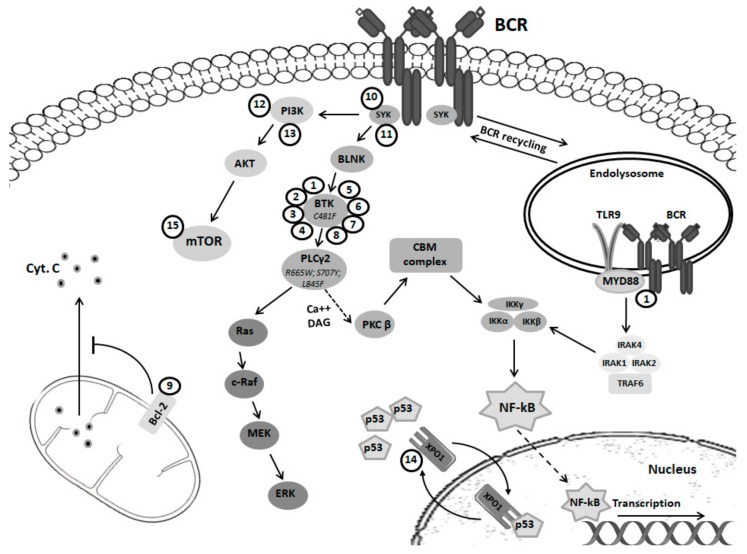
Figure 1
Figure 1
Overview of the B-cell receptor pathway. Shown are the B cell receptor (BCR) and signaling intermediates engaged in signal propagation following binding of the BCR to antigen. Numbers indicate inhibitors targeting particular components of the BCR signaling: (1) ibrutinib; (2) acalabrutinib; (3) zanabrutinib; (4) tirabrutinib; (5) GDC-0853; (6) vecabrutinib; (7) LOXO-305; (8) ARQ-531; (9) venetoclax; (10) entospletinib; (11) cerdulatinib; (12) duvelisib; (13) idelalisib; (14) selinexor; (15) CC-115. See main text for details. Bcl-2, B-cell lymphoma 2 protein; BLNK, B-cell linker protein; BTK, Bruton tyrosine kinase; CBM, CARD11–BCL-10–MALT1; Cyt.C, cytochrome C; DAG, diacylglycerol; ERK, extracellular signal–regulated kinase; IKK, inhibitor of NF-κB kinase; IRAKs, interleukin-1 receptor-associated kinases; MEK, mitogen-activated protein kinase; mTOR, mammalian target of rapamycin; MYD88, myeloid differentiation primary response 88; NF-κB, nuclear factor-κB; PI3K, phosphoinositide 3-kinase; PKCβ, protein kinase Cβ; PLCγ, phospholipase Cγ; SYK, spleen tyrosine kinase; TLR9, toll-like receptor 9; TRAF6, TNF receptor-associated factor 6; XPO1, exportin 1.

References

    1. Rawstron A.C., Bennett F.L., O’Connor S.J., Kwok M., Fenton J.A., Plummer M., de Tute R., Owen R.G., Richards S.J., Jack A.S., et al. Monoclonal B-cell lymphocytosis and chronic lymphocytic leukemia. N. Engl. J. Med. 2008;359:575–583. doi: 10.1056/NEJMoa075290. - DOI - PubMed
    1. Redaelli A., Laskin B.L., Stephens J.M., Botteman M.F., Pashos C.L. The clinical and epidemiological burden of chronic lymphocytic leukaemia. Eur. J. Cancer Care. 2004;13:279–287. doi: 10.1111/j.1365-2354.2004.00489.x. - DOI - PubMed
    1. Hallek M., Cheson B.D., Catovsky D., Caligaris-Cappio F., Dighiero G., Dohner H., Hillmen P., Keating M., Montserrat E., Chiorazzi N., et al. Guidelines for diagnosis, indications for treatment, response assessment and supportive management of chronic lymphocytic leukemia. Blood. 2018;131:2745–2760. doi: 10.1182/blood-2017-09-806398. - DOI - PubMed
    1. Jamroziak K., Pula B., Walewski J. Current Treatment of Chronic Lymphocytic Leukemia. Curr. Treat. Options Oncol. 2017;18:5. doi: 10.1007/s11864-017-0448-2. - DOI - PubMed
    1. Landau D.A., Tausch E., Taylor-Weiner A.N., Stewart C., Reiter J.G., Bahlo J., Kluth S., Bozic I., Lawrence M., Bottcher S., et al. Mutations driving CLL and their evolution in progression and relapse. Nature. 2015;526:525–530. doi: 10.1038/nature15395. - DOI - PMC - PubMed
