


The Ecology of Salicylic Acid Signaling: Primary, Secondary and Tertiary Effects with Applications in Agriculture
- PMID: 31766518
- PMCID: PMC6928651
- DOI: 10.3390/ijms20235851
The Ecology of Salicylic Acid Signaling: Primary, Secondary and Tertiary Effects with Applications in Agriculture
Abstract
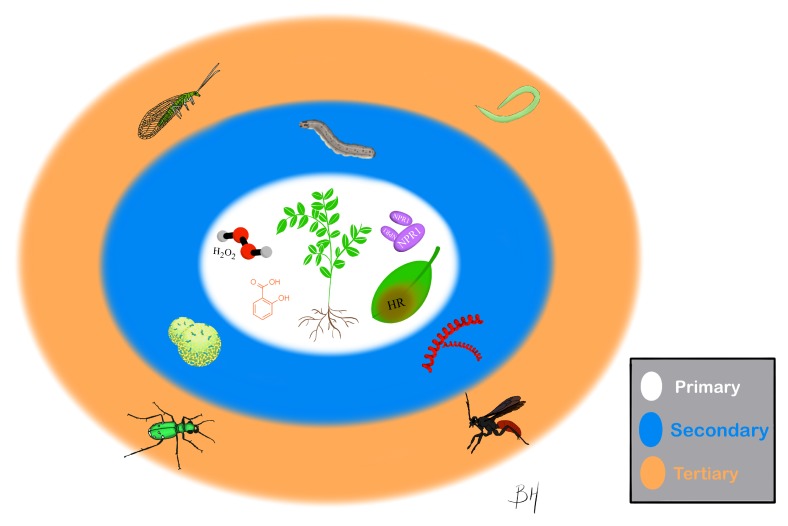
The salicylic acid pathway is one of the primary plant defense pathways, is ubiquitous in vascular plants, and plays a role in rapid adaptions to dynamic abiotic and biotic stress. Its prominence and ubiquity make it uniquely suited for understanding how biochemistry within plants can mediate ecological consequences. Induction of the salicylic acid pathway has primary effects on the plant in which it is induced resulting in genetic, metabolomic, and physiologic changes as the plant adapts to challenges. These primary effects can in turn have secondary consequences for herbivores and pathogens attacking the plant. These secondary effects can both directly influence plant attackers and mediate indirect interactions between herbivores and pathogens. Additionally, stimulation of salicylic acid related defenses can affect natural enemies, predators and parasitoids, which can recruit to plant signals with consequences for herbivore populations and plant herbivory aboveground and belowground. These primary, secondary, and tertiary ecological consequences of salicylic acid signaling hold great promise for application in agricultural systems in developing sustainable high-yielding management practices that adapt to changing abiotic and biotic environments.
Keywords: aboveground belowground; indirect effects; indirect interactions; natural enemies; plant defense in agriculture; plant mediated interactions.
Conflict of interest statement
The authors declare no conflict of interest.
Figures
References
-
- Bruinsma J. World Agriculture: Towards 2015/2030: An FAO Study. Routledge; London, UK: 2017.
Publication types
MeSH terms
Substances
LinkOut - more resources
Full Text Sources
