. 2019 Oct;5(4):218-236.
doi: 10.1159/000501797. Epub 2019 Aug 13.

Research Domain Criteria: Strengths, Weaknesses, and Potential Alternatives for Future Psychiatric Research

Affiliations

Research Domain Criteria: Strengths, Weaknesses, and Potential Alternatives for Future Psychiatric Research

Christopher A Ross et al. Mol Neuropsychiatry. 2019 Oct.

Abstract

The Research Domain Criteria (RDoC) paradigm was launched 10 years ago as a superior approach for investigation of mental illness. RDoC conceptualizes normal human behavior, emotion, and cognition as dimensional, with mental illnesses as dimensional extremes. We suggest that RDoC may have value for understanding normal human psychology and some conditions plausibly construed as extremes of normal variation. By contrast, for the most serious of mental illnesses, including dementia, autism, schizophrenia, and bipolar disorder, we argue that RDoC is conceptually flawed. RDoC conflates variation along dimensional axes of normal function with quantitative measurements of disease phenotypes and with the occurrence of diseases in overlapping clusters or spectra. This moves away from the disease model of major mental illness. Further, RDoC imposes a top-down approach to research. We argue that progress in major mental illness research will be more rapid with a bottom-up approach, starting with the discovery of etiological factors, proceeding to investigation of pathogenic pathways, including use of cell and animal models, and leading to a refined nosology and novel, targeted treatments.

Keywords: Autism; Bipolar disorder; Category; Diagnosis; Dimension; Gene-environment interaction; Genetics; National Institute of Mental Health; Nosology; Psychosis; Research Domain Criteria; Schizophrenia; Spectrum.


Conflict of interest statement

Dr. Ross reports grant support from NIH and CHDI, previous support from JNJ/Janssen, Teva, and Raptor/Horizon, clinical trial support from Teva, Vaccinex, Roche/Genentech, and CHDI, and consulting for Teva, Sage, uniQure, Roche/Ionis, and HSG. Dr. Margolis reports grant support from the NIH, ABCD Charitable Trust, and Teva.

Figures
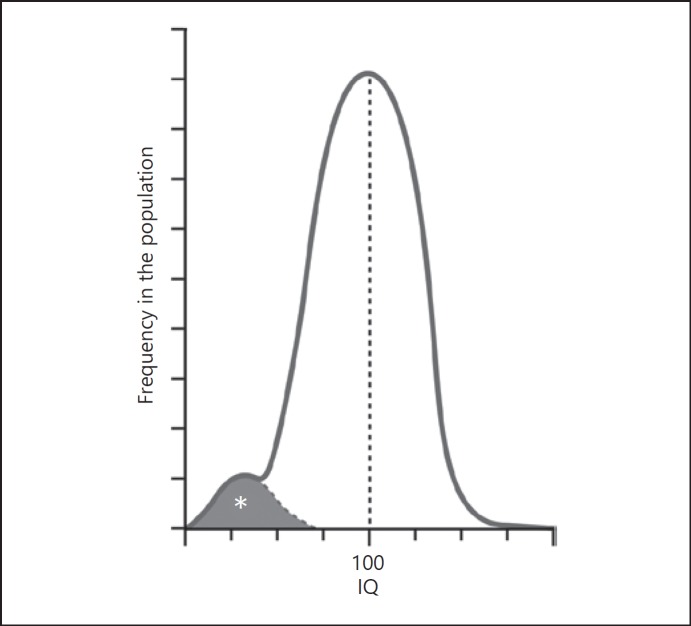
Fig. 1
Fig. 1
Bimodality of the superficially unimodal Gaussian distribution of IQ in the population. In addition to the normal distribution of IQ in the general population, a second distribution, at the very low end, reflects the existence of a separate population of individuals with specific, etiologically defined, syndromes, such as fragile X syndrome, Rett syndrome, Angelman syndrome, Down syndrome (adapted from McHugh and Slavney [15]). Note that we are not claiming that other disorders (such as schizophrenia) have Mendelian origins, but simply that a quantitative trait with a superficially Gaussian “dimensional” distribution can conceal disparate subcategories and etiologies best seen as categorically distinct, and using the disease model. Illustrator: Joan M.K. Tycko.
Fig. 2
Fig. 2
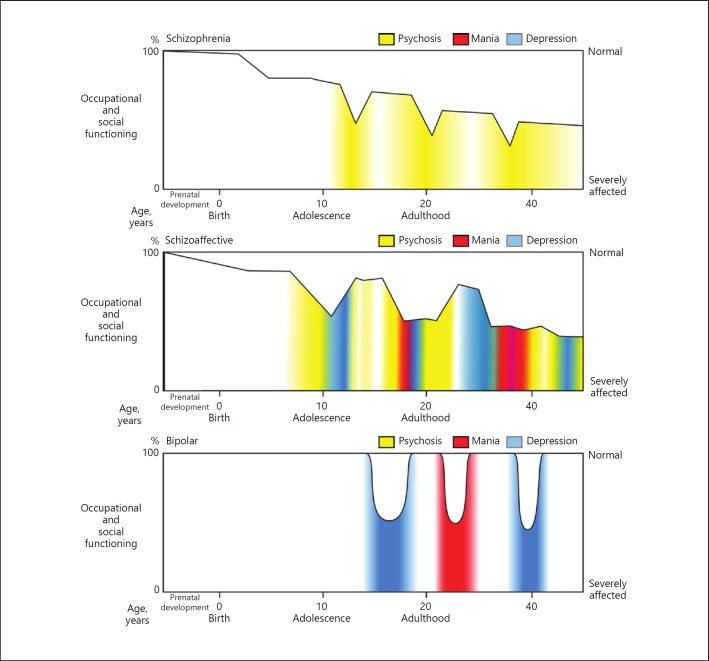
Idealized natural histories of forms of psychotic disorder. These schematics are based on simplified views of the natural histories of these disorders, originating with the ideas of Kraepelin, Bleuler, Baillarger, Falret, and Leonhard, and generally validated by longitudinal outcome studies. The broad distinction is between schizophrenia and bipolar illness. Schizophrenia is notable for subtle developmental abnormalities, detectible even in childhood. Manifest symptoms emerge in adolescence and young adulthood, with a functional and cognitive decline followed by a chronic course punctuated by episodes of more acute illness. By contrast, bipolar disorder, in its pure form, appears to involve fewer developmental abnormalities, and does not universally lead to cognitive and social decline. Instead, bipolar disorder, in its classic form, has an episodic course in which normality is interrupted by episodes of depression or mania. Many patients, however, have intermediate forms of illness, often termed schizoaffective disorder, characterized by a mixture of affective changes and psychotic phenomena, and a relatively chronic course. These three categories are oversimplifications of what is in reality a complex and heterogeneous group of diseases, which may be better described as a “spectrum” of related disorders. Nonetheless, the diagram emphasizes the importance of incorporating the natural history of the major mental illnesses, including the changes in pathophysiology that underlie changes in phenotype over the course of the disease. This concept that diseases are not static over time is one of the fundamental features of the biomedical approach to disease nosology and research, largely missing in RDoC. Illustrator: Joan M.K. Tycko.
Fig. 3
Fig. 3
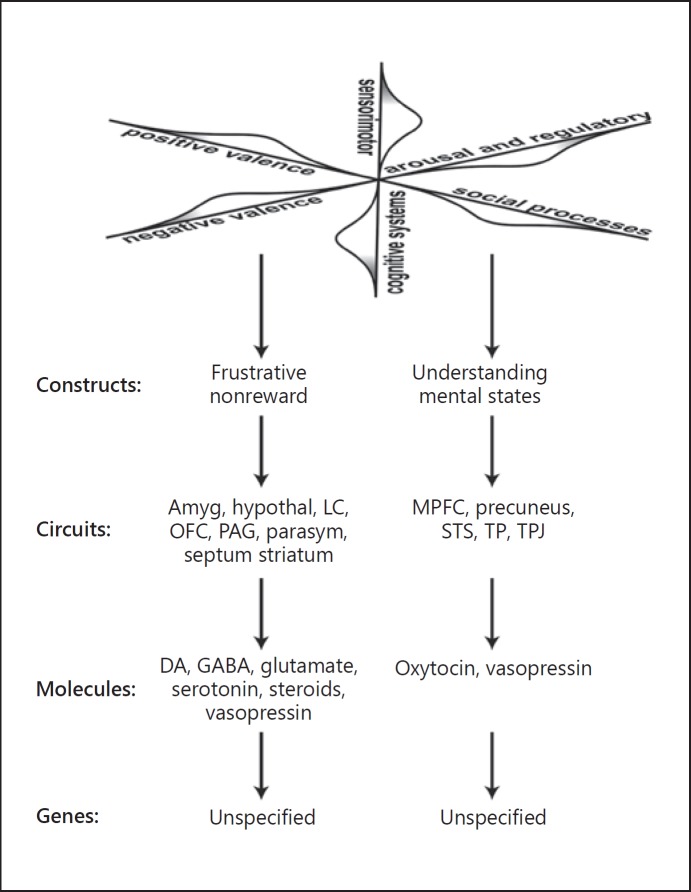
The top-down approach of RDoC. The RDoC approach to psychiatry begins with arbitrary domains, divided into constructs, which are the representations of one, and often many, circuits based on a few already known molecules. Depicted are one construct each from two different domains. Note the plethora of ill-defined “circuits,” the paucity of novel molecules, and the decision to exclude genes (as of 2019) for lack of evidence. The relevance to psychiatric diseases, as manifest in patients, is obscure. Amyg, amygdala; hypothal, hypothalamus; LC, locus coeruleus; MPFC, medial prefrontal cortex; OFC, orbital frontal cortex; PAG, periaqueductal gray; parasym, parasympathetic; STS, superior temporal sulcus; TP, temporal pole; TPJ, temporal parietal junction. All terms and relationships adapted from the NIMH RDoC matrix website (https://www.nimh.nih.gov/research/research-funded-by-nimh/rdoc/constructs/rdoc-matrix.shtml).
Fig. 4
Fig. 4
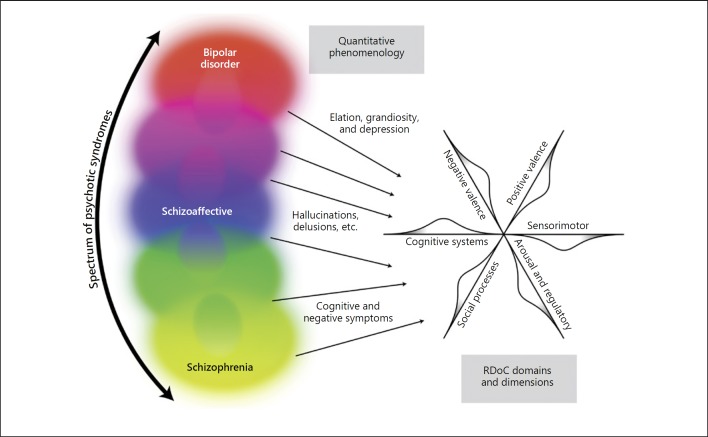
Disjunction between phenomenology of psychosis and “dimensions” of RDoC. The “spectrum” of psychosis is shown using current terminology, recognizing that both the terminology and the relationship among the various disorders will inevitably evolve in the future. Certain phenomena of this spectrum of diseases, such as delusions, hallucinations, and thought disorder, appear qualitatively distinct from normal phenomenology. Other characteristic phenomena (e.g., mood and cognition) can be measured quantitatively, and may resemble extremes of normal phenomenology. However, we argue that despite this phenomenological resemblance to extremes of normal variation, these quantitatively measurable phenomena do not necessarily correspond to the domains and constructs of the RDoC scheme (illustrated schematically as axes to show the six current RDoC domains and their dimensional nature). In our view, the phenomena of major mental illnesses represent a shift off dimensional axes of normal variation, the consequence of a breakdown in normal brain function caused by complex etiological and pathophysiological processes, and are best understood using the disease model. The main point is that even though a clinical phenomenon is quantifiable, it does not follow that such a phenomenon can best be understood as an extreme of dimensional variation along a normal axis. This line of argument also leads to the conclusion that, for disease research and clinical practice, it is better to focus attention on the quantitative phenomena observed in patients, rather than to make the a priori assumption that variations in quantitative phenomena observed in the normal population will be of direct relevance. Illustrator: Joan M.K. Tycko.
Fig. 5
Fig. 5
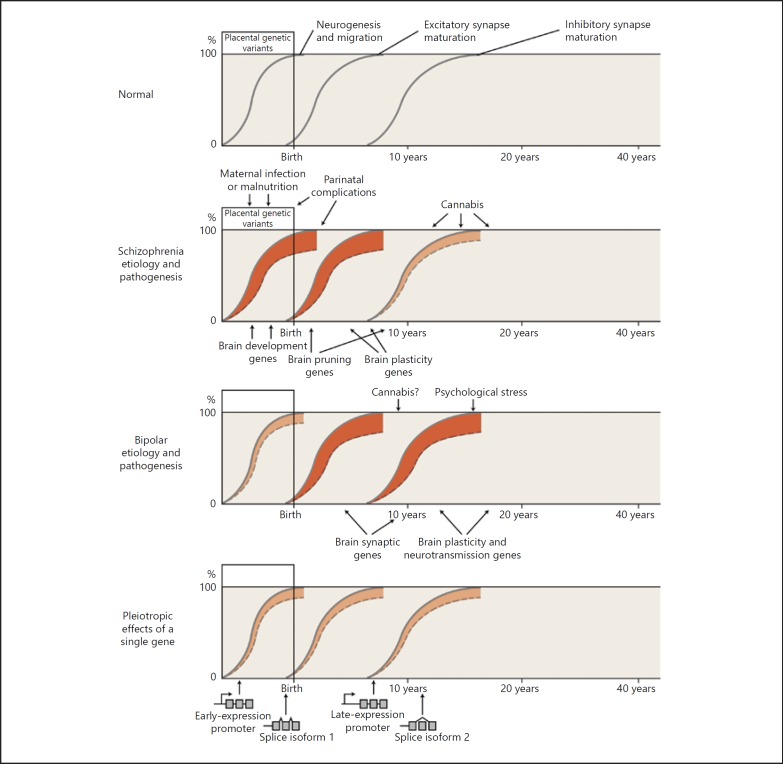
Relationship between genetic and environmental risk factors and clinical phenotypes. Genetic and environmental factors, acting in part on the differential expression of genes, disrupt the normal developmental processes, leading to abnormal brain structure and function. The y axis indicates the extent to which a developmental process has reached completion. The x axis indicates age, reflecting developmental status. A solid gray line indicates normal brain development (neurogenesis and migration, excitatory synapses, and inhibitory synapses). A dashed line below the solid gray line, with red shading between the lines, indicates a disruption of the process – a shift to an abnormal brain state (depiction modified from Insel [93]). Normal development involves multiple neurobiological processes; here we show just three as a simplification to highlight that different processes mature at different times. Phenotypic differences arise because of individual differences in exposure to genetic and environmental risk factors, in the timing of exposure to environmental risk factors, and in the interactions among genetic and environmental risk factors. We emphasize here that risk factor-induced changes in gene expression, including different isoforms of the same gene, may lead to changes in synaptic structure and function, though many other pathogenic mechanisms are also likely involved. We hypothesize (no doubt as an oversimplification) that risk alleles and environmental risk factors acting during earlier stages of development (such as placental stress occurring in an individual with a genetic vulnerability to such stress) tend to predispose to schizophrenia. By contrast, in general, alleles and environmental factors altering gene expression later in development predispose more to bipolar disorder. The earlier influences may preferentially affect excitatory synapses (which generally mature earlier), while the later influences may preferentially affect inhibitory synapses (which generally mature later). The bottom panel highlights how different alleles of the same gene can have effects at different time points in development via differing promotor usage or splice isoforms. Many other mechanisms (not shown), such as epigenetic changes or posttranslational regulation via microRNAs, could give similar results. We are well aware that these hypotheses involve oversimplifications and may turn out to be incorrect, but we believe that it is useful to develop and test concepts that attempt to correlate genetic, pathophysiological, and clinical information. Illustrator: Joan M.K. Tycko.
Fig. 6
Fig. 6
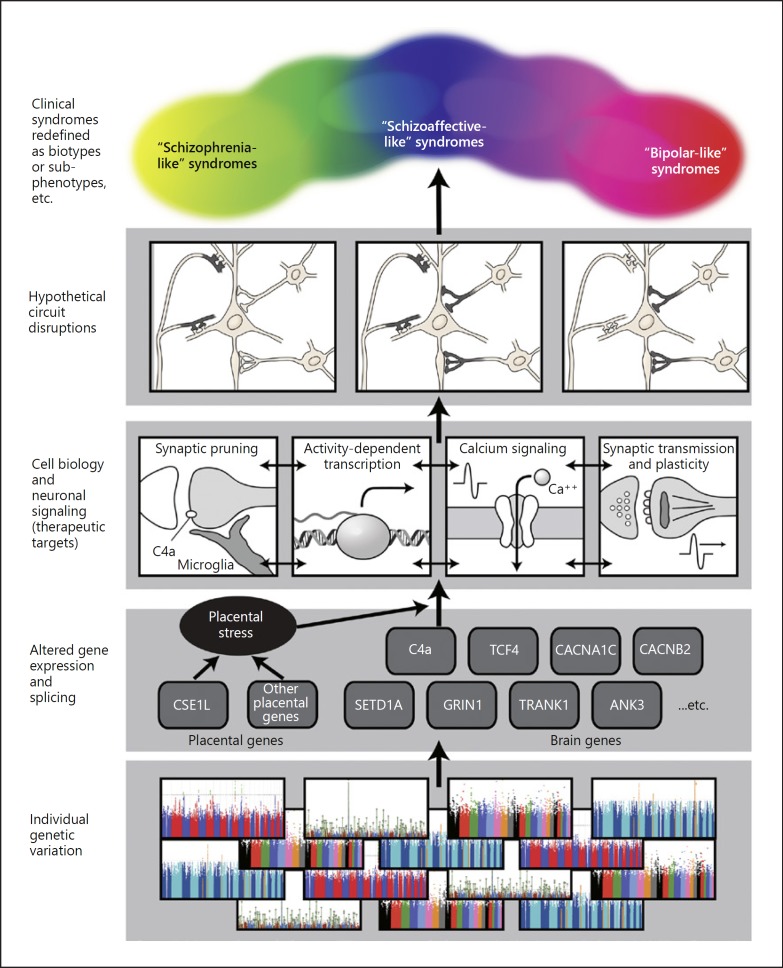
Hypothetical bottom-up scheme for conceptualizing the causal chain from genetic etiologies to clinical phenotypes. We hypothesize that the large number of genetic risk factors (also environmental factors, not shown) for major mental illness converge on a smaller number of molecular pathways, which in turn will selectively alter brain circuitry, leading to clinical phenotypes. This scheme stands in contrast to the top-down approach of RDoC in its emphasis on the etiology and pathogenesis of disease, rather than on normal biology. Furthermore, this depiction of the bottom-up approach corrects an imbalance in RDoC, which overemphasizes circuit-level analysis and underemphasizes analysis at the molecular and cellular levels. We include a representation of the hypotheses noted in the text that genetic risk variants affecting isoforms expressed earlier in development and in excitatory neurons might predispose more to schizophrenia-like phenotypes, while variants affecting isoforms expressed later in development and in inhibitory neurons may predispose more to bipolar disorder. A representation of genes predisposing to an abnormal response to placental stress, which we hypothesize are more relevant for schizophrenia-like syndromes than for bipolar-like syndromes, is provided as an example of gene-environment interaction. While these are no doubt oversimplifications (and particularly the circuit changes are not yet well defined, so are shown as hypothetical synaptic alterations), they may illustrate the possibility that general principles illuminating nosology may emerge even from very complex GWAS, transcriptome, and other datasets. We represent the clinical phenotypes as a “spectrum,” with the expectation that the clinical syndromes may well be redefined and subcategorized based on increasing understanding of etiology and pathophysiology. In general, etiologies and pathogeneses more relevant to schizophrenia-like syndromes are shown on the left side of the figure, while etiologies and pathogeneses more relevant to bipolar-like syndromes are shown on the right side. While no doubt oversimplifications, these and other hypotheses can be tested and validated or rejected, a critical strength of the bottom-up approach. Illustrator: Joan M.K. Tycko.

References

    1. Cuthbert BN, Workgroup NR, NIMH RDoC Workgroup The RDoC framework: continuing commentary. World Psychiatry. 2014 Jun;13((2)):196–7. - PMC - PubMed
    1. Insel TR. The NIMH Research Domain Criteria (RDoC) Project: precision medicine for psychiatry. Am J Psychiatry. 2014 Apr;171((4)):395–7. - PubMed
    1. Cuthbert BN. The RDoC framework: facilitating transition from ICD/DSM to dimensional approaches that integrate neuroscience and psychopathology. World Psychiatry. 2014 Feb;13((1)):28–35. - PMC - PubMed
    1. National Institute of Mental Health Strategy 1.4 of the 2008 NIMH Strategic Plan. 2008:pp 1–60.

    1. Morris SE, Cuthbert BN. Research Domain Criteria: cognitive systems, neural circuits, and dimensions of behavior. Dialogues Clin Neurosci. 2012 Mar;14((1)):29–37. - PMC - PubMed