Review
. 2019 Dec;593(24):3551-3570.
doi: 10.1002/1873-3468.13697. Epub 2019 Dec 15.

Epigenetics and the dynamics of chromatin during adenovirus infections

Affiliations
Review

Epigenetics and the dynamics of chromatin during adenovirus infections

Kelsey L Lynch et al. FEBS Lett. 2019 Dec.

Abstract

The DNA genome of eukaryotic cells is compacted by histone proteins within the nucleus to form chromatin. Nuclear-replicating viruses such as adenovirus have evolved mechanisms of chromatin manipulation to promote infection and subvert host defenses. Epigenetic factors may also regulate persistent adenovirus infection and reactivation in lymphoid tissues. In this review, we discuss the viral proteins E1A and protein VII that interact with and alter host chromatin, as well as E4orf3, which separates host chromatin from sites of viral replication. We also highlight recent advances in chromatin technologies that offer new insights into virus-directed chromatin manipulation. Beyond the role of chromatin in the viral replication cycle, we discuss the nature of persistent viral genomes in lymphoid tissue and cell lines, and the potential contribution of epigenetic signals in maintaining adenovirus in a quiescent state. By understanding the mechanisms through which adenovirus manipulates host chromatin, we will understand new aspects of this ubiquitous virus and shed light on previously unknown aspects of chromatin biology.

Keywords: E1A; adenovirus; chromatin; epigenetics; histones; host-pathogen interactions; persistence; post-translational modifications; protein VII.


Figures

Fig. 1.
Fig. 1.
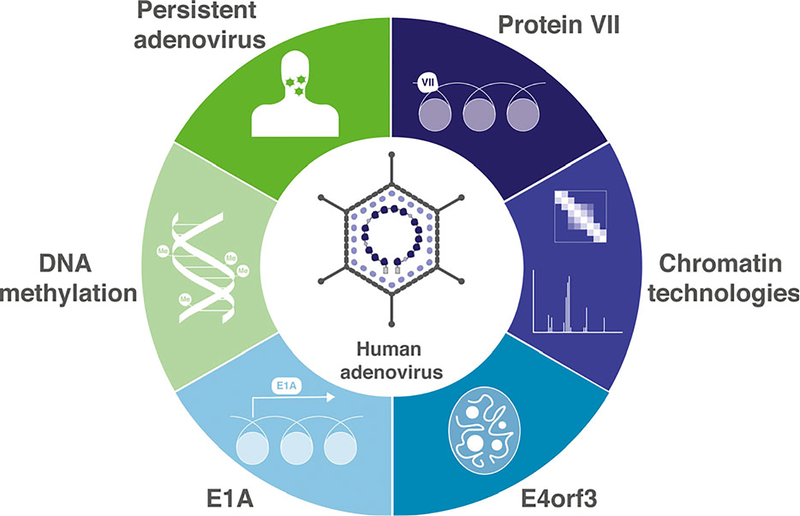
Schematic overview of the content of this review. Host chromatin and epigenetics are central to the adenovirus replication cycle. We focus on core protein VII because it interacts both with the viral genome and with host chromatin. We also address the effects of early viral proteins E1A and E4orf3 on host chromatin and nuclear organization. Although the nature of persistent adenovirus infection is not well-characterized, epigenetic state and chromatin may be important for maintaining adenovirus in lymphoid tissues. Adenovirus infection also impacts host DNA methylation, an important inherited DNA modification. Historically, adenoviruses have provided key insights into chromatin biology, and developing chromatin technologies will reveal new facets of the intersection of adenoviruses and chromatin.
Fig. 2.
Fig. 2.
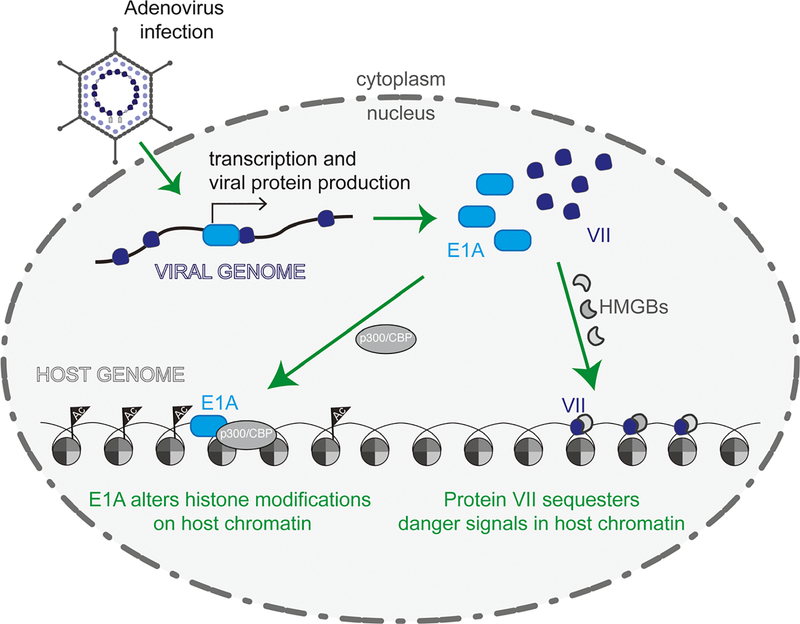
Impact of E1A and protein VII on host chromatin. Adenovirus E1A and protein VII significantly affect both viral genomes and host chromatin. Viral DNA is bound by the histone-like protein VII as it enters the nucleus. E1A is the first protein produced during infection and has been implicated in initiating transcription and displacing protein VII from incoming viral genomes. E1A binds the host acetyltransferase proteins p300/CBP to disrupt acetylation of histones and alter host transcription to promote viral replication. Late-expressed protein VII binds host chromatin and sequesters the danger signaling HMGB proteins in chromatin. For more details on viral entry, see reference [39].

References

    1. Ghebremedhin B (2014) Human adenovirus: viral pathogen with increasing importance. Eur J Microbiol Immunol 4, 26–33. - PMC - PubMed
    1. Echavarría M (2008) Adenoviruses in immunocompromised hosts. Clin Microbiol Rev 21, 704–715. - PMC - PubMed
    1. Esquer Garrigos Z, Barth D, Hamdi AM, Abu Saleh OM and Sohail MR (2018) Nitazoxanide is a therapeutic option for adenovirus-related enteritis in immunocompromised adults. Antimicrob Agents Chemother 62, e01937–18. - PMC - PubMed
    1. Majorant D, Qiu F, Kalil AC, Wilson N and Florescu DF (2018) Adenovirus – a deadly disease in the solid organ transplant population: risk factors and outcomes. Transpl Proc 50, 3769–3774. - PubMed
    1. Pochon C and Voigt S (2018) Respiratory virus infections in hematopoietic cell transplant recipients. Front Microbiol 9, 3294. - PMC - PubMed

Publication types

MeSH terms

LinkOut - more resources