. 2020 Feb;122(3):361-371.
doi: 10.1038/s41416-019-0649-5. Epub 2019 Nov 27.

FKBPL-based peptide, ALM201, targets angiogenesis and cancer stem cells in ovarian cancer

Affiliations

FKBPL-based peptide, ALM201, targets angiogenesis and cancer stem cells in ovarian cancer

Stephanie Annett et al. Br J Cancer. 2020 Feb.

Abstract

Background: ALM201 is a therapeutic peptide derived from FKBPL that has previously undergone preclinical and clinical development for oncology indications and has completed a Phase 1a clinical trial in ovarian cancer patients and other advanced solid tumours.

Methods: In vitro, cancer stem cell (CSC) assays in a range of HGSOC cell lines and patient samples, and in vivo tumour initiation, growth delay and limiting dilution assays, were utilised. Mechanisms were determined by using immunohistochemistry, ELISA, qRT-PCR, RNAseq and western blotting. Endogenous FKBPL protein levels were evaluated using tissue microarrays (TMA).

Results: ALM201 reduced CSCs in cell lines and primary samples by inducing differentiation. ALM201 treatment of highly vascularised Kuramochi xenografts resulted in tumour growth delay by disruption of angiogenesis and a ten-fold decrease in the CSC population. In contrast, ALM201 failed to elicit a strong antitumour response in non-vascularised OVCAR3 xenografts, due to high levels of IL-6 and vasculogenic mimicry. High endogenous tumour expression of FKBPL was associated with an increased progression-free interval, supporting the protective role of FKBPL in HGSOC.

Conclusion: FKBPL-based therapy can (i) dually target angiogenesis and CSCs, (ii) target the CD44/STAT3 pathway in tumours and (iii) is effective in highly vascularised HGSOC tumours with low levels of IL-6.


Conflict of interest statement

T.R. is an inventor and patent holder for ALM201. T.R. has received research funding from Alamc Discovery Ltd. A.de.F. has received a grant from AstraZeneca (unrelated to work in this paper). The remaining authors declare no competing interests.

Figures
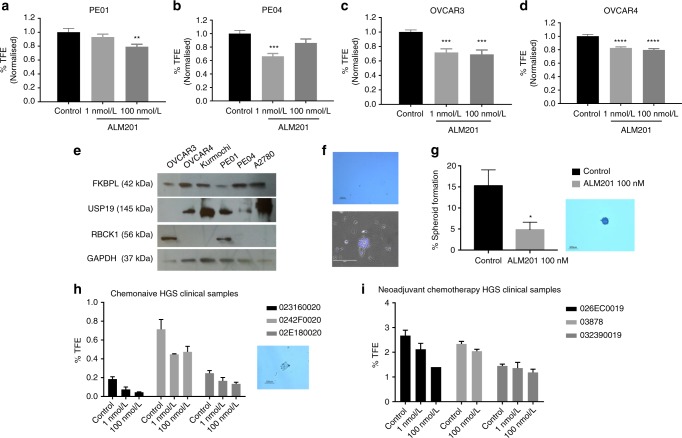
Fig. 1
Fig. 1
FKBPL and its clinical peptide derivative, ALM201, reduce tumoursphere formation in ovarian cancer cell lines and high-grade serous patient samples. The effect of ALM201 treatment on the primary TFE in the a PE01, b PE04, c OVCAR3 and d OVCAR4 after treatment with 1 and 100 nmol/L ALM201 treatment. e Protein expression of FKBPL, USP19 and RBCK1 was analysed in ovarian cell lines (OVCAR3, OVCAR4, Kuramochi, PE01, PE04 and A2780) by western blot (n = 3). f The Kuramochi cell line does not form tumourspheres (top picture) and Kuramochi PGCCs were isolated by incubation with cobalt chloride (450 μM) for 72 h (bottom picture). g The Kuramochi PGCCs were trypsinised and seeded into Matrigel containing tumoursphere media and treated with PBS or ALM201 (100 nmol/L). A representative image of spheroid formed from a PGCC (inset). Cells were incubated for 3 weeks, with fresh ALM201 added weekly and the number of spheroids >50 μM counted manually. h Tumoursphere formation of cancer cells derived from primary chemo-naive high-grade serous ovarian tumours (n = 3) and i primary high-grade serous ovarian tumours that received neoadjuvant chemotherapy (n = 3). Data points are mean ± SEM. n ≥ 3. *P < 0.05; **P < 0.01; ***P < 0.001 (one-way ANOVA or two-tailed Student t-test). TFE, tumoursphere-forming efficiency.
Fig. 2
Fig. 2
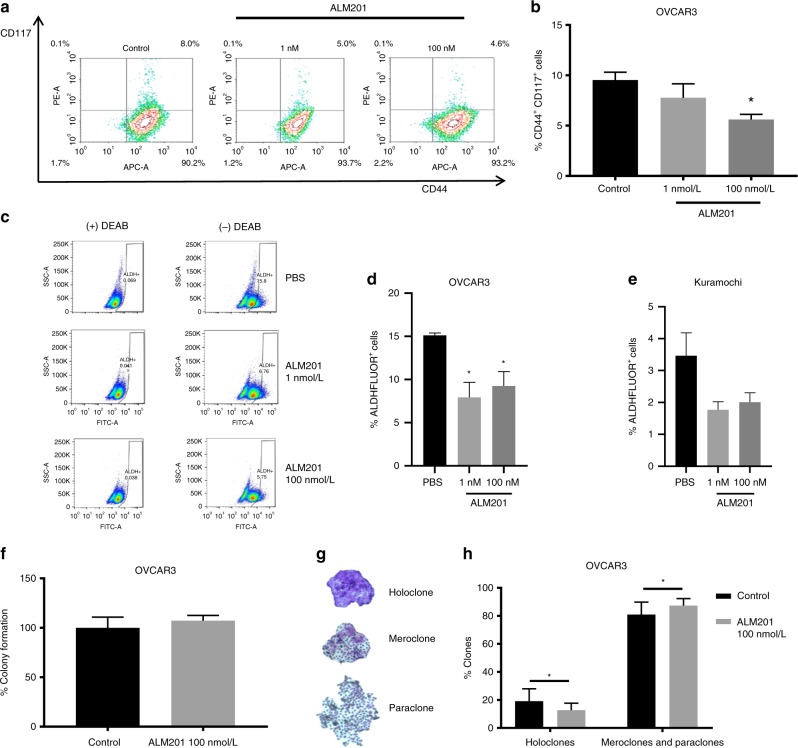
ALM201 reduces the CD44±/CD117± and ALDH± cell subpopulation by differentiating the CSCs to more ‘mature’ cancer cells. a Representative flow cytometry images demonstrating a reduction in the CD44+/CD117+ subpopulation following 72-h ALM201 treatment of OVCAR3 monolayers. b Percentage of CD44+/CD177+ OVCAR3 cells after treatment with ALM201 compared with PBS-treated controls. c Representative flow cytometry images demonstrating a shift in the ALDH+ cell population in OVCAR3 cells after treatment for 72 h with ALM201 (1 and 100 nmol/L). d Percentage reduction in the ALDH+ cell population was quantified in OVCAR3 and e Kuramochi cell lines following treatment for 72 h with ALM201 (1 and 100 nmol/L). f ALM201 treatment does not affect the total number of colonies formed. g Representative images of OVCAR3 colonies: holoclones, meroclone and paraclones; different colonies were manually counted and expressed per 100 cells seeded. h A reduction in the number of holoclones formed and a concomitant increase in the number of more differentiated, meroclone and paraclone colonies, following ALM201 treatment was observed in OVCAR3 cells. Data points are mean ± SEM. n ≥ 3. *P < 0.05; **P < 0.01 (one-way ANOVA or two-tailed Student t-test). SSC, side scatter.
Fig. 3
Fig. 3
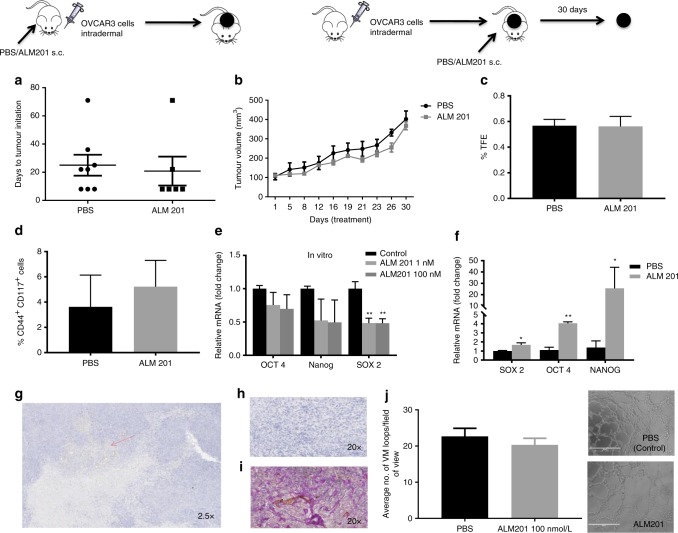
ALM201 does not target CSCs or inhibit angiogenesis in OVCAR3 xenografts. a Tumour initiation in vivo assay following implantation of OVCAR3 cells and treatment with PBS or ALM201 (0.3 mg/kg/day) subcutaneously from day 1 (inset experimental design; n= 5). b OVCAR3 cells were implanted into mice, tumours established until 100 mm3 and then treated with PBS or ALM201 (0.3 mg/kg/day) for 30 days (inset experimental design; n = 5). c OVCAR3 tumour xenografts were excised and dissociated, and the CSC subpopulation analysed by tumoursphere assay (n = 3) or d flow cytometry by quantifying CD44+CD117+ cell population (n = 3). e OVCAR3 monolayers were treated with ALM201 (1 and 100 nmol/L) for 24 h, and expression levels of the pluripotency transcription factors (SOX2, OCT4 and NANOG) analysed by q-PCR. f Expression of pluripotency transcription factors in OVCAR3 xenografts following treatment with PBS or ALM201 (0.3 mg/kg/day) for 30 days. g OVCAR3 xenografts were sectioned, and immunohistochemistry staining for CD31+ blood vessels conducted. A small number of blood vessels (red arrow) were observed at ×2.5 magnification and no CD31+ vessels (h) in the majority of the xenografts at ×20 magnification. i CD31+/PAS dual immunohistochemistry staining of OVCAR3 indicated extensive vasculogenic mimicry networks in OVCAR3 xenografts. j Treatment with ALM201 (100 nmol/L) does not inhibit OVCAR3 tubule formation (representative image in inset; n = 3). Each dot represents a single mouse. Data points are mean ± SEM. n ≥ 3. *P < 0.05; **P < 0.01 (one-way ANOVA or Student t-test).
Fig. 4
Fig. 4
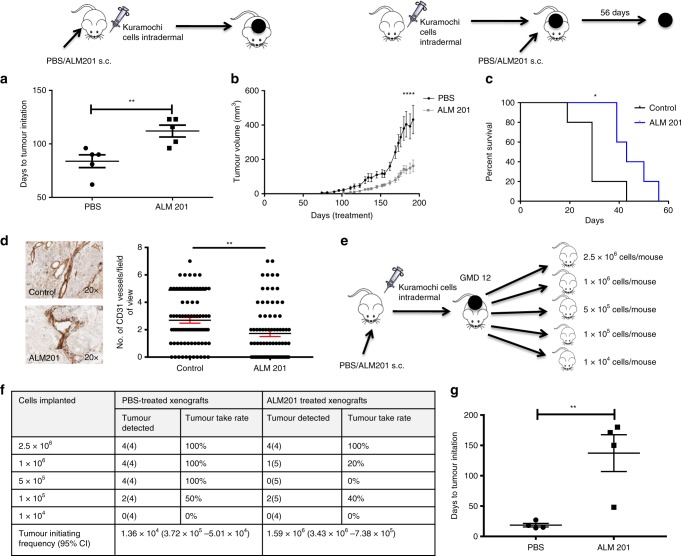
ALM201 targets CSCs and angiogenesis in the Kuramochi xenografts. a In vivo tumour initiation assay following implantation of Kuramochi cells into SCID mice and subcutaneous treatment with PBS or ALM201 (0.3 mg/kg/day) from day 1; days to tumour initiation were calculated (inset experimental design; n = 5) b and tumour growth monitored. c Kuramochi cells were implanted into mice, tumours established until 100 mm3 and treatment with PBS or ALM201 (0.3 mg/kg/day) administered for 56 days (inset experimental design; n = 5). ALM201 treatment increased survival, as determined by time to tumour quadrupling. d Kuramochi xenografts were sectioned, and immunohistochemistry staining for CD31+ blood vessels conducted, and ALM201 significantly decreased the number of blood vessels. e Tumour cells dissociated from ALM201 or PBS-treated Kuramochi xenografts were re-implanted in a limiting dilution assay into second-generation mice. The second-generation mice did not receive further treatment and were observed for tumour initiation. f The number of mice that developed tumours after 6 months of monitoring is tabulated. Tumour-initiating frequency (TIF) was calculated by using ELDA software (p = 8.77 × 10−5; n > 4/group). g In total, 2.5 × 106 cells were re-implanted into second-generation mice, and tumours from first-generation ALM201-treated mice demonstrated a 118-day delay in tumour initiation. Each dot represents one mouse. Data points are mean ± SEM. n ≥ 3. *P < 0.05; **P < 0.01 (two-tailed, unpaired t-test or one-way ANOVA).
Fig. 5
Fig. 5
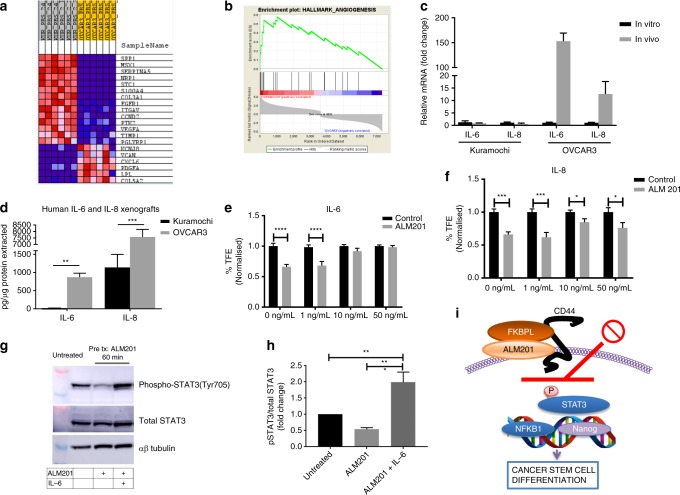
OVCAR3 xenografts upregulate inflammatory cytokines and ALM201 anti-CSC activity is abrogated by IL-6. a Heat map and b enrichment plot of angiogenesis-related genes upregulated (red) in Kuramochi cell line compared with the OVCAR3 cell line by RNAseq analysis. c IL-6 and IL-8 mRNA is upregulated in vivo compared with in vitro in the OVCAR3 cells but not in the Kuramochi cells (n > 3). d Human IL-6 and IL-8 protein is significantly higher in the OVCAR3 xenografts compared with the Kuramochi xenografts; mouse IL-6 and IL-8 (Kc) was not detected. e Addition of recombinant IL-6 to OVCAR3 tumoursphere assay abrogated the ability of ALM201 to decrease tumourspheres (n = 3). f ALM201 decreases OVCAR3 tumourspheres in the presence of IL-8. g Representative western blot demonstrating that ALM201 decreases phosphorylation of STAT3 and this effect is abrogated by addition of IL-6. h Densitometric analysis of western blots by using ImageJ, n ≥ 3. i Diagram summarising the effect of ALM201 on OVCAR3 cancer cells. Data points are mean ± SEM. n ≥ 3. *P < 0.05; **P < 0.01 (two-way ANOVA).
Fig. 6
Fig. 6
High FKBPL expression increased progression-free survival. a FKBPL expression was analysed by using microarray data from publicly available data sets (http://www.kmplot.com/ovar). Kaplan–Meier survival curves of ovarian cancer patients were generated, showing that those with low mRNA FKBPL expression indicated a significantly reduced overall survival (p < 0.05). FKBPL expression Kaplan–Meier estimates of HGSOC PFS from diagnosis in cohort I (n = 177; b), cohort II (n = 193; c), cohort III (n = 99; d) and cohort IV (n = 180; e). Kaplan–Meier estimates were determined with average FKBPL score for PFS, where FKBPL protein expression has been separated by histoscore of 190: high >190 (blue) and low < 190 (red). f Hazard ratio plot of HGSOC PFS from diagnosis against FKBPL levels by cohorts I, II, III and IV (n = 639). g Hazard ratio plot of HGSOC PFS from diagnosis against FKBPL levels by cohort from cohorts I, II and IV (n = 549).

References

    1. Siegel RL, Miller KD, Jemal A. Cancer statistics, 2015. CA Cancer J. Clin. 2015;65:5–29. - PubMed
    1. Bowtell DD, Böhm S, Ahmed AA, Aspuria P-J, Bast RC, Beral V, et al. Rethinking ovarian cancer II: reducing mortality from high-grade serous ovarian cancer. Nat. Rev. Cancer. 2015;15:668–679. doi: 10.1038/nrc4019. - DOI - PMC - PubMed
    1. Jacobs IJ, Menon U, Ryan A, Gentry-Maharaj A, Burnell M, Kalsi JK, et al. Ovarian cancer screening and mortality in the UK Collaborative Trial of Ovarian Cancer Screening (UKCTOCS): a randomised controlled trial. Lancet. 2016;387:945–956. doi: 10.1016/S0140-6736(15)01224-6. - DOI - PMC - PubMed
    1. Hennessy BT, Coleman RL, Markman M. Ovarian cancer. Lancet. 2009;374:1371–1382. doi: 10.1016/S0140-6736(09)61338-6. - DOI - PubMed
    1. Monk BJ, Minion LE, Coleman RL. Anti-angiogenic agents in ovarian cancer: past, present, and future. Ann. Oncol. 2016;27(suppl 1):i33–i39. doi: 10.1093/annonc/mdw093. - DOI - PMC - PubMed

Publication types

MeSH terms