p53/PCDH17/Beclin-1 Proteins as Prognostic Predictors for Urinary Bladder Cancer
- PMID: 31772653
- PMCID: PMC6856748
- DOI: 10.7150/jca.37335
p53/PCDH17/Beclin-1 Proteins as Prognostic Predictors for Urinary Bladder Cancer
Abstract
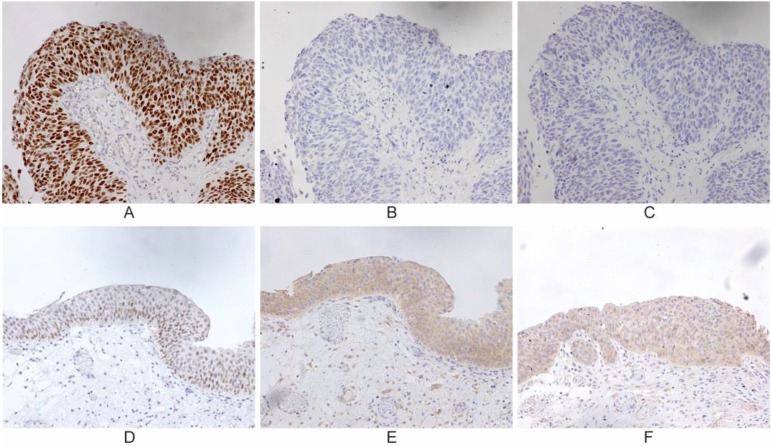
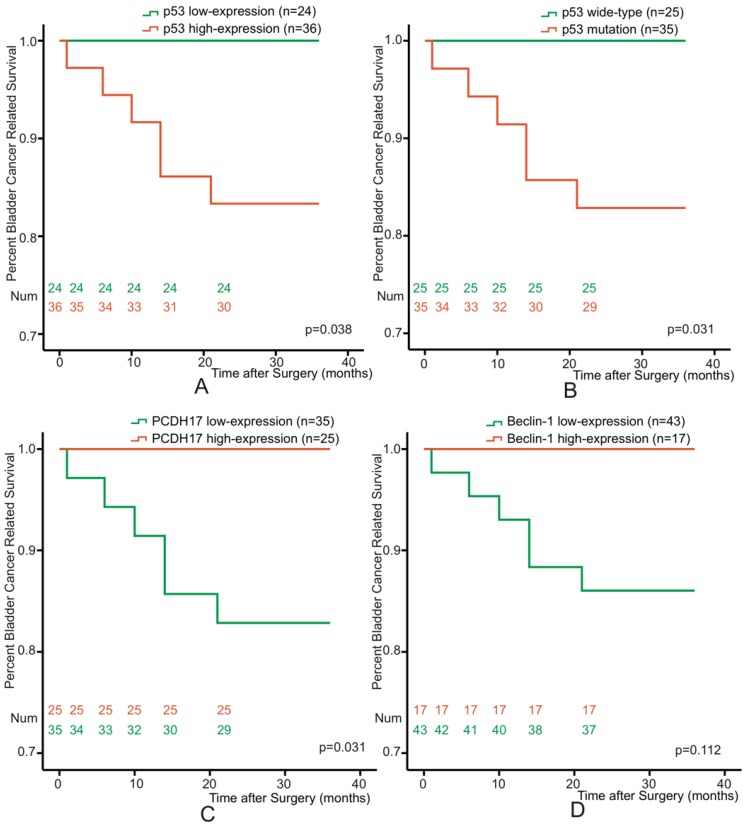
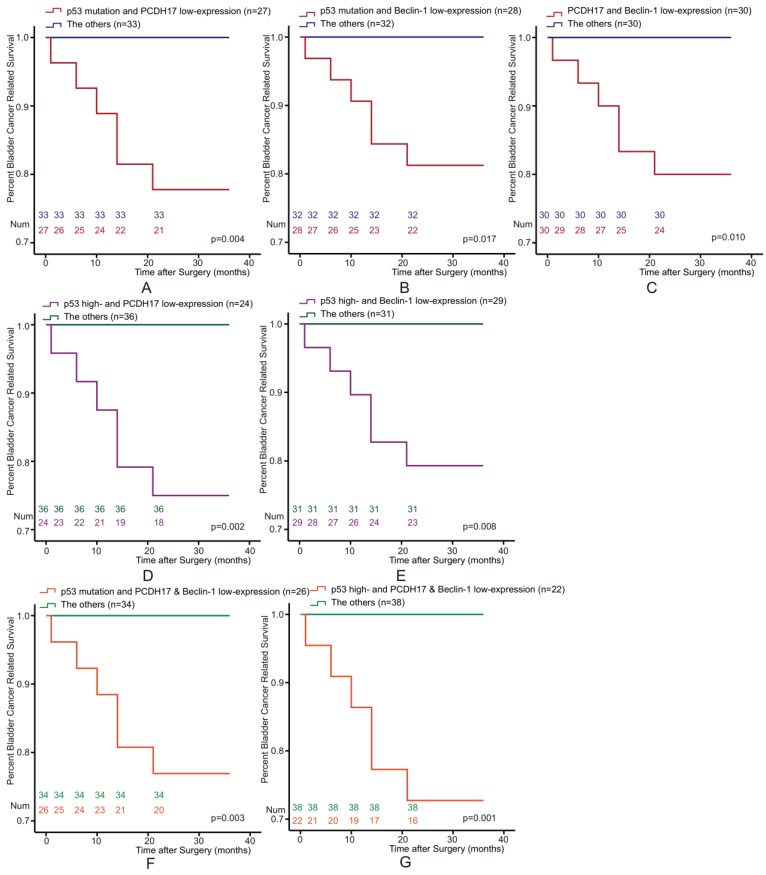
Purpose: To determine whether p53, PCDH17, Beclin-1 expression is associated with clinicopathological characteristics of bladder cancer. Materials and Methods: 75 patients with non-muscle-invasive and muscle-invasive bladder cancer were included. Immunohistochemical staining for p53, PCDH17 and Beclin-1 were carried out on the same paraffin-embedded blocks serial sections of these patients who underwent surgery between 2010 and 2015. In addition, p53 gene mutations in these tumors were screened by DNA sequencing. Results: Forty-nine (66.7%) of 75 tumors had p53 gene mutations detected by DNA sequencing method. Of these tumors, 43 (86.0%) exhibited p53 high expression. Furthermore, p53 mutation and low expression of PCDH17 were significantly associated with muscle-invasive bladder cancer. Beclin-1 was also strongly associated with T stage. The p53 mutation, the expression of p53 and PCDH17 were significantly associated with survival from bladder cancer. In addition, patients with p53 high-expression or p53 mutation, PCDH17 low-expression and Beclin-1 low-expression significantly had a poor prognosis. Conclusions: Use of a DNA sequencing method to detect p53 gene mutations was consistent with an immunohistochemical method to detect p53 alterations. In conjunction with levels of p53/PCDH17/Beclin-1, p53 and PCDH17 were independently associated with prognosis; Beclin-1 only had a tendency towards overall survival. p53/PCDH17/Beclin-1 phenotype seems to play a more important role than p53 expression in bladder cancer outcome. It is also identified that p53/PCDH17, p53/Beclin-1 or PCDH17/Beclin-1 all have a cooperative and synergistic effect, which may provide us the potential biomarker for bladder cancer patients.
Keywords: Beclin-1; Urinary bladder neoplasms; p53; protocadherin 17.
© The author(s).
Conflict of interest statement
Competing Interests: The authors have declared that no competing interest exists.
Figures
References
-
- Siegel RL, Miller KD, Jemal A. Cancer statistics, 2018. CA Cancer J Clin. 2018;68:7–30. - PubMed
-
- Burger M, Catto JW, Dalbagni G, Grossman HB, Herr H, Karakiewicz P. et al. Epidemiology and risk factors of urothelial bladder cancer. Eur Urol. 2013;63:234–41. - PubMed
-
- Mak RH, Hunt D, Shipley WU, Efstathiou JA, Tester WJ, Hagan MP. et al. Long-term outcomes in patients with muscle-invasive bladder cancer after selective bladder-preserving combined-modality therapy: a pooled analysis of Radiation Therapy Oncology Group protocols 8802, 8903, 9506, 9706, 9906, and 0233. J Clin Oncol. 2014;32:3801–9. - PMC - PubMed
LinkOut - more resources
Full Text Sources
Research Materials
Miscellaneous