


Cartilage Restoration in the Adolescent Knee: a Systematic Review
- PMID: 31773480
- PMCID: PMC6942099
- DOI: 10.1007/s12178-019-09595-x
Cartilage Restoration in the Adolescent Knee: a Systematic Review
Abstract
Purpose of review: The purpose of this systematic review was to assess the outcomes and complications of described cartilage restoration techniques for cartilage defects (grades I to IV) in the adolescent knee.
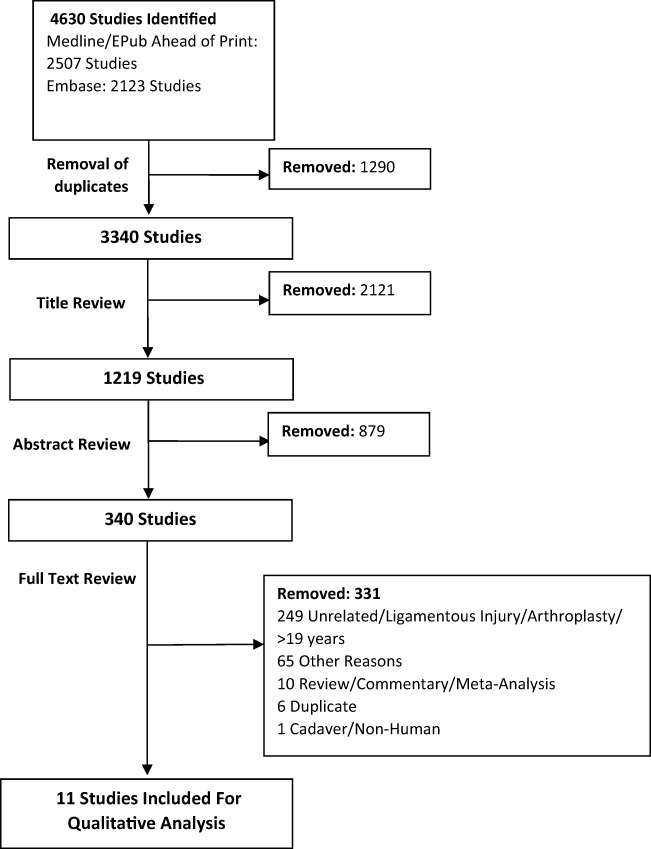
Recent findings: Eleven studies satisfied the inclusion criteria comprising 307 patients with a mean follow-up of 4.6 years (range 1-18.9 years). Study patients were treated with autologous chondrocyte implantation (ACI) (n = 98, mean age 16.0), microfracture (MFx) (n = 36, mean age 15.4), internal fixation (n = 71, mean age 13.1), osteochondral allograft (OCA) transplantation (n = 78, mean age 16.4), and cartillage and excision (n = 24; mean age 14.2). ACI, MFx, OCA transplantation, and internal fixation showed significant improvement in knee functionality scores. The overall complication rate was 10.6% (n = 31). OCA transplantation had the highest complication rate (26.9%; n = 21/78). In summary, our review shows that ACI was the most commonly used technique. Furthermore, ACI, MFx, OCA transplantation, and internal fixation show the most promise in treating the adolescent population due to positive postoperative functional outcomes and low complication rates. However, future studies with large sample sizes, standardized outcome documentation, and long-term follow-up are required to confirm these preliminary results.
Keywords: Adolescent; Cartilage; Knee; OCD; Patella.
Conflict of interest statement
Ryan P. Coughlin, MD FRCSC, Arnav Gupta, MD (Cand.), Olawale A. Sogbein, MD (Cand.), Ajaykumar Shanmugaraj, BHSc, Adrian Z. Kurz, MD, FRCSC, Nicole Simunovic, MSc, Yi-Meng Yen, MD PhD, and Olufemi R. Ayeni, MD PhD FRCSC, declare no conflicts of interest.
References
Publication types
LinkOut - more resources
Full Text Sources
Research Materials
