Association of Slight to Mild Hearing Loss With Behavioral Problems and School Performance in Children
- PMID: 31774492
- PMCID: PMC6902199
- DOI: 10.1001/jamaoto.2019.3585
Association of Slight to Mild Hearing Loss With Behavioral Problems and School Performance in Children
Abstract
Importance: Children with severe hearing loss are known to have more behavioral problems and may perform worse at school than children without. Few large-scale studies of slight to mild hearing loss are available.
Objective: To examine the relevance of slight to mild hearing loss by studying its association with behavioral problems and school performance.
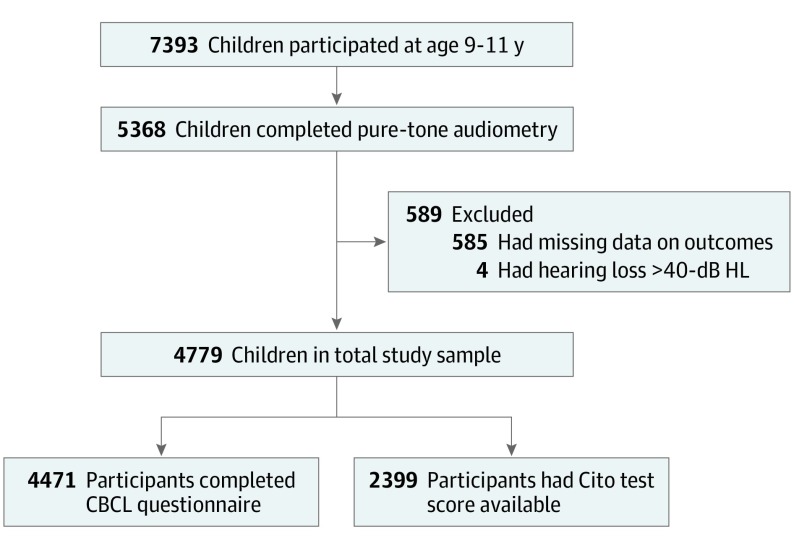
Design, setting, and participants: This cross-sectional study was performed within an ongoing prospective birth cohort study in Rotterdam, the Netherlands. Participants were part of a population-based sample of children. Between ages 9 and 11 years, 5355 children underwent audiometric and behavioral evaluations. Children were excluded if they had missing data for either audiometry or both outcomes. Data were collected from April 2012 through October 2015. Data were analyzed from March to June 2018.
Exposures: Audiometric evaluation included pure-tone audiometry tests and speech-in-noise testing.
Main outcomes and measures: Child behavior was rated by the primary caregiver using the Child Behavior Checklist at ages 9 to 11 years (n = 4471). School performance was measured with a standardized test at age 12 years (n = 2399).
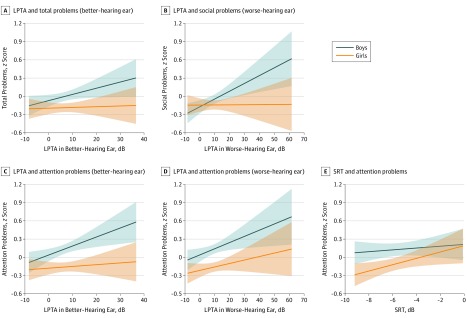
Results: The final sample included 4779 participants who were a mean (SD) age of 9.8 (0.3) years. The sample had nearly equal distribution between boys (n = 2200; 49.2%) and girls (n = 2271; 50.8%). Associations of hearing thresholds with behavioral problems differed between boys and girls. Among boys, higher pure-tone hearing thresholds at low frequencies were associated with higher total problem, social problem, and attention problem scores (total problems for the better-hearing ear: β = 0.01; 95% CI, 0-0.02). Higher speech reception thresholds were associated with higher attention problem scores among girls (β = 0.04; 95% CI, 0-0.08). Higher speech reception thresholds were associated with poorer school performance scores for both boys and girls (β = -0.06; 95% CI, -0.10 to -0.02).
Conclusions and relevance: Higher hearing thresholds during pure-tone audiometric and speech-in-noise testing were associated with higher behavioral problem scores and poorer school performance. This supports the relevance of slight to mild hearing loss with these outcomes in school-aged children.
Conflict of interest statement
Figures
Comment in
References
-
- Clark JG. Uses and abuses of hearing loss classification. ASHA. 1981;23(7):493-500. - PubMed
Publication types
MeSH terms
LinkOut - more resources
Full Text Sources
Medical
Miscellaneous