


Characteristics of E-cigarette, or Vaping, Products Used by Patients with Associated Lung Injury and Products Seized by Law Enforcement - Minnesota, 2018 and 2019
- PMID: 31774740
- PMCID: PMC6881051
- DOI: 10.15585/mmwr.mm6847e1
Characteristics of E-cigarette, or Vaping, Products Used by Patients with Associated Lung Injury and Products Seized by Law Enforcement - Minnesota, 2018 and 2019
Abstract
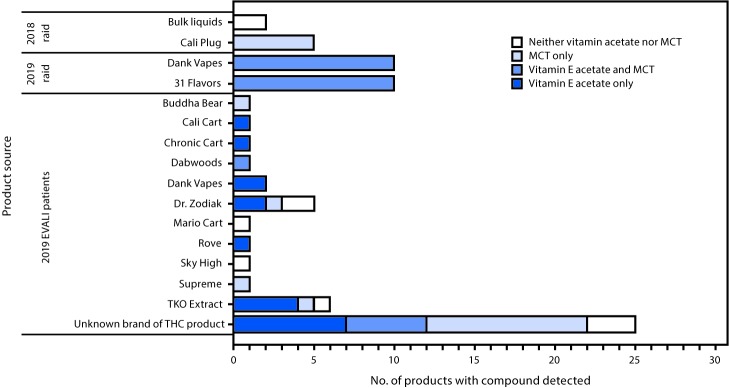
During August 9-October 31, 2019, 96 patients were classified as having e-cigarette, or vaping, product use-associated lung injury (EVALI) by the Minnesota Department of Health (MDH); other patients are being investigated for case classification and exposures. Among 58 patients interviewed, 53 (91%) reported obtaining tetrahydrocannabinol (THC)-containing products from informal sources such as friends, family members, or in-person or online dealers. Using gas chromatography-mass spectrometry (GCMS), the MDH Public Health Laboratory (PHL) analyzed 46 THC-containing e-cigarette, or vaping, products obtained from 12 EVALI patients for various potential toxicants, including vitamin E acetate, which has recently been detected in some THC-containing products and in samples of lung fluid from EVALI patients (1-4). To explore whether vitamin E acetate is a recently added component in THC-containing products, MDH tested ten products seized by law enforcement in 2018, before the EVALI outbreak, and 20 products seized in 2019, during the outbreak. Twenty-four products obtained from 11 EVALI patients from 2019 contained vitamin E acetate. Among the seized products tested by MDH, none seized in 2018 contained vitamin E acetate, although all tested THC-containing products seized in 2019 tested positive for vitamin E acetate. These chemical analyses of products obtained from EVALI patients and of products intended for the illicit market both before and during the outbreak support a potential role for vitamin E acetate in the EVALI outbreak; however, the number of products tested was small, and further research is needed to establish a causal link between exposure to inhaled vitamin E acetate and EVALI. Collaboration between public health jurisdictions and law enforcement to characterize THC-containing products circulating before the recognition of the EVALI outbreak and during the outbreak might provide valuable information about a dynamic market. These Minnesota findings highlight concerns about e-cigarette, or vaping, products that contain THC acquired from informal sources. Because local supply chains and policy environments vary, CDC continues to recommend not using e-cigarette, or vaping, products that contain THC or any e-cigarette, or vaping, products obtained from informal sources. E-cigarette, or vaping, products should never be used by youths, young adults, or pregnant women.* Until the relationship between inhaled vitamin E acetate and lung health is better characterized, vitamin E acetate should not be added to e-cigarette, or vaping, products.
Conflict of interest statement
All authors have completed and submitted the International Committee of Medical Journal Editors form for disclosure of potential conflicts of interest. No potential conflicts of interest were disclosed.
Figures
References
-
- Blount BC, Karwowski MP, Morel-Espinosa M, et al. Evaluation of bronchoalveolar lavage fluid from patients in an outbreak of e-cigarette, or vaping, product use–associated lung injury—10 states, August–October 2019. MMWR Morb Mortal Wkly Rep 2019;68:1040–1. 10.15585/mmwr.mm6845e2 - DOI - PMC - PubMed
-
- Food and Drug Administration. Lung illnesses associated with use of vaping products; information for the public, FDA actions, and recommendation. Silver Spring, MD: US Department of Health and Human Services, Food and Drug Administration; 2019. https://www.fda.gov/news-events/public-health-focus/lung-illnesses-assoc...
-
- Sun L. New York to subpoena firms selling substances linked to illicit vaping products. The Washington Post. September 9, 2019. https://www.washingtonpost.com/health/2019/09/09/new-york-subpoena-firms...
-
- Minnesota CBS. Officials: 75,000 vaping cartridges seized in Anoka County. CBS Minnesota. September 24, 2019. https://minnesota.cbslocal.com/2019/09/24/officials-75000-vaping-cartrid...
MeSH terms
Substances
LinkOut - more resources
Full Text Sources
Medical
