Free flap thrombosis in patients with hypercoagulability: A systematic review
- PMID: 31775211
- PMCID: PMC6882692
- DOI: 10.5999/aps.2019.00738
Free flap thrombosis in patients with hypercoagulability: A systematic review
Abstract
Background: Even with satisfactory anastomosis technique and adequate experience of the surgeon, flap loss due to thrombosis can still occur due to the patient's underlying condition. Patients with hypercoagulability due to etiologies such as malignancy, hereditary conditions, and acquired thrombophilia are among those who could benefit from free flap procedures. This review aimed to evaluate the risk of free flap thrombosis in patients with hypercoagulability and to identify the most effective thromboprophylaxis regimen.
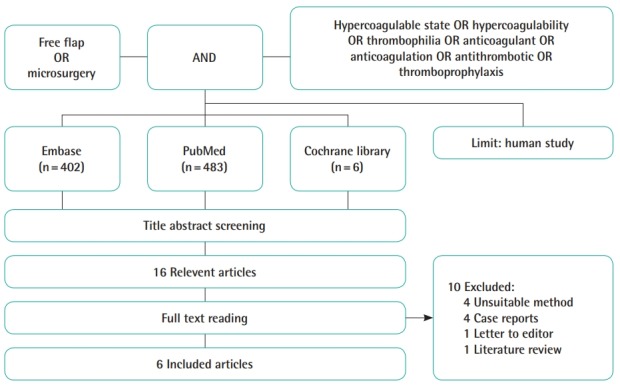
Methods: This review was conducted in accordance with the Preferred Reporting Items for Systematic Reviews and Meta-Analyses guideline. The PubMed, Embase, and Cochrane Library databases were explored. Types of free flaps, types of hypercoagulable states, thrombosis prevention protocols, thrombosis complication rates, and flap vitality outcomes were reviewed. Samples from the included studies were pooled to calculate the relative risk of free flap thrombosis complications in patients with hypercoagulability compared to those without hypercoagulability.
Results: In total, 885 articles underwent title, abstract, and full-text screening. Six articles met the inclusion criteria. The etiologies of hypercoagulability varied. The overall incidence of thrombosis and flap loss in hypercoagulable patients was 13% and 10.3%, respectively. The thrombosis risk was two times higher in hypercoagulable patients (P=0.074) than in controls. Thromboprophylaxis regimens were variable. Heparin was the most commonly used regimen.
Conclusions: Hypercoagulability did not significantly increase the risk of free flap thrombosis. The most effective thromboprophylaxis regimen could not be determined due to variation in the regimens. Further well-designed studies should be conducted to confirm this finding.
Keywords: Free tissue flaps; Thrombophilia; Thrombosis.
Conflict of interest statement
No potential conflict of interest relevant to this article was reported.
Figures

References
-
- Buncke HJ, Jr, Schulz WP. Total ear reimplantation in the rabbit utilizing microminiature vascular anastomoses. Br J Plast Surg. 1966;19:15–22. - PubMed
-
- Khouri RK, Cooley BC, Kunselman AR, et al. A prospective study of microvascular free-flap surgery and outcome. Plast Reconstr Surg. 1998;102:711–21. - PubMed
-
- Baumeister S, Follmar KE, Zenn MR, et al. Strategy for reoperative free flaps after failure of a first flap. Plast Reconstr Surg. 2008;122:962–71. - PubMed
-
- Davison SP, Clemens MW, Kochuba AL. Anatomy of free flap failures: dissection of a series. Mod Plast Surg. 2013;03:89–95.
-
- Srikanthan K, Viswanathan N, Yuen JC. Free-flap failure in thrombophilia: case report and systematic review of the literature. Ann Plast Surg. 2013;71:675–81. - PubMed
LinkOut - more resources
Full Text Sources
Miscellaneous