Review
. 2019 Nov 25;24(23):4286.
doi: 10.3390/molecules24234286.

Anti-Cancer Activity of Porphyran and Carrageenan from Red Seaweeds

Affiliations
Review

Anti-Cancer Activity of Porphyran and Carrageenan from Red Seaweeds

Zhiwei Liu et al. Molecules. .

Abstract

Seaweeds are some of the largest producers of biomass in the marine environment and are rich in bioactive compounds that are often used for human and animal health. Porphyran and carrageenan are natural compounds derived from red seaweeds. The former is a characteristic polysaccharide of Porphyra, while the latter is well known from Chondrus, Gigartina, and various Eucheuma species, all in Rhodophyceae. The two polysaccharides have been found to have anti-cancer activity by improving immunity and targeting key apoptotic molecules and therefore deemed as potential chemotherapeutic or chemopreventive agents. This review attempts to review the current study of anti-cancer activity and the possible mechanisms of porphyran and carrageenan derived from red seaweeds to various cancers, and their cooperative actions with other anti-cancer chemotherapeutic agents is also discussed.

Keywords: anti-cancer; carrageenan; porphyran; seaweed.


Conflict of interest statement

The authors declare no conflicts of interest.

Figures
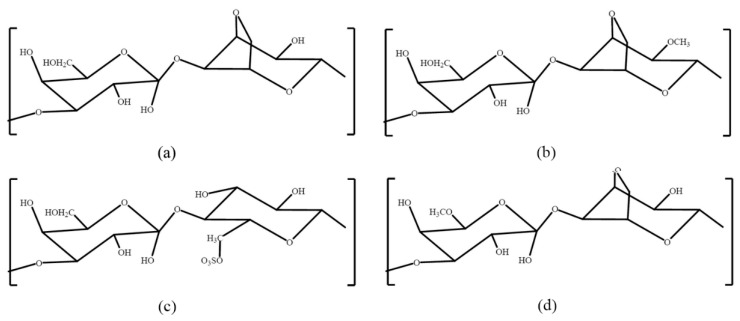
Figure 1
Figure 1
Typical repetitive structures in porphyran [38]: (a) G-A; (b) G-A2M; (c) G-L6S; (d) G6M-A. G: 1,3-linked β-d-galactose; A: 1,4-linked 3,6-anhydro-α-l-galactose; A2M: 1,4-linked 2-O-methyl-3,6-anhydro-α-l-galactose; L6S: 1,4-linked α-l-galactose 6-sulfate; G6M: 1,3-linked 6-O-methyl-β-d-galactose.
Figure 2
Figure 2
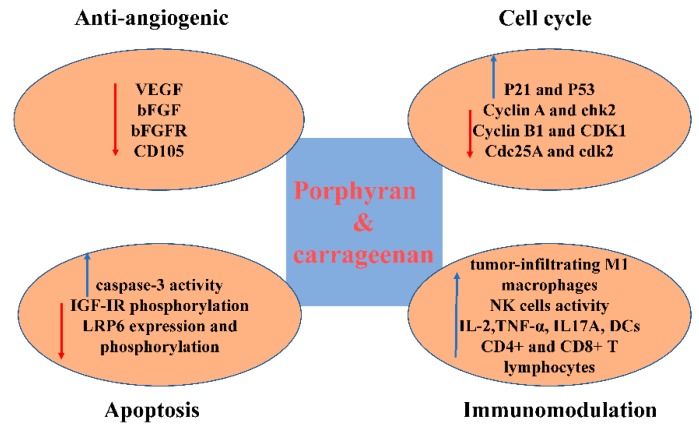
Possible mechanism in the anti-cancer activity of porphyran and carrageenan.
Figure 3
Figure 3
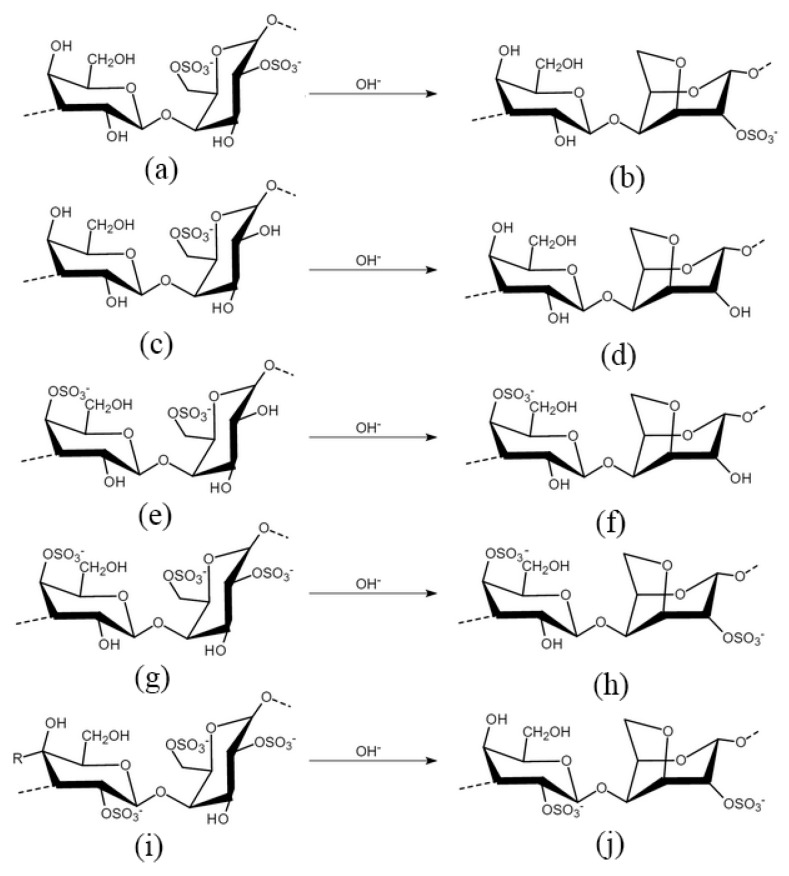
Chemical structure of carrageenans [64]: (a) δ-carrageenan; (b) α-carrageenan; (c) γ-carrageenan; (d) β-carrageenan; (e) μ-carrageenan; (f) κ-carrageenan; (g) ν-carrageenan; (h) ι-carrageenan; (i) λ-carrageenan; and (j) θ-carrageenan.

References

    1. Global Cancer Observatory. [(accessed on 18 November 2019)]; Available online: http://gco.iarc.fr/
    1. Senthilkumar K., Manivasagan P., Venkatesan J., Kim S.-K. Brown seaweed fucoidan: Biological activity and apoptosis, growth signaling mechanism in cancer. Int. J. Biol. Macromol. 2013;60:366–374. doi: 10.1016/j.ijbiomac.2013.06.030. - DOI - PubMed
    1. Atashrazm F., Lowenthal R., Woods G., Holloway A., Dickinson J. Fucoidan and Cancer: A Multifunctional Molecule with Anti-Tumor Potential. Mar. Drugs. 2015;13:2327–2346. doi: 10.3390/md13042327. - DOI - PMC - PubMed
    1. Gutiérrez-Rodríguez A.G., Juárez-Portilla C., Olivares-Bañuelos T., Zepeda R.C. Anticancer activity of seaweeds. Drug Discov. Today. 2018;23:434–447. doi: 10.1016/j.drudis.2017.10.019. - DOI - PubMed
    1. Dotan E., Aggarwal C., Smith M.R. Impact of Rituximab (Rituxan) on the Treatment of B-Cell Non-Hodgkin’s Lymphoma. Pharm. Ther. 2010;35:148–157. - PMC - PubMed

LinkOut - more resources