Review
. 2019 Nov 25;20(23):5919.
doi: 10.3390/ijms20235919.

McArdle Disease: New Insights into Its Underlying Molecular Mechanisms

Affiliations
Review

McArdle Disease: New Insights into Its Underlying Molecular Mechanisms

Francisco Llavero et al. Int J Mol Sci. .

Abstract

McArdle disease, also known as glycogen storage disease type V (GSDV), is characterized by exercise intolerance, the second wind phenomenon, and high serum creatine kinase activity. Here, we recapitulate PYGM mutations in the population responsible for this disease. Traditionally, McArdle disease has been considered a metabolic myopathy caused by the lack of expression of the muscle isoform of the glycogen phosphorylase (PYGM). However, recent findings challenge this view, since it has been shown that PYGM is present in other tissues than the skeletal muscle. We review the latest studies about the molecular mechanism involved in glycogen phosphorylase activity regulation. Further, we summarize the expression and functional significance of PYGM in other tissues than skeletal muscle both in health and McArdle disease. Furthermore, we examine the different animal models that have served as the knowledge base for better understanding of McArdle disease. Finally, we give an overview of the latest state-of-the-art clinical trials currently being carried out and present an updated view of the current therapies.

Keywords: McArdle disease; O-glycosylation; glycogen phosphorylase; glycogen storage disease type V; hexosamine biosynthetic pathway; small GTPases.


Conflict of interest statement

The authors declare that they have no conflicts of interest with the contents of this article. All authors qualify for authorship, approved the final version of the manuscript and agree to be accountable for all aspects of the work in ensuring that questions related to the accuracy or integrity of any part of the work are appropriately investigated and resolved.

Figures

Figure 1
Figure 1
The muscle phosphorylase isoform (PYGM) sequence presents the following information: Serine 15; A, allosteric region; AMP, adenosine monophosphate (AMP) interaction site; RBD-PYGM, Region binding domain of PYGM to Rac1-GTP that exhibits significant homology with the Rac binding domain of PAK1 (serine/threonine p21-activated kinase); RG, glycogen reserve region; CAT, catalytic region; Nt, amino terminal; Ct, carboxyl terminal.
Figure 2
Figure 2
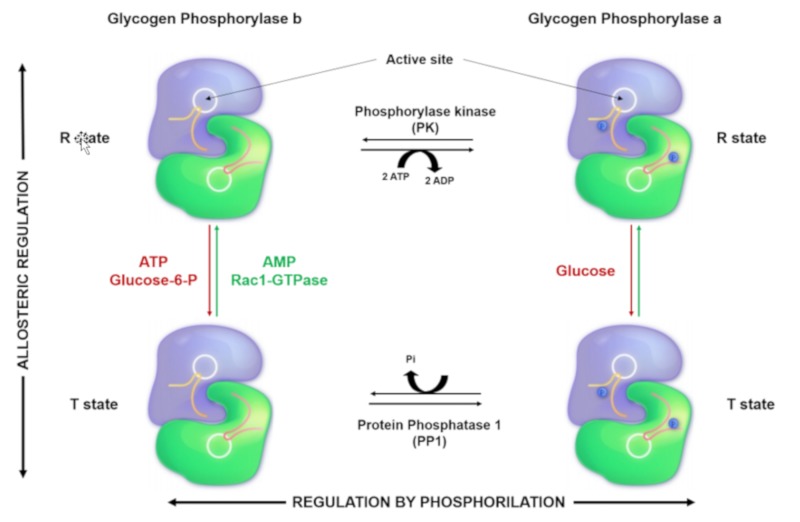
PYGM regulation: Glycogen phosphorylase (PYGM) is regulated both by phosphorylation (X axis) and by allosteric mechanisms (Y axis). The phosphorylation of Serine 15 (S15) of the amino terminal induces the change in the PYG homodimer in its inactive form (b) to its active form (a). Both forms are in a balance between the tense state (T) and the relaxed state (R). Although the equilibrium favors the T state of the b form and the R state of a form, the molecules responsible for allosteric activation of PYG b are adenosine monophosphate (AMP) and GTPase Rac1 (Rac1GTPase), which bind to their respective allosteric regions. The union of AMP or the phosphorylation of the S15 induces a conformational change, freeing the entrance to the catalytic region, which is hindered in the state tense. The enzyme responsible for phosphorylating S15 of PYG is phosphorylase kinase (PK), and protein phosphatase 1 (PP1) is responsible for dephosphorylating it. (Adapted from Bardford and Johnson 1989, Nature; Johnson 1992, Protein Science).
Figure 3
Figure 3
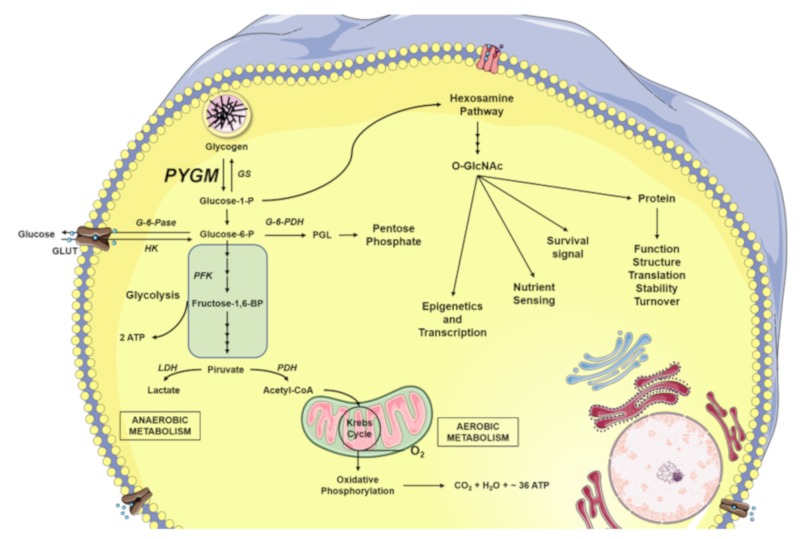
Glucose metabolism. Both glucose-1-phosphate (G1P) released from the intracellular glycogen stores by glycogen phosphorylase (GP), as well as the glucose introduced into the cell are converted to glucose-6-phosphate (G6P) by phosphoglucomutase (PGM) and hexokinase (HK), respectively. The G6P can be directed to different destinations. One of them is the pentose phosphate pathway for the formation of nucleic acids, which is directed by the G-6-P dehydrogenase (G-6-PDH), forming the first product of 6-phosphoglucose δ-lactone (PGL). Another destination can be glycolysis, in which the phosphofructokinase (PFK) plays a primordial role, producing fructose 1,6-bisphosphate (F-1,6-BP); the glycolytic reactions will culminate in the production of pyruvate and adenosine triphosphate (ATP). Pyruvate can be fermented in lactate by the catalysis of the lactate dehydrogenase (LDH), as happens during anaerobic muscle exercise. On the other hand, pyruvate can be used to obtain ATP through oxidation. The first enzyme that participates in this chain of reactions is the pyruvate dehydrogenase (PDH), which produces Acetyl CoA, a substrate of the Krebs cycle, which together with oxidative phosphorylation produces molecules of ATP, carbon dioxide (CO2), and water (H2O). Glucose, moreover, in addition to being the fuel of the cell’s energy metabolism, is also used by the cellular machinery as a vitally important substrate for the production of key intermediaries of the hexosamine biosynthetic pathway (HBP). GS, glycogen synthase; O-GlcNAc, β-linked N-acetylglucosamine; GLUT, Glucose transporters.
Figure 4
Figure 4
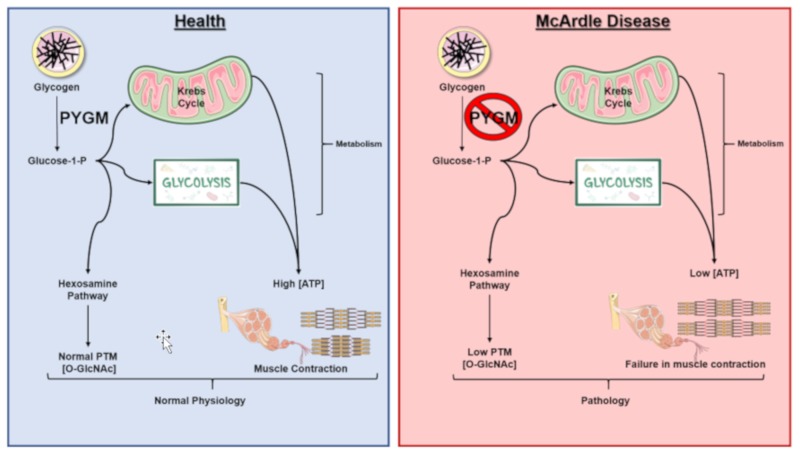
McArdle disease Scheme. McArdle disease, also referred to as myophosphorylase deficiency or type V glycogen storage disease, is a recessive inherited disorder characterized by an inability to metabolize glycogen due to the absence of a functional myophosphorylase (PYGM). Patients lack sufficient glucose-1-phosphate (G1P) monomers needed for glycolysis and the hexosamine biosynthetic pathway (HBP). This results in lower ATP and, consequently, lower muscle contraction, as well as in lower post-translational modifications by O-GlcNAcylation in comparison to normal conditions. PTM: post-translational modification; O-GlcNAc, β-linked N-acetylglucosamine.

References

    1. Lebo R.V., Anderson L.A., DiMauro S., Lynch E., Hwang P., Fletterick R. Rare McArdle disease locus polymorphic site on 11q13 contains CpG sequence. Hum. Genet. 1990;86:17–24. doi: 10.1007/BF00205166. - DOI - PubMed
    1. McArdle B. Myopathy due to a defect in muscle glycogen breakdown. Clin. Sci. 1951;10:13–35. - PubMed
    1. Mellick R.S., Mahler R.F., Hughes B.P. McArdle’s syndrome: Phosphorylase-deficient myopathy. Lancet. 1962;1:1045–1048. doi: 10.1016/S0140-6736(62)92145-1. - DOI - PubMed
    1. De Castro M., Johnston J., Biesecker L. Determining the prevalence of McArdle disease from gene frequency by analysis of next-generation sequencing data. Genet. Med. 2015;17:1002–1006. doi: 10.1038/gim.2015.9. - DOI - PMC - PubMed
    1. Santalla A., Nogales-Gadea G., Encinar A.B., Vieitez I., González-Quintana A., Serrano-Lorenzo P. Genotypic and phenotypic features of all Spanish patients with McArdle disease: A 2016 update. BMC Genom. 2017;18(Suppl. S8):819. doi: 10.1186/s12864-017-4188-2. - DOI - PMC - PubMed

MeSH terms

Substances

LinkOut - more resources