


A comparison of clinical paediatric guidelines for hypotension with population-based lower centiles: a systematic review
- PMID: 31775858
- PMCID: PMC6882047
- DOI: 10.1186/s13054-019-2653-9
A comparison of clinical paediatric guidelines for hypotension with population-based lower centiles: a systematic review
Abstract
Background: Different definitions exist for hypotension in children. In this study, we aim to identify evidence-based reference values for low blood pressure and to compare these with existing definitions for systolic hypotension.
Methods: We searched online databases until February 2019 (including MEDLINE, EMBASE, Web of Science) using a comprehensive search strategy to identify studies that defined age-related centiles (first to fifth centile) for non-invasive systolic blood pressure in healthy children < 18 years. Existing cut-offs for hypotension were identified in international guidelines and textbooks. The age-related centiles and clinical cut-offs were compared and visualized using step charts.
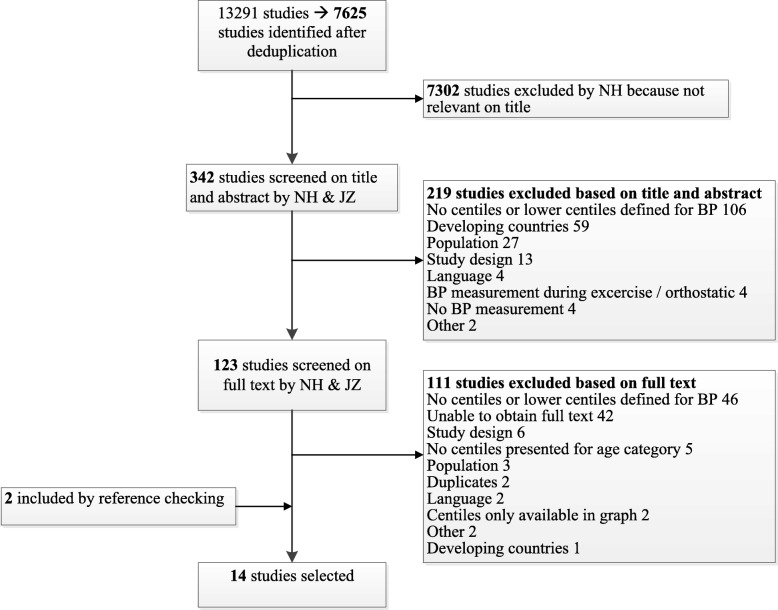
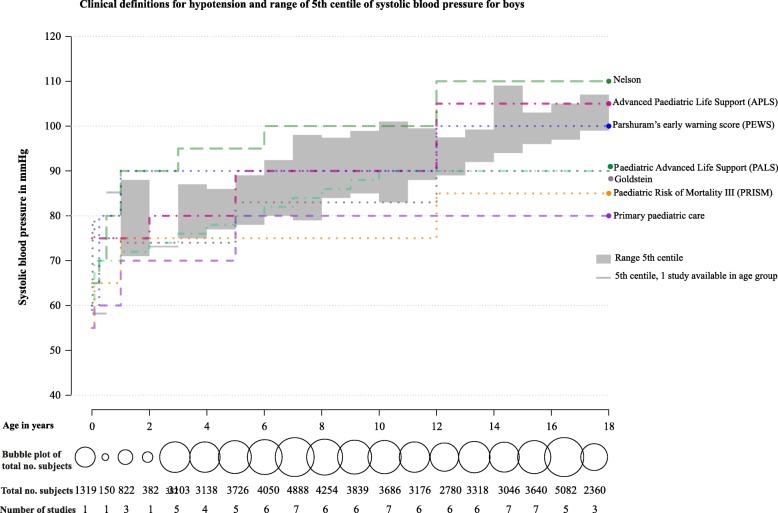
Results: Fourteen studies with population-based centiles were selected, of which 2 addressed children < 1 year. Values for the fifth centile differed 8 to 17 mmHg for age. We identified 13 clinical cut-offs of which only 5 reported accurate references. Age-related cut-offs for hypotension showed large variability (ranging from 15 to 30 mmHg). The clinical cut-offs varied in agreement with the low centiles. The definition from Paediatric Advanced Life Support agreed well for children < 12 years but was below the fifth centiles for children > 12 years. For children > 12 years, the definition of Parshuram's early warning score agreed well, but the Advanced Paediatric Life Support definition was above the fifth centiles.
Conclusions: The different clinical guidelines for low blood pressure show large variability and low to moderate agreement with population-based lower centiles. For children < 12 years, the Paediatric Advanced Life Support definition fits best but it underestimates hypotension in older children. For children > 12 years, the Advanced Paediatric Life Support overestimates hypotension but Parshuram's cut-off for hypotension in the early warning score agrees well. Future studies should focus on developing reference values for hypotension for acutely ill children.
Keywords: Hypotension; Percentiles; Reference values; Vital signs.
Conflict of interest statement
The authors declare that they have no competing interests.
Figures
References
-
- Dellinger RP, Levy MM, Rhodes A, Annane D, Gerlach H, Opal SM, Sevransky JE, Sprung CL, Douglas IS, Jaeschke R, et al. Surviving sepsis campaign: international guidelines for management of severe sepsis and septic shock: 2012. Crit Care Med. 2013;41(2):580–637. - PubMed
-
- Suttipongkaset P, Chaikittisilpa N, Vavilala MS, Lele AV, Watanitanon A, Chandee T, Krishnamoorthy V. Blood pressure thresholds and mortality in pediatric traumatic brain injury. Pediatrics. 2018;142(2). - PubMed
-
- Haque IU, Zaritsky AL. Analysis of the evidence for the lower limit of systolic and mean arterial pressure in children. Pediatr Crit Care Med. 2007;8(2):138–144. - PubMed
-
- Marlais M, Lyttle MD, Inwald D. Ten concerns about blood pressure measurement and targets in paediatric sepsis. Intensive Care Med. 2017;43(3):433–435. - PubMed
Publication types
MeSH terms
LinkOut - more resources
Full Text Sources
Medical
