


Factors associated with child survival in children admitted to outpatient therapeutic program at public health institutions in Afar Regional State, Ethiopia: a prospective cohort study
- PMID: 31775913
- PMCID: PMC6882177
- DOI: 10.1186/s41043-019-0193-1
Factors associated with child survival in children admitted to outpatient therapeutic program at public health institutions in Afar Regional State, Ethiopia: a prospective cohort study
Abstract
Introduction: About 20 million children suffer from severe acute malnutrition each year. The World Health Organization recommends the outpatient therapeutic program as a standard treatment protocol for the management of uncomplicated severe acute malnutrition and for children who are transferred from inpatient cares after recovery. This study aimed to assess the treatment outcome of severe acute malnutrition and determinants of survival in children admitted to outpatient therapeutic program at public health institutions, Afar Regional State.
Methods: Institution-based prospective cohort study was conducted on 286 children aged 6-59 months admitted to the outpatient therapeutic program, from April to September 2017, at selected public health institutions in Afar Regional State. For the comparison of time to recovery among the different groups of children on the outpatient therapeutic program, Kaplan-Meir curve was used and significance test for these differences was assessed by the log-rank test. Then, a proportional hazard in the Cox model was used to identify independent predictors of survival. p value < 0.05 was considered significant.
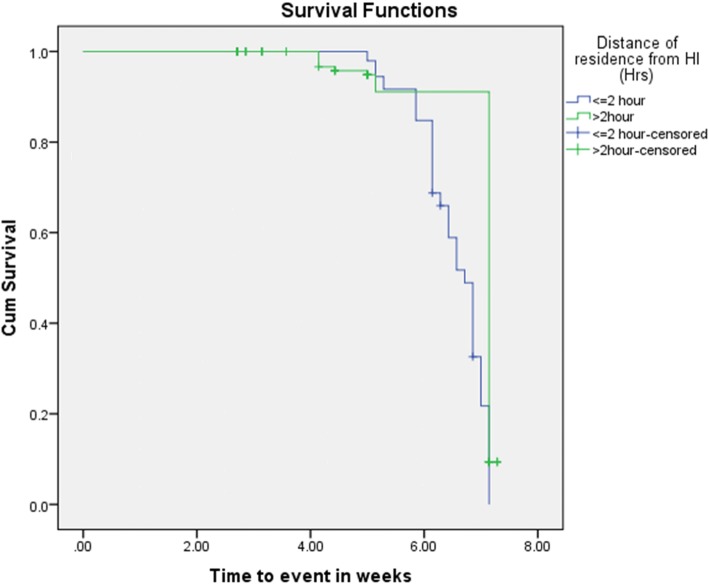
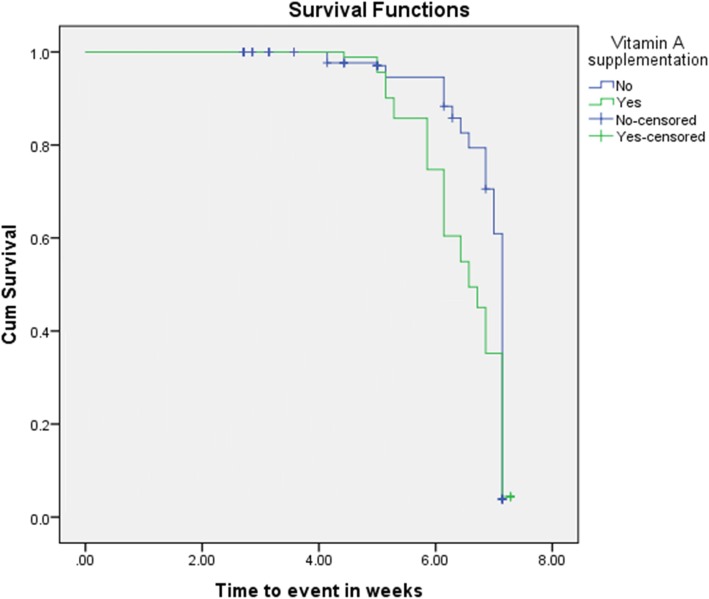
Results: Of 286 children, 238 (83.2%; 95% CI (79, 88)), 18 (6.3%), 14 (4.9%), 8 (2.8%), and 8 (2.8%) cases were cured, defaulters, non-responder, died, and transfer to inpatient care, respectively. The overall mean rate of weight gain was 10.5(± 3.45) g/kg/day, and mean length of stay was 44.15(± 8.77) days. The recovery rate of children whose mothers travel less than 2 h to the health institution was about three times (AHR, 2.91; 95% CI (2.18, 3.88)) higher than children whose mothers travel 2 h and above. Compared with children who received vitamin A supplementation, children who lack supplementation were less likely (AHR, 0.39; 95% CI (0.25, 0.59)) to be cured. Moreover, the rate of recovery from outpatient therapeutic program among children who received antibiotics was about 1.4 times (AHR, 1.38; 95% CI (1.01, 1.89)) higher compared with children who did not receive of antibiotics.
Conclusion: This study showed that nearly eight children in every ten had recovered from severe acute malnutrition. Therefore, considering the distance of health facility from children's residence, improving vitamin A supplementation and antibiotics are vital in improving the rate of recovery. Further research is also required to identify and address barriers to the provision of antibiotics and vitamin A supplementation.
Keywords: Afar; Cohort; Ethiopia; Outpatient therapeutic; Prospective.
Conflict of interest statement
The authors declare that they have no competing interests.
Figures
References
-
- Sphere Association. The Sphere Handbook: Humanitarian Charter and minimum standards in humanitarian response, fourth edition, Geneva, Switzerland, 2018. Available at https://spherestandards.org/wp-content/uploads/Sphere-Handbook-2018-EN.pdf
-
- Akparibo, R., Lee, A.C.K. and Booth, A. Recovery, relapse and episodes of default in the management of acute malnutrition in children in humanitarian emergencies: A systematic review. Humanitarian Evidence Programme. Oxford: Oxfam GB 2017. Available at https://fic.tufts.edu/assets/Acute-Malnutrition-Systematic-Review.pdf
-
- United Nations Children’s Fund (UNICEF), World Health Organization, International Bank for Reconstruction and Development/The World Bank. Levels and trends in child malnutrition: key findings of the 2019 Edition of the Joint Child Malnutrition Estimates. Geneva: World Health Organization; 2019
-
- Meyer R, Marino L. Identifying acute malnutrition–do we have an answer for policy makers? BMC Nutrition. 2016;2:20. doi: 10.1186/s40795-016-0060-z. - DOI
-
- Black R, Allen LH, Bhutta ZA, Caulfield LE, De Onis M, Ezzati M, Mathers C, Rivera J. Maternal and child under nutrition: Global and regional exposures and health consequences. The Lancet. 2008. - PubMed
Publication types
MeSH terms
Substances
LinkOut - more resources
Full Text Sources
Medical
Miscellaneous
