


High Agreement Between an Ultrasensitive Clostridioides difficile Toxin Assay and a C. difficile Laboratory Algorithm Utilizing GDH-and-Toxin Enzyme Immunoassays and Cytotoxin Testing
- PMID: 31776192
- PMCID: PMC6989068
- DOI: 10.1128/JCM.01629-19
High Agreement Between an Ultrasensitive Clostridioides difficile Toxin Assay and a C. difficile Laboratory Algorithm Utilizing GDH-and-Toxin Enzyme Immunoassays and Cytotoxin Testing
Abstract
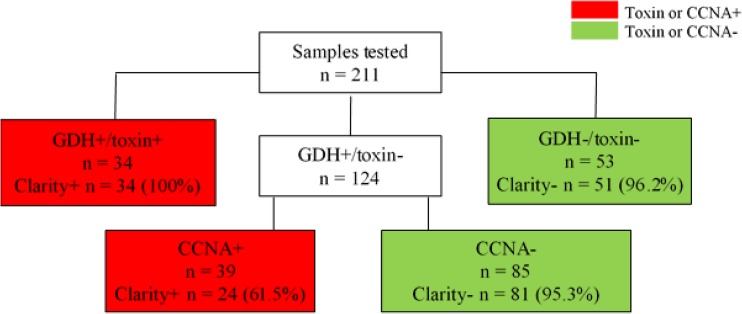
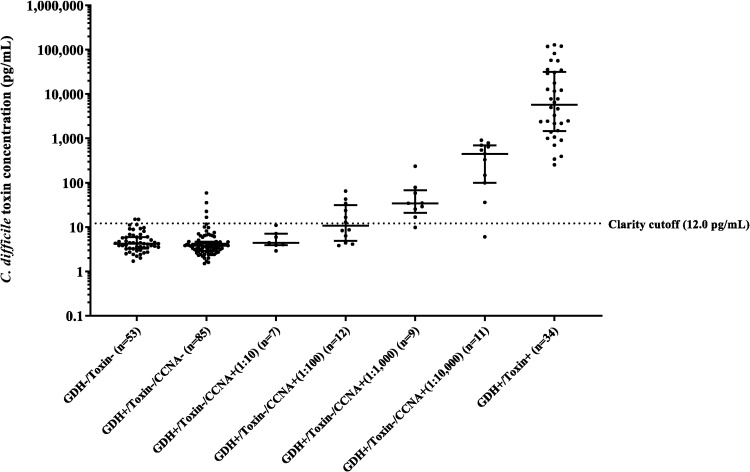
The Singulex Clarity C. diff toxins A/B (Clarity) assay is an automated, ultrasensitive immunoassay for the detection of Clostridioides difficile toxins in stool. In this study, the performance of the Clarity assay was compared to that of a multistep algorithm using an enzyme immunoassay (EIA) for detection of glutamate dehydrogenase (GDH) and toxins A and B arbitrated by a semiquantitative cell cytotoxicity neutralization assay (CCNA). The performance of the assay was evaluated using 211 residual deidentified stool samples tested with a GDH-and-toxin EIA (C. Diff Quik Chek Complete; Techlab), with GDH-and-toxin discordant samples tested with CCNA. The stool samples were stored at -80°C before being tested with the Clarity assay. For samples discordant between Clarity and the standard-of-care algorithm, the samples were tested with PCR (Xpert C. difficile; Cepheid), and chart review was performed. The testing algorithm resulted in 34 GDH+/toxin+, 53 GDH-/toxin-, and 124 GDH+/toxin- samples, of which 39 were CCNA+ and 85 were CCNA- Clarity had 96.2% negative agreement with GDH-/toxin- samples, 100% positive agreement with GDH+/toxin+ samples, and 95.3% agreement with GDH+/toxin-/CCNA- samples. The Clarity result was invalid for one sample. Clarity agreed with 61.5% of GDH+/toxin-/CCNA+ samples, 90.0% of GDH+/toxin-/CCNA+ (high-positive) samples, and 31.6% of GDH+/toxin-/CCNA+ (low-positive) samples. The Singulex Clarity C. diff toxins A/B assay demonstrated high agreement with a testing algorithm utilizing a GDH-and-toxin EIA and CCNA. This novel automated assay may offer an accurate, stand-alone solution for C. difficile infection (CDI) diagnostics, and further prospective clinical studies are merited.
Keywords: C. difficile; C. difficile EIA; C. difficile PCR; CDI; cytotoxin; single-molecule counting; toxin; ultrasensitive.
Copyright © 2020 American Society for Microbiology.
Figures
References
-
- Hall I, O’Toole E. 1935. Intestinal flora in newborn infants, with description of a new pathogenic anaerobe Bacillus difficilis. Am J Dis Child 49:390–402. doi: 10.1001/archpedi.1935.01970020105010. - DOI
-
- Lessa FC, Mu Y, Bamberg WM, Beldavs ZG, Dumyati GK, Dunn JR, Farley MM, Holzbauer SM, Meek JI, Phipps EC, Wilson LE, Winston LG, Cohen JA, Limbago BM, Fridkin SK, Gerding DN, McDonald LC. 2015. Burden of Clostridium difficile infection in the United States. N Engl J Med 372:825–834. doi: 10.1056/NEJMoa1408913. - DOI - PMC - PubMed
-
- Davies KA, Ashwin H, Longshaw CM, Burns DA, Davis GL, Wilcox MH, EUCLID study group. 2016. Diversity of Clostridium difficile PCR ribotypes in Europe: results from the European, multicentre, prospective, biannual, point-prevalence study of Clostridium difficile infection in hospitalised patients with diarrhoea (EUCLID), 2012 and 2013. Euro Surveill 21:30294. doi: 10.2807/1560-7917.ES.2016.21.29.30294. - DOI - PubMed
Publication types
MeSH terms
Substances
Grants and funding
LinkOut - more resources
Full Text Sources
