


Green spaces and mortality: a systematic review and meta-analysis of cohort studies
- PMID: 31777338
- PMCID: PMC6873641
- DOI: 10.1016/S2542-5196(19)30215-3
Green spaces and mortality: a systematic review and meta-analysis of cohort studies
Erratum in
-
Correction to Lancet Planet Health 2019; 3: e469-77.Lancet Planet Health. 2021 Aug;5(8):e504. doi: 10.1016/S2542-5196(21)00208-4. Lancet Planet Health. 2021. PMID: 34390667 Free PMC article. No abstract available.
Abstract
Background: Green spaces have been proposed to be a health determinant, improving health and wellbeing through different mechanisms. We aimed to systematically review the epidemiological evidence from longitudinal studies that have investigated green spaces and their association with all-cause mortality. We aimed to evaluate this evidence with a meta-analysis, to determine exposure-response functions for future quantitative health impact assessments.
Methods: We did a systematic review and meta-analysis of cohort studies on green spaces and all-cause mortality. We searched for studies published and indexed in MEDLINE before Aug 20, 2019, which we complemented with an additional search of cited literature. We included studies if their design was longitudinal; the exposure of interest was measured green space; the endpoint of interest was all-cause mortality; they provided a risk estimate (ie, a hazard ratio [HR]) and the corresponding 95% CI for the association between green space exposure and all-cause mortality; and they used normalised difference vegetation index (NDVI) as their green space exposure definition. Two investigators (DR-R and DP-L) independently screened the full-text articles for inclusion. We used a random-effects model to obtain pooled HRs. This study is registered with PROSPERO, CRD42018090315.
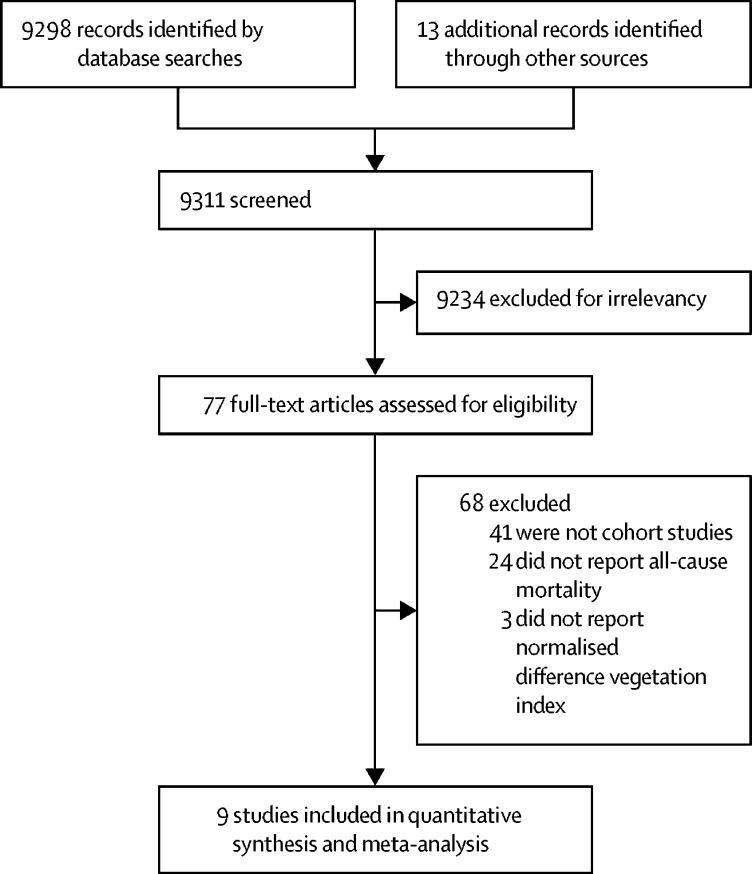
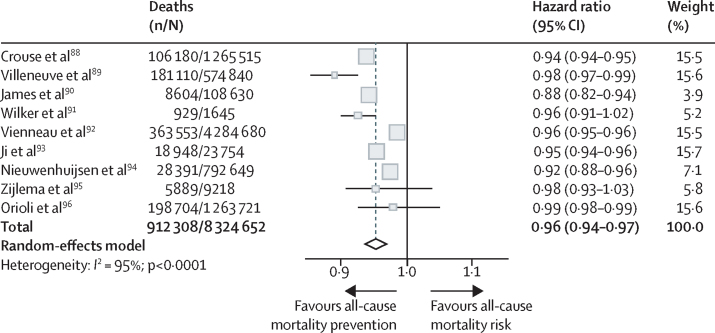
Findings: We identified 9298 studies in MEDLINE and 13 studies that were reported in the literature but not indexed in MEDLINE, of which 9234 (99%) studies were excluded after screening the titles and abstracts and 68 (88%) of 77 remaining studies were excluded after assessment of the full texts. We included nine (12%) studies in our quantitative evaluation, which comprised 8 324 652 individuals from seven countries. Seven (78%) of the nine studies found a significant inverse relationship between an increase in surrounding greenness per 0·1 NDVI in a buffer zone of 500 m or less and the risk of all-cause mortality, but two studies found no association. The pooled HR for all-cause mortality per increment of 0·1 NDVI within a buffer of 500 m or less of a participant's residence was 0·96 (95% CI 0·94-0·97; I2, 95%).
Interpretation: We found evidence of an inverse association between surrounding greenness and all-cause mortality. Interventions to increase and manage green spaces should therefore be considered as a strategic public health intervention.
Funding: World Health Organization.
© 2019 World Health Organization; licensee Elsevier. This is an Open Access article published under the CC BY 3·0 IGO license which permits unrestricted use, distribution, and reproduction in any medium, provided the original work is properly cited. In any use of this article, there should be no suggestion that WHO endorses any specific organisation, products or services. The use of the WHO logo is not permitted. This notice should be preserved along with the article's original URL.
Figures
Comment in
-
Green space, health, and wellbeing: considerations for South Asia.Lancet Planet Health. 2020 Apr;4(4):e135-e136. doi: 10.1016/S2542-5196(20)30056-5. Lancet Planet Health. 2020. PMID: 32353290 No abstract available.
-
Health impact assessment of Philadelphia's 2025 tree canopy cover goals.Lancet Planet Health. 2020 Apr;4(4):e149-e157. doi: 10.1016/S2542-5196(20)30058-9. Lancet Planet Health. 2020. PMID: 32353295
-
Exposure to green spaces and all-cause mortality: limitations in measurement and definitions of exposure.Lancet Planet Health. 2021 Aug;5(8):e501. doi: 10.1016/S2542-5196(21)00180-7. Lancet Planet Health. 2021. PMID: 34390663 No abstract available.
-
Exposure to green spaces and all-cause mortality: limitations in measurement and definitions of exposure - Authors' reply.Lancet Planet Health. 2021 Aug;5(8):e502. doi: 10.1016/S2542-5196(21)00178-9. Lancet Planet Health. 2021. PMID: 34390664 Free PMC article. No abstract available.
References
-
- UN-Habitat Urbanization and development: emerging futures. 2016. https://www.sdgfund.org/world-cities-report-2016-urbanization-and-develo...
-
- Nieuwenhuijsen MJ, Khreis H, Verlinghieri E, Mueller N, Rojas-Rueda D. Participatory quantitative health impact assessment of urban and transport planning in cities: a review and research needs. Environ Int. 2017;103:61–72. - PubMed
-
- Gascon M, Triguero-Mas M, Martínez D. Residential green spaces and mortality: a systematic review. Environ Int. 2016;86:60–67. - PubMed
Publication types
MeSH terms
Grants and funding
LinkOut - more resources
Full Text Sources
