


Meta-analysis of the association between aldose reductase gene (CA)n microsatellite variants and risk of diabetic retinopathy
- PMID: 31777552
- PMCID: PMC6862190
- DOI: 10.3892/etm.2019.8086
Meta-analysis of the association between aldose reductase gene (CA)n microsatellite variants and risk of diabetic retinopathy
Abstract
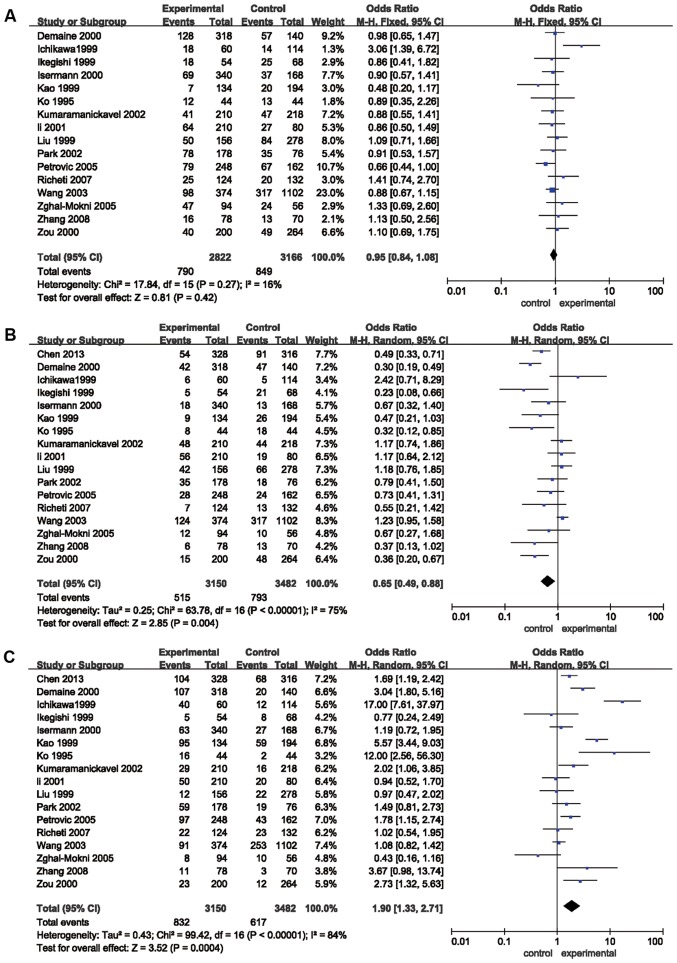
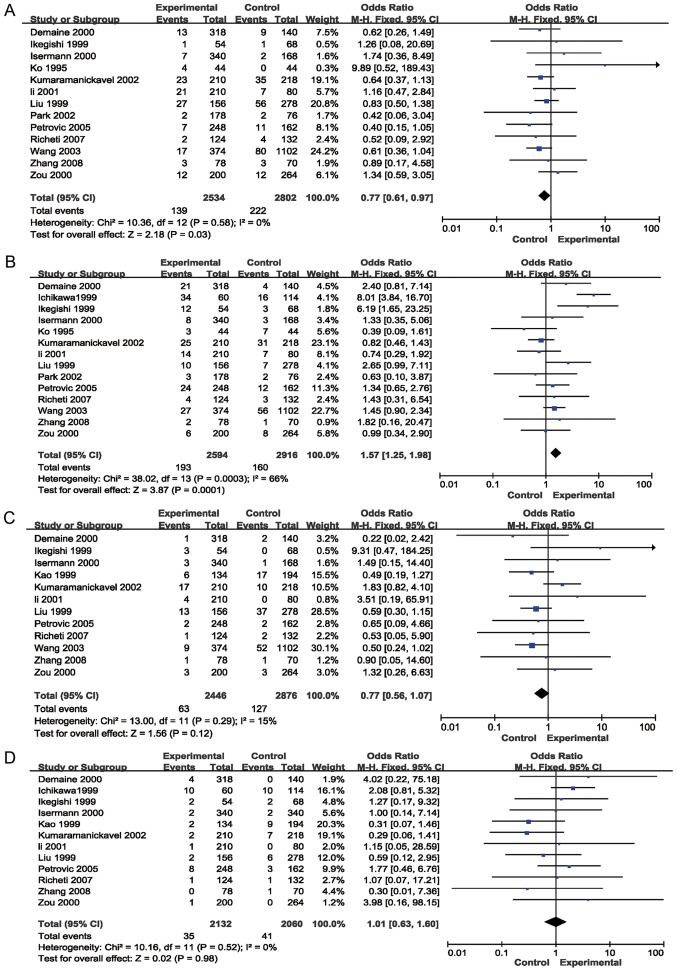
Diabetic retinopathy (DR) is one of the most severe microvascular complications of diabetes mellitus (DM). The (CA)n microsatellite variation of the aldose reductase (ALR) gene has been indicated to be associated with DR in previous studies; however, the results were inconclusive. To provide a more precise evaluation of the association between the (CA)n variations of ALR and the risk for DR, a meta-analysis was performed in the present study. Relevant articles were retrieved from the PubMed, Embase, Chinese National Knowledge Infrastructure and Cochrane Library databases. Pooled odds ratios (ORs) and 95% confidence intervals (CIs) were used to evaluate the strength of the associations. The present meta-analysis included 17 studies comprising 1,575 DM patients with retinopathy and 1,741 DM patients without retinopathy. The results indicated that the Z-2 allele was a risk factor for DR in Asian (OR=1.82, 95% CI: 1.16-2.86, P=0.009) and Caucasian (OR=2.08, 95% CI: 1.14-3.79, P=0.02) populations, as well as in type 1 diabetes (T1D; OR=3.42, 95% CI: 1.46-8.04, P=0.005) and type 2 diabetes (T2D; OR=1.66, 95% CI: 1.05-2.63, P=0.03). Furthermore, the Z+2 allele was determined to be a protective factor for DR in Caucasian individuals (OR=0.50, 95% CI: 0.34-0.73, P=0.0004) and those with T1D (OR=0.39, 95% CI: 0.27-0.57, P<0.00001). Z+4 was also identified to be a protective factor, reducing the risk of DR in patients with T1D (OR=0.74, 95% CI: 0.57-0.96, P=0.02). Z-4 was revealed to be a risk factor for DR in Asian populations (OR=1.57, 95% CI: 1.22-2.03, P=0.0005) and in individuals with T1D (OR=1.62, 95% CI: 1.27-2.08, P=0.0001). However, no association was detected between the Z, Z+6 and Z-6 alleles and the risk of DR (P>0.05). In conclusion, the present results revealed the following: Z+2 may serve as a protective factor for DR in Caucasian individuals and those with T1D; Z+4 may be a protective factor for DR in patients with T2D; Z-2 may represent a risk factor for DR in all subgroups analyzed; and Z-4 may be a risk factor for DR in Asian populations and patients with T2D.
Keywords: aldose reductase; diabetic retinopathy; meta-analysis; variation.
Copyright © 2019, Spandidos Publications.
Figures



References
LinkOut - more resources
Full Text Sources
Miscellaneous