. 2020 Jan 8;48(D1):D265-D268.
doi: 10.1093/nar/gkz991.

CDD/SPARCLE: the conserved domain database in 2020

Affiliations

CDD/SPARCLE: the conserved domain database in 2020

Shennan Lu et al. Nucleic Acids Res. .

Abstract

As NLM's Conserved Domain Database (CDD) enters its 20th year of operations as a publicly available resource, CDD curation staff continues to develop hierarchical classifications of widely distributed protein domain families, and to record conserved sites associated with molecular function, so that they can be mapped onto user queries in support of hypothesis-driven biomolecular research. CDD offers both an archive of pre-computed domain annotations as well as live search services for both single protein or nucleotide queries and larger sets of protein query sequences. CDD staff has continued to characterize protein families via conserved domain architectures and has built up a significant corpus of curated domain architectures in support of naming bacterial proteins in RefSeq. These architecture definitions are available via SPARCLE, the Subfamily Protein Architecture Labeling Engine. CDD can be accessed at https://www.ncbi.nlm.nih.gov/Structure/cdd/cdd.shtml.


Figures

Figure 1.
Figure 1.
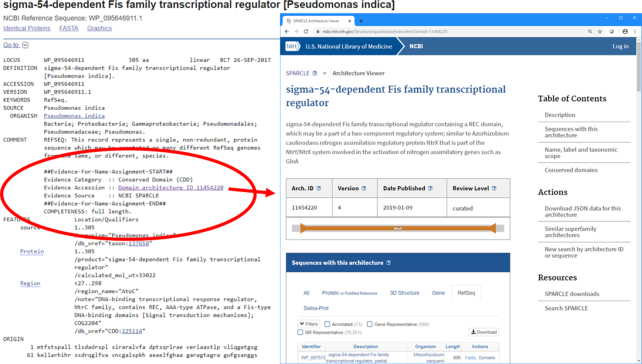
‘flatfile’ (GenPept format) view of a bacterial protein from the RefSeq collection. Bacterial of proteins with the accession prefix ‘WP’ are now being equipped with evidence for the name assignment (highlighted with a red oval). Evidence accessions are hot-linked to provide more information about the specific annotation rule, in this case a conserved domain architecture curated in SPARCLE. Other evidence types with hotlinks to an annotation rule viewer are Hidden Markov Models (HMMs) and BLAST rules, which have higher precedence than domain architectures and will overrule the name suggested by SPARCLE.

References

    1. El-Gebali S., Mistry J., Bateman A., Eddy S.R., Luciani A., Potter S.C., Qureshi M., Richardson L.J., Salazar G.A., Smart A. et al. .. The Pfam protein families database in 2019. Nucleic Acids Res. 2019; 47:D427–D432. - PMC - PubMed
    1. Letunic I., Bork P.. 20 years of the SMART protein domain annotation resource. Nucleic Acids Res. 2018; 46:D493–D496. - PMC - PubMed
    1. Tatusov R.L., Natale D.A., Garkavtsev I.V., Tatusova T.A., Shankavaram U.T., Rao B.S., Kiryutin B., Galperin M.Y., Fedorova N.D., Koonin E.V.. The COG database: new developments in phylogenetic classification of proteins from complete genomes. Nucleic Acids Res. 2001; 29:22–28. - PMC - PubMed
    1. Haft D.H., Selengut J.D., Richter A.R., Harkins D., Basu M.K., Beck E.. TIGRFAMs and genome properties in 2013. Nucleic Acids Res. 2013; 41:D387–D395. - PMC - PubMed
    1. Klimke W., Agarwala R., Badretdin A., Chetvernin S., Ciufo S., Fedorov B., Kiryutin B., O’Neill K., Resch W., Resenchuk S. et al. .. The National center for biotechnology information's protein clusters database. Nucleic Acids Res. 2009; 37:D216–D223. - PMC - PubMed

Publication types