


Competitive numerical analysis for stochastic HIV/AIDS epidemic model in a two-sex population
- PMID: 31778127
- PMCID: PMC8687341
- DOI: 10.1049/iet-syb.2019.0051
Competitive numerical analysis for stochastic HIV/AIDS epidemic model in a two-sex population
Abstract
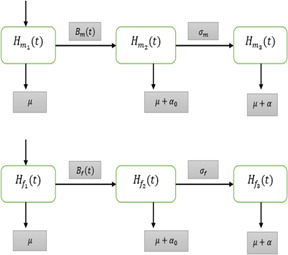
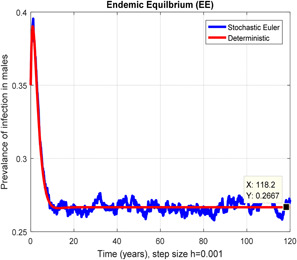
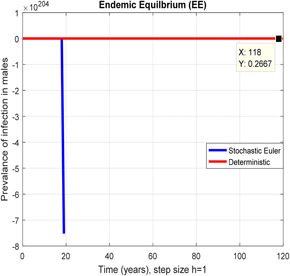
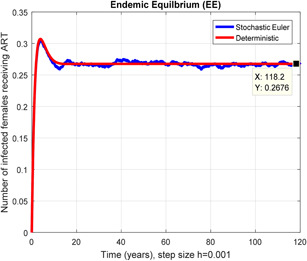
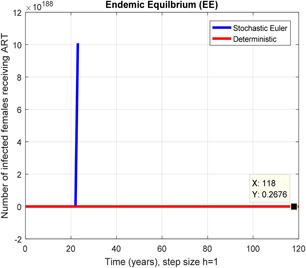
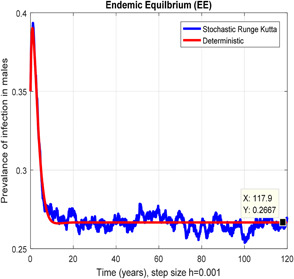
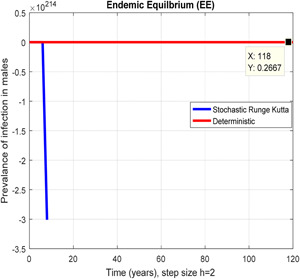
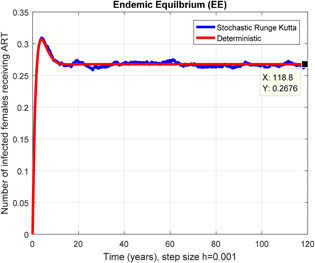
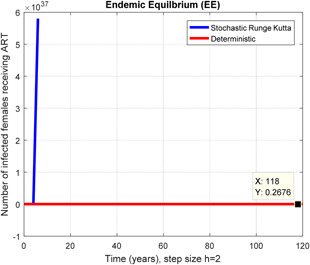
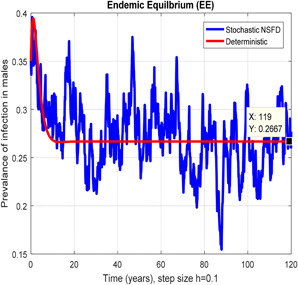
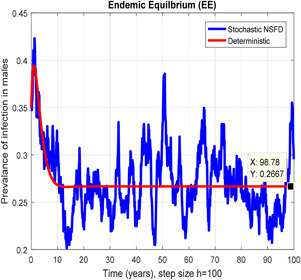
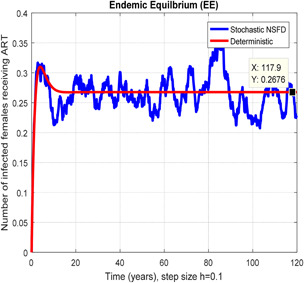
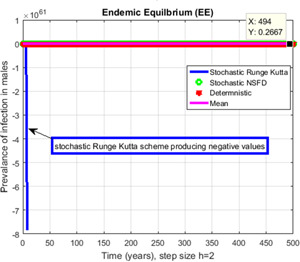
This study is an attempt to explain a reliable numerical analysis of a stochastic HIV/AIDS model in a two-sex population considering counselling and antiretroviral therapy (ART). The authors are comparing the solutions of the stochastic and deterministic HIV/AIDS epidemic model. Here, an endeavour has been made to explain the stochastic HIV/AIDS epidemic model is comparatively more pragmatic in contrast with the deterministic HIV/AIDS epidemic model. The effect of threshold number H* holds on the stochastic HIV/AIDS epidemic model. If H* < 1 then condition helps us to control disease in a two-sex human population while H* > 1 explains the persistence of disease in the two-sex human population. Lamentably, numerical methods such as Euler-Maruyama, stochastic Euler, and stochastic Runge-Kutta do not work for large time step sizes. The recommended structure preserving framework of the stochastic non-standard finite difference (SNSFD) scheme conserve all vital characteristics such as positivity, boundedness, and dynamical consistency defined by Mickens. The effectiveness of counselling and ART may control HIV/AIDS in a two-sex population.
Figures
References
-
- Ochoche Jefrey M.: ‘Modeling HIV in the presence of infected immigrants and vertical transmission’, Int. J. Sci. Technol. Res., 2013, 2, (11), pp. 571–588
-
- Li Q. Cao S., and Chen X. et al.: ‘Stability analysis of an HIV dynamics model with drug resistance’, Discret. Dyn. Nat. Soc., 2012, 12, pp. 1530–1544
-
- Bhunu C.P. Mushayabasa S., and Kojouharov H. et al.: ‘Mathematical analysis of an HIV model impact of educational programs and abstinence in sub‐saharan Africa’, J. Math. Model Algorithms, 2011, 10, (1), pp. 31–55
-
- Kimbir A.R., and Oduwole H.K.: ‘A mathematical model of HIV transmission dynamics considering counselling and antiretroviral therapy’, J. Math. Stat. Model., 2008, 2, (5), pp. 166–169
-
- Hsieh Y.H.: ‘A two‐sex model for treatment of AIDS and behavior change in a population of varying size’, IMA J. Math. Appl. Biol. Sci., 1996, 13, (3), pp. 151–173 - PubMed
MeSH terms
Substances
LinkOut - more resources
Full Text Sources
Medical
