


Interventions for preventing falls in people with multiple sclerosis
- PMID: 31778221
- PMCID: PMC6953359
- DOI: 10.1002/14651858.CD012475.pub2
Interventions for preventing falls in people with multiple sclerosis
Abstract
Background: Multiple sclerosis (MS) is one of the most prevalent diseases of the central nervous system with recent prevalence estimates indicating that MS directly affects 2.3 million people worldwide. Fall rates of 56% have been reported among people with MS in a recent meta-analysis. Clinical guidelines do not outline an evidence-based approach to falls interventions in MS. There is a need for synthesised information regarding the effectiveness of falls prevention interventions in MS.
Objectives: The aim of this review was to evaluate the effectiveness of interventions designed to reduce falls in people with MS. Specific objectives included comparing: (1) falls prevention interventions to controls and; (2) different types of falls prevention interventions.
Search methods: We searched the Trials Register of the Cochrane Multiple Sclerosis and Rare Diseases of the CNS Group, Cochrane Central Register of Controlled Trials (2018 Issue 9); MEDLINE (PubMed) (1966 to 12 September 2018); Embase (EMBASE.com) (1974 to 12 September 2018); Cumulative Index to Nursing and Allied Health Literature (EBSCOhost) (1981 to 12 September 2018); Latin American and Caribbean Health Science Information Database (Bireme) (1982 to 12 September 2018); ClinicalTrials.gov; and World Health Organization International Clinical Trials Registry Platform; PsycINFO (1806 to 12 September 2018; and Physiotherapy Evidence Database (1999 to 12 September 2018).
Selection criteria: We selected randomised controlled trials or quasi-randomised trials of interventions to reduce falls in people with MS. We included trials that examined falls prevention interventions compared to controls or different types of falls prevention interventions. Primary outcomes included: falls rate, risk of falling, number of falls per person and adverse events.
Data collection and analysis: Two review authors screened studies for selection, assessed risk of bias and extracted data. We used a rate ratio (RaR) and 95% confidence interval to compare falls rate between groups. For risk of falling, we used a risk ratio (RR) and 95% CI based on the number of fallers in each group.
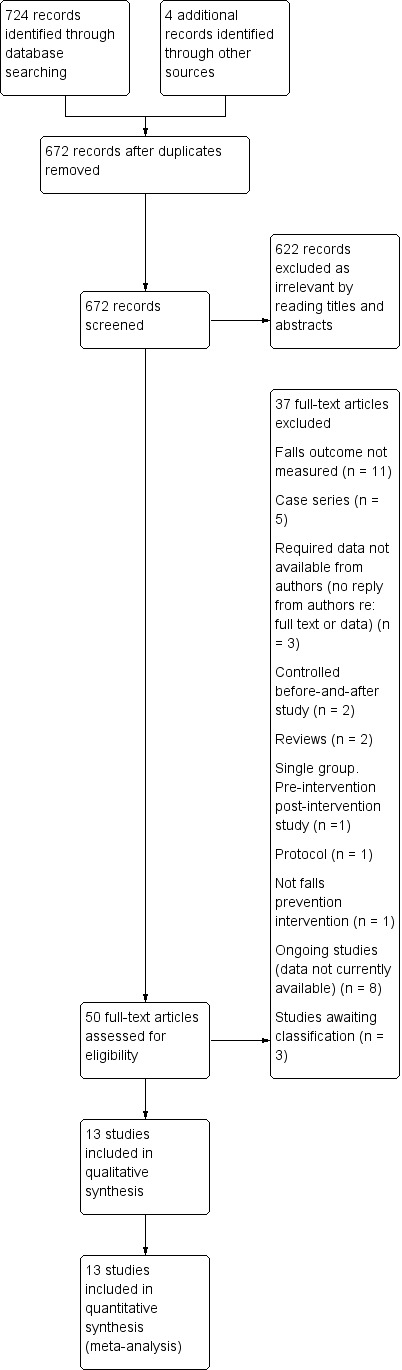
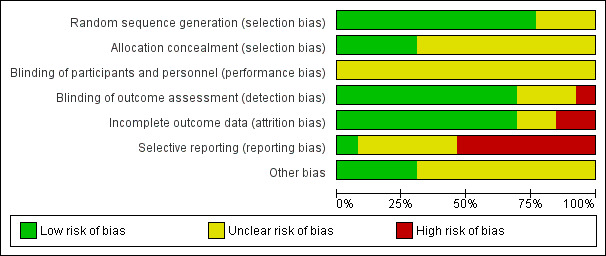
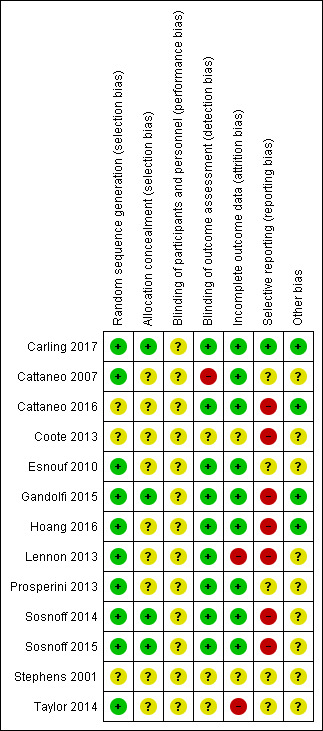
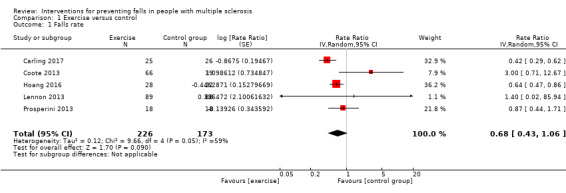
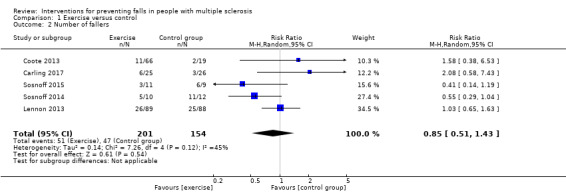
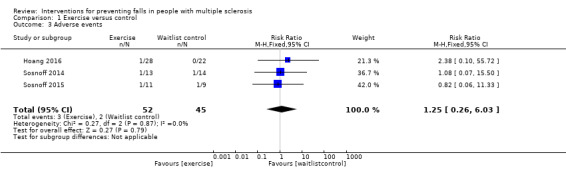
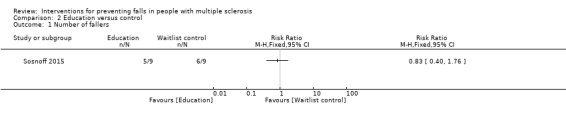
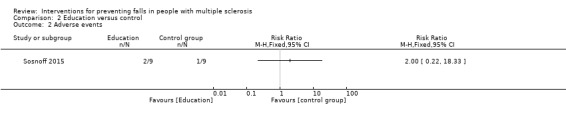
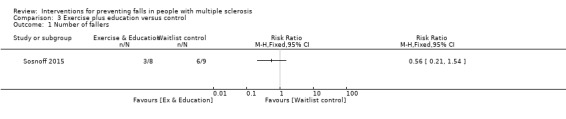
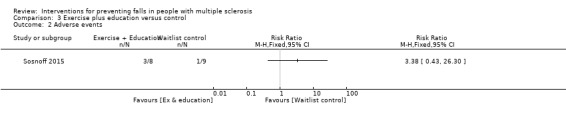
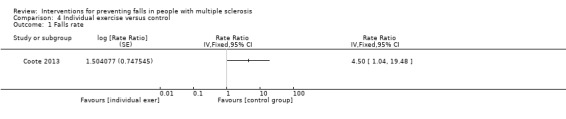
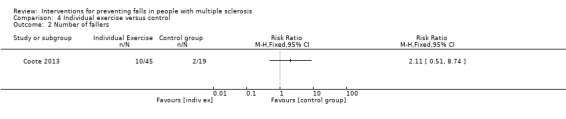
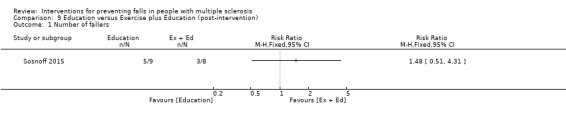
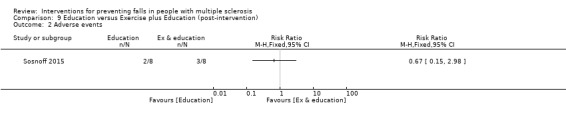
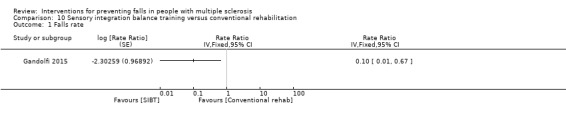
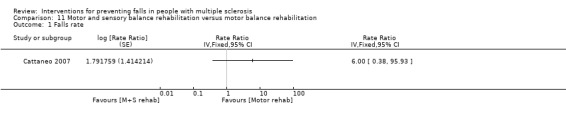
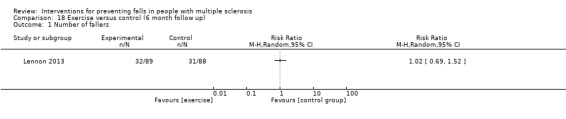
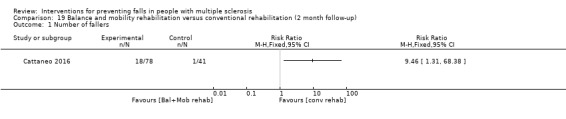
Main results: A total of 839 people with MS (12 to 177 individuals) were randomised in the 13 included trials. The mean age of the participants was 52 years (36 to 62 years). The percentage of women participants ranged from 59% to 85%. Studies included people with all types of MS. Most trials compared an exercise intervention with no intervention or different types of falls prevention interventions. We included two comparisons: (1) Falls prevention intervention versus control and (2) Falls prevention intervention versus another falls prevention intervention. The most common interventions tested were exercise as a single intervention, education as a single intervention, functional electrical stimulation and exercise plus education. The risk of bias of the included studies mixed, with nine studies demonstrating high risk of bias related to one or more aspects of their methodology. The evidence was uncertain regarding the effects of exercise versus control on falls rate (RaR of 0.68; 95% CI 0.43 to 1.06; very low-quality evidence), number of fallers (RR of 0.85; 95% CI 0.51 to 1.43; low-quality evidence) and adverse events (RR of 1.25; 95% CI 0.26 to 6.03; low-quality evidence). Data were not available on quality of life outcomes comparing exercise to control. The majority of other comparisons between falls interventions and controls demonstrated no evidence of effect in favour of either group for all primary outcomes. For the comparison of different falls prevention interventions, the heterogeneity of intervention types across studies prohibited the pooling of data. In relation to secondary outcomes, there was evidence of an effect in favour of exercise interventions compared to controls for balance function with a SMD of 0.50 (95% CI 0.09 to 0.92), self-reported mobility with a SMD of 16.30 (95% CI 9.34 to 23.26) and objective mobility with a SMD of 0.28 (95% CI 0.07 to 0.50). Secondary outcomes were not assessed under the GRADE criteria and results must be interpreted with caution.
Authors' conclusions: The evidence regarding the effects of interventions for preventing falls in MS is sparse and uncertain. The evidence base demonstrates mixed risk of bias, with very low to low certainty of the evidence. There is some evidence in favour of exercise interventions for the improvement of balance function and mobility. However, this must be interpreted with caution as these secondary outcomes were not assessed under the GRADE criteria and as the results represent data from a small number of studies. Robust RCTs examining the effectiveness of multifactorial falls interventions on falls outcomes are needed.
Copyright © 2019 The Cochrane Collaboration. Published by John Wiley & Sons, Ltd.
Conflict of interest statement
SH ‐ none.
CK ‐ none.
RG ‐ none.
MF ‐ none.
CM ‐ none.
CDW ‐ none.
SC ‐ SC is an author of one of the included studies in this Cochrane Review (Coote 2013).
Figures
Update of
References
References to studies included in this review
Carling 2017 {published data only}
Cattaneo 2007 {published data only}
-
- Cattaneo D, Jonsdottir J, Zocchi M, Regola A. Effects of balance exercises on people with multiples sclerosis: a pilot study. Clinical Rehabilitation 2007;21:771‐81. - PubMed
Cattaneo 2016 {published data only}
-
- Cattaneo D, Rasova K, Gervasoni E, Dobrovodská G, Montesano A, Jonsdottir J. Falls prevention and balance rehabilitation in multiple sclerosis: a bi‐centre randomised controlled trial, disability and rehabilitation. Disability and Rehabilitation 2016;40:522‐6. - PubMed
-
- NCT02390830. Falls Prevention and Balance Rehabilitation in Multiple Sclerosis. https://clinicaltrials.gov/ct2/show/NCT02390830 18/03/2015.
Coote 2013 {published data only}
-
- Coote S, Hogan N, Franklin S. Falls in people with multiple sclerosis who use a walking aid: prevalence, factors, and effect of strength and balance interventions. Archives of physical medicine and rehabilitation 2013;94:616‐21. - PubMed
Esnouf 2010 {published data only}
-
- Esnouf JE, Taylor PN, Mann GE, Barrett CL. Impact on activities of daily living using a functional electrical stimulation device to improve dropped foot in people with multiple sclerosis, measured by the Canadian Occupational Performance Measure. Multiple Sclerosis 2010;16:1141‐7. - PubMed
Gandolfi 2015 {published data only}
-
- Gandolfi M, Munari D, Geroin C, Gajofatto A, Donata Benedetti M, Midiri A, et al. Sensory integration balance training inpatients with multiple sclerosis: a randomised, controlled trial. Multiple Sclerosis Journal 2015;21:1453‐62. - PubMed
Hoang 2016 {published data only}
-
- ACTRN12612001139864. Balance exercise for multiple sclerosis [Exercise to improve balance and reduce fall risk in people with multiple sclerosis – a pilot randomized controlled trial]. https://www.anzctr.org.au/Trial/Registration/TrialReview.aspx?id=363148 26/10/2012.
-
- Hoang P, Schoene D, Gandevia S, Smith S, Lord SR. Effects of a home‐based step training programme on balance, stepping, cognition and functional performance in people with multiple sclerosis – a randomised controlled trial. Multiple Sclerosis Journal 2016;22:94‐103. - PubMed
Lennon 2013 {published data only}
-
- Lennon S. Group exercise therapy for balance and mobility in people with multiple sclerosis: a randomised controlled trial. Personal communication with author.
Prosperini 2013 {published data only}
-
- Prosperini L, Fortuna D, Giannì C, Leonardi L, Marchetti MR, Pozzilli C. Home‐based balance training using the wiibalance board: a randomized, crossover pilot study in multiple sclerosis. Neurorehabilitation and neural repair 2013;27:516‐25. - PubMed
Sosnoff 2014 {published data only}
-
- NCT01837017. Project FARMS: fall risk reduction in multiple sclerosis. https://clinicaltrials.gov/ct2/show/NCT01837017 22/04/2013.
-
- Sosnoff J, Finlayson M, McAuley E, Morrison S, Motl RW. Home‐based exercise program and fall‐risk reduction in older adults with multiple sclerosis: phase 1 randomised controlled trial. Clinical Rehabilitation 2014;28:254‐63. - PubMed
Sosnoff 2015 {published data only}
-
- NCT01956227. Fall risk reduction in multiple sclerosis: exercise versus behavior (FARMS‐2). https://clinicaltrials.gov/ct2/show/NCT01956227 08/10/2013.
-
- Sosnoff JJ, Moon Y, Wajda DA, Finlayson ML, McAuley E, Peterson EW, et al. Fall risk and incidence reduction in high risk individuals with multiple sclerosis: a pilot randomised control trial. Clinical Rehabilitation 2015;29:952‐60. - PubMed
Stephens 2001 {published data only}
-
- Stephens J, DuShuttle D, Hatcher C, Schumnes J, Slaninka C. Use of awareness through movement improves balance and balance confidence in people with multiple sclerosis: a randomised controlled study. Journal of neurological physical therapy 2001;25:39‐49.
Taylor 2014 {published data only}
-
- Taylor P, Barrett C, Mann G, Wareham W, Swain I. A feasibility study to investigate the effect of functional electrical stimulation and physiotherapy exercise on the quality of gait of people with multiple sclerosis. Neuromodulation 2014;17:75–84. - PubMed
References to studies excluded from this review
ACTRN12612000218897 {published and unpublished data}
-
- ACTRN12612000218897. Investigating fatigue, balance, falls and mobility in people with multiple sclerosis. https://www.anzctr.org.au/Trial/Registration/TrialReview.aspx?ACTRN=1261... 21/02/2012.
Brichetto 2015 {published data only}
-
- Brichetto G, Piccardo E, Pedullà L, Battaglia MA, Tacchino A. Tailored balance exercises on people with multiple sclerosis: a pilot randomized, controlled study. Multiple sclerosis 2015;21(8):1055‐63. - PubMed
Cadorin 2015 {published and unpublished data}
-
- Cadorin C, Stabile MR, Rossi S, Boscolo E, Vendramin A, Campagnolo D, et al. A comparison between two technological tools for balance training in patients with progressive multiple sclerosis: a pilot study. Multiple sclerosis journal 2015;21:503.
Cakt 2010 {published data only}
-
- Cakt BD, Nacir B, Genç H, Saraçoğlu M, Karagöz A, Erdem HR, et al. Cycling progressive resistance training for people with multiple sclerosis: a randomized controlled study. American journal of physical medicine and rehabilitation 2010;89:446‐57. - PubMed
Eftekharsadat 2015 {published data only}
-
- Eftekharsadat B, Babaei‐Ghazani A, Mohammadzadeh M, Talebi M, Eslamian F, Azari E. Effect of virtual reality‐based balance training in multiple sclerosis. Neurological research 2015;37:539‐44. - PubMed
Forsberg 2016 {published and unpublished data}
Francavilla 2015 {published and unpublished data}
-
- Francavilla G, Sgarito C, Brichetto G, Battaglia MA, Lopes de Carvalho MA. Randomized controlled trial about effectiveness of personalized treatment of balance disorders in multiple sclerosis: integration of visual, proprioceptive and vestibular components. American academy of physical medicine and rehabilitation 2015;7:s83.
Goodman 2008 {published data only (unpublished sought but not used)}
-
- Goodman AD, Brown TR, Cohen JA, Krupp LB, Schapiro R, Schwid SR, et al. Dose comparison trial of sustained‐release fampridine in multiple sclerosis. Neurology 2008;71:1134‐41. - PubMed
Kalgarfard 2013 {published data only}
-
- Kargarfard M, Mehrabi M, Hamidi‐Tehrani J, Rouzbahani R. Changes in speed, endurance and balance in women with multiple sclerosis after 4 and 8 weeks of aquatic exercise training. Journal of Isfahan medical school 2013;31:1628‐39.
Kalron 2016 {published data only}
Kramer 2014 {published data only}
-
- Kramer A, Dettmers C, Gruber M. Exergaming with additional postural demands improves balance and gait in patients with multiple sclerosis as much as conventional balance training and leads to high adherence to home‐based balance training. Archives of physical medicine and rehabilitation 2104;95:1803‐9. - PubMed
Marzal Alfaro 2016 {published data only}
-
- Marzal Alfaro BM, Martin‐Barbero M, Ribed A, Revuelta JL, Tovar‐Pozo M, Lorenzo‐Pinto A, et al. Adherence, quality of life and patient satisfaction with dalfampridine in clinical practice. European journal of hospital pharmacy 2016;23:A141.
McAuley 2007 {published data only}
-
- McAuley E, Motl RW, Morris KS, Hu L, Doerksen SE, Elavsky S, et al. Enhancing physical activity adherence and well‐being in multiple sclerosis: a randomised controlled trial. Multiple sclerosis 2007;13:652‐9. - PubMed
Monjezi 2017 {published data only}
-
- Monjezi S, Negahban H, Tajali S, Yadollahpour N, Majdinasab N. Effects of dual‐task balance training on postural performance in patients with multiple sclerosis: a double‐blind, randomized controlled pilot trial. Clinical rehabilitation 2017;31:234‐41. - PubMed
NCT01829776 {published and unpublished data}
-
- NCT01829776. Pilot study of free from falls program in multiple sclerosis (FFF). https://clinicaltrials.gov/ct2/show/NCT01829776 11/04/2013.
Nedeljkoviü 2014 {published data only}
-
- Nedeljković U, Raspopović ED, Ilić N, Dačković J, Dujmović I. Endurance and resistance training in rehabilitation of patients with multiple sclerosis. Vojnosanit pregled 2014;71:963‐8. - PubMed
Nilsagard 2014 {published and unpublished data}
-
- Nilsagard YE, Koch LK, Nilsson M, Forsberg AS. Balance exercise program reduced falls in people with multiple sclerosis: a single‐group, pretest‐posttest trial. Archives of physical medicine and rehabilitation 2014; Vol. 95, issue 12:2428–34. - PubMed
O'Hara 2002 {published data only}
-
- O’Hara L, Cadbury H, Souza L, Ide L. Evaluation of the effectiveness of professionally guided self‐care for people with multiple sclerosis living in the community: a randomized controlled trial. Clinical rehabilitation 2002;16:119‐28. - PubMed
Prosperini 2010 {published data only}
-
- Prosperini L, Leonardi L, Carli P, ML Mannocchi, C Pozzilli. Visuo‐proprioceptive training reduces risk of falls in patients with multiple sclerosis. Multiple sclerosis 2010;16:491‐9. - PubMed
Prosperini 2014 {published data only}
Sandroff 2014 {published data only}
-
- Sandroff BM, Klaren RE, Pilutti LA, Dlugonski D, Benedict RHB, Motl RW. Randomized controlled trial of physical activity, cognition, and walking in multiple sclerosis. Journal of neurology 2014;261:363‐72. - PubMed
Sebastiao 2017 {published data only}
Segev‐Jacubovski 2011 {published data only}
Tarakci 2013 {published data only}
-
- Tarakci E, Yeldan I, Huseyinsinoglu BE, Zenginler Y, Eraksoy M. Group exercise training for balance, functional status, spasticity, fatigue and quality of life in multiple sclerosis: a randomized controlled trial. Clinical rehabilitation 2013;27(9):813‐22. - PubMed
Ward 2004 {published data only}
-
- Ward CD, Turpin G, Dewey ME, Fleming S, Hurwitz B, Ratib S, et al. Education for people with progressive neurological conditions can have negative effects: evidence from a randomized controlled trial. Clinical rehabilitation 2004;18:717‐25. - PubMed
Zenginler 2016 {published data only}
-
- Zenginler Y, Tarakci E, Kurtuncu M, Razak Ozdincler A. The impact of Nintendo Wii fit games on the balance and functionality of multiple sclerosis patients: a randomized controlled study. ECTRIMS online library. Kürtüncü M 2016;145682:EP1587.
References to studies awaiting assessment
Cattaneo 2018 {published data only}
-
- Cattaneo D, Rasova K, Gervasoni E, Dobrovodska G, Montesano A, Jonsdottir J. Falls prevention and balance rehabilitation in multiple sclerosis: a bi‐centre randomised controlled trial. Disability and rehabilitation 2018;40:522‐6. - PubMed
Kannan 2017 {published data only}
Martini 2018 {published data only}
-
- Hildebrand A, Martini D, Fling B, Cameron M. Ambulation assistive device training prevents falls, increases device satisfaction and may decrease sitting and increase walking in MS: a randomized‐controlled pilot study. Neurology 2017;88(16 Supplement):S24.004.
References to ongoing studies
ACTRN12616000415404 {published and unpublished data}
-
- ACTRN12616000415404. Do interventions targeting proprioceptive feedback and exercise improve functional gait and reduce falls and falls risk in people with MS?. https://www.anzctr.org.au/Trial/Registration/TrialReview.aspx?id=370297 31/03/2016.
ACTRN12616001053415 {unpublished data only}
-
- ACTRN12616001053415. An interactive step training system to reduce falls in people with multiple sclerosis: a randomised controlled trial. https://www.anzctr.org.au/Trial/Registration/TrialReview.aspx?id=370671 05/08/2016.
Hatton 2016 {unpublished data only}
ISRCTN13587999 (Gunn 2017) {published and unpublished data}
-
- ISRCTN13587999. Balance right in multiple sclerosis. https://doi.org/10.1186/ISRCTN13587999 29/09/2016.
NCT02314585 {published and unpublished data}
-
- NCT02314585. Fall risk reduction in multiple sclerosis (FIRMS). https://clinicaltrials.gov/ct2/show/NCT02314585 11/12/2014.
NCT02583386 {published and unpublished data}
-
- NCT02583386. Comprehensive fall prevention and detection in multiple sclerosis (FFF). https://clinicaltrials.gov/ct2/show/NCT02583386 22/10/2015.
NCT02694666 {published data only}
-
- NCT02694666. Vibration training for preventing falls in healthy population and multiple sclerosis. https://clinicaltrials.gov/ct2/show/NCT02694666 29/02/2016.
NCT02885233 {published and unpublished data}
-
- NCT02885233. Evaluation of a web‐based fall prevention program on people with multiple sclerosis. https://clinicaltrials.gov/ct2/show/NCT02885233 31/08/2016. - PMC - PubMed
Additional references
Bazelier 2011
Berg 1989
-
- Berg K, Wood‐Dauphinee S, Williams JI, Gayton D. Measuring balance in the elderly: preliminary development of an instrument. Physiotherapy Canada 1989;41:304‐11.
Browne 2014
Cameron 2012
Carling 2017a
-
- Carling A, Forsberg A, Gunnarsson M, Nilsagard Y. [Request for additional results [personal communication]]. Email to A Carling 20‐03‐2018.
Cattaneo 2016a
-
- Cattaneo D, Rasova K, Gervasoni E, Dobrovodska G, Montesano A, Jonsdottir J. [Request for additional results [personal communication]]. Email D Cattaneo 22‐06‐2018.
Coote 2013a
-
- Coote S, Hogan N, Franklin S. [Request for additional results [personal communication]]. Email to S Coote 06‐03‐2018.
Coote 2013b
-
- Coote SC, Hogan N, Franklin S. Falls in people with multiple sclerosis who use a walking aid: prevalence, factors and effect of balance and strength interventions. Archives of physical medicine and rehabilitation 2013;94:616‐21. - PubMed
Coote 2014
Esnouf 2010a
-
- Esnouf JE, Taylor PN, Mann GE, Barrett CL. [Request for additional results [personal communication]]. Email to P Taylor 22‐06‐2018.
Finlayson 2010
-
- Finlayson M, Peterson E. Falls, aging and disability. Physical medicine and rehabilitation clinics of North America 2010;21:357‐73. - PubMed
Fischer 1999
-
- Fischer JS, LaRocca NG, Miller DM, Ritvo PG, Andrews H, Paty D. Recent developments in the assessment of quality of life in multiple sclerosis (MS). Multiple sclerosis 1999;5:251‐9. - PubMed
Franchignoni 2010
Fry 2006
-
- Fry DK, Pfalzer LA. Reliability of four functional tests and rating of perceived exertion in persons with multiple sclerosis. Physiotherapy Canada. Physiotherapie Canada 2006;58:212‐20.
Gillespie 2003
Gillespie 2012
Gunn 2013
-
- Gunn HJ, Newell P, Haas B, Marsden JF, Freeman JA. Identification of risk factors for falls in multiple sclerosis: a systematic review and meta‐analysis. Physical therapy 2013;93:504‐13. - PubMed
Gunn 2015
-
- Gunn H, Markevics S, Haas B, Marsden J, Freeman J. Systematic review: the effectiveness of interventions to reduce falls and improve balance in adults with multiple sclerosis.. Archive of physical and medical rehabilitation 2015;96:1898‐912. - PubMed
Higgins 2011
-
- Higgins JPT, Green S. Cochrane Handbook for Systematic Reviews of Interventions Version 5.1.0 [updated March 2011]. The Cochrane Collaboration, 2011. Available from www.cochrane‐handbook.org.
Hoang 2016a
-
- Hoang P, Schoene D, Gandevia S, Smith S, Lord SR. [Request for additional results [personal communication]]. Email to P Hoang 12‐07‐2018.
Hobart 2001
-
- Hobart J, Lamping D, Fitzpatrick R, Riazi A, Thompson A. The Multiple Sclerosis Impact Scale (MSIS‐29): a new patient‐based outcome measure. Brain 2001;124:962‐73. - PubMed
Hobart 2003
-
- Hobart JC, Riazi A, Lamping DL, Fitzpatrick R, Thompson AJ. Measuring the impact of MS on walking ability: the 12‐Item MS Walking Scale (MSWS‐12). Neurology 2003;60:31‐6. - PubMed
Hoffmann 2014
-
- Hoffmann TC, Glasziou PP, Boutron I, Milne R, Perera R, Moher D, et al. Better reporting of interventions: template for intervention description and replication (TIDieR) checklist and guide. BMJ 2014;348:g1687. - PubMed
Hohol 1995
-
- Hohol MJ, Orav EJ, Weiner HL. Disease steps in multiple sclerosis: a simple approach to evaluate disease progression. Neurology 1995;45:251‐5. - PubMed
ICD‐8 1965
-
- World Health Organization. Report of the international conference for the eighth revision of the international classification of diseases. Unpublished document WHO/ICD9/74.4; available on request from Strengthening of Epidemiological and Statistical Services, World Health Organization. Geneva: World Health Organization, 1965.
Keith 1987
-
- Keith RA, Granger CV, Hamilton BB, Sherwin FS. The functional independence measure: a new tool for rehabilitation. Advances in clinical rehabilitation 1987;1:6‐18. - PubMed
Kurtzke 1983
-
- Kurtzke JF. Rating neurologic impairment in multiple sclerosis: an expanded disability status scale (EDSS). Neurology 1983;11:1444‐52. - PubMed
Lamb 2005
-
- Lamb SE, Jørstad‐Stein EC, Hauer K, Becker C. Prevention of Falls Network Europe and Outcomes Consensus Group. Development of a common outcome data set for fall injury prevention trials: the Prevention of Falls Network Europe consensus. Journal of the American geriatrics society 2005;53:618‐22. - PubMed
Lamb 2011
Lefebvre 2011
-
- Lefebvre C, Manheimer E, Glanville J. Chapter 6: Searching for studies. In: Higgins JPT, Green S (editors). Cochrane Handbook for Systematic Reviews of Interventions Version 5.1.0 (updated March 2011). The Cochrane Collaboration, 2011. Available from www.cochrane‐handbook.org.
Lennon 2013a
-
- Lennon S. [Request for additional results [personal communication]]. Email to S Lennon 03‐02‐2018.
Lord 2003
-
- Lord SR, Menz HB, Tiedemann A. A physiological profile approach to falls risk assessment and prevention. Physical therapy 2003;83:237‐52. - PubMed
Lublin 1996
-
- Lublin FD, Reingold SC. Defining the clinical course of multiple sclerosis: results of an international survey. National Multiple Sclerosis Society (USA) Advisory Committee on Clinical Trials of New Agents in Multiple Sclerosis. Neurology 1996;46:907‐11. - PubMed
Lublin 2014
Matsuda 2011
-
- Matsuda PN, Shumway‐Cook A, Bamer AM, Johnson SL, Amtmann D, Kraft GH. Falls in multiple sclerosis. PM & R: the journal of injury, function, and rehabilitation 2011;3(7):624‐32. - PubMed
Matsuda 2012
-
- Matsuda PN, Shumway‐Cook A, Ciol MA, Bombardier CH, Kartin DA. Understanding falls in multiple sclerosis: association of mobility status, concerns about falling, and accumulated impairments. Physical therapy 2012;92:407‐15. - PubMed
McColl 2001
-
- McColl MA, Davies D, Carlson P, Johnston J, Minnes P. The community integration measure: development and preliminary validation. Archives of physical medicine and rehabilitation 2001;82:429‐34. - PubMed
McDonald 2001
-
- McDonald WI, Compston A, Edan G, Goodkin D, Hartung HP, Lublin FD, et al. Recommended diagnostic criteria for multiple sclerosis: guidelines from the international panel on the diagnosis of multiple sclerosis. Annals of neurology 2001;50:121‐7. - PubMed
Moher 2012
-
- Moher D, Hopewell S, Schulz KF, Montori V, Gøtzsche PC, Devereaux PJ, et al. CONSORT 2010 explanation and elaboration: updated guidelines for reporting parallel group randomised trials. International journal of surgery 2012;10:28‐55. - PubMed
NGC 2014
-
- National Guideline Clearinghouse (NGC). Guideline summary: management of multiple sclerosis in primary and secondary care. National Clinical Guideline Centre (UK).
Nilsagard 2015
Oliver 2004
-
- Oliver D, Daly F, Martin FC, McMurdo ME. Risk factors and risk assessment tools for falls in hospital in‐patients: a systematic review. Age and ageing 2004;33:122‐30. - PubMed
Polman 2005
-
- Polman CH, Reingold SC, Edan G, Filippi M, Hartung HP, Kappos L, et al. Diagnostic criteria for multiple sclerosis: 2005 revisions to the “McDonald Criteria”. Annals of neurology 2005;58:840‐6. - PubMed
Polman 2011
Poser 1983
-
- Poser CM, Paty DW, Scheinberg L, McDonald WI, Davis FA, Ebers GC, et al. New diagnostic criteria for multiple sclerosis: guidelines for research protocols. Annals of neurology 1983;13:227‐31. - PubMed
Prosperini 2013a
-
- Prosperini L, Fortuna D, Gianni C, Leonardi L, Marchetti MR, Pozzilli C. [Request for additional results [personal communication]]. Email to L Prosperini 22‐06‐2018.
Review Manager 2014 [Computer program]
-
- Copenhagen: Nordic Cochrane Centre, The Cochrane Collaboration. Review Manager (RevMan). Version 5.3. Copenhagen: Nordic Cochrane Centre, The Cochrane Collaboration, 2014.
Schumacher 1965
-
- Schumacher GA, Beebe G, Kibler RF, Kurland LT, Kurtzke JF, McDowell F, et al. Problems of experimental trials of therapy in multiple sclerosis: report by the panel on the evaluation of experimental trials in multiple sclerosis. Annals of the New York Academy of Sciences 1965;122:552–68. - PubMed
Smith 1982
-
- Smith A. Symbol Digits Modalities Test. Los Angeles: Western Psychological Services, 1982.
Sosnoff 2014a
-
- Sosnoff JJ, Finlayson M, McAuley E, Morrison S, Motl RW. [Request for additional results [personal communication]]. Email to J Sosnoff 22‐06‐2018.
Sosnoff 2014b
Sosnoff 2015a
-
- Sosnoff JJ, Moon Y, Wajda DA, Finlayson ML, McAuley E, Peterson EW, et al. [Request for additional results [personal communication]]. Email to JJ Sosnoff 22‐06‐2018.
Stephens 2001a
-
- Stephens J, DuShuttle D, Hatcher C, Shmunes J, Slaninka C. [Request for additional results [personal communication]]. Email to J Stephens 07‐03‐2018.
Taylor 2014a
-
- Taylor P, Barrett C, Mann G, Wareham W, Swain I. [Request for additional results [personal communication]]. Email to P Taylor 12‐07‐2018.
References to other published versions of this review
Publication types
MeSH terms
LinkOut - more resources
Full Text Sources
Medical
