Interleukin-6 and adhesion molecules VCAM-1 and ICAM-1 as biomarkers of post-acute myocardial infarction heart failure
- PMID: 31778438
- PMCID: PMC6886400
- DOI: 10.1590/1414-431X20198658
Interleukin-6 and adhesion molecules VCAM-1 and ICAM-1 as biomarkers of post-acute myocardial infarction heart failure
Abstract
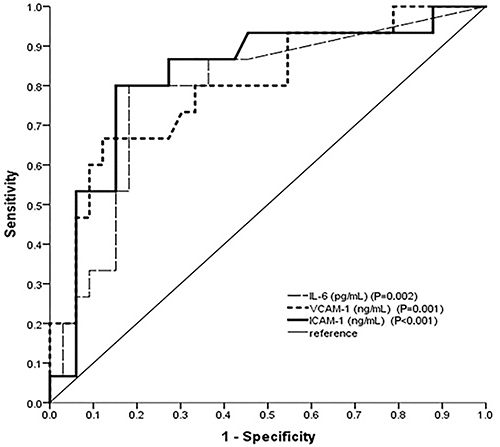
Acute coronary syndromes are associated with a high prevalence of complications including heart failure (HF). The aim of this study was to investigate the association of novel biomarkers with the occurrence of post-acute myocardial infarction (AMI) HF. A prospective study was conducted with patients admitted to the emergency department with ST-segment elevation myocardial infarction (STEMI). Blood and urine samples were collected for analysis of traditional and novel biomarkers, including interleukin-6, vascular cell adhesion molecule 1 (VCAM-1), and intercellular adhesion molecule-1 (ICAM-1). We compared the levels of these biomarkers between patients with and without post-STEMI HF. A total of 48 patients were assessed, with a prevalence of males. Fifteen patients (31.2%) had post-STEMI HF. Patients with HF had higher mean values of IL-6, VCAM-1, and ICAM-1 compared to those who did not develop HF (57.06 vs 14.03 pg/mL, P=0.001; 1719.58 vs 1304.34 ng/mL, P=0.001; and 1594.20 vs 1158.74 ng/mL, P<0.001, respectively). The three biomarkers were shown to be good predictors of post-STEMI HF (IL-6: AUC 0.786, P=0.002; VCAM-1: AUC 0.797, P=0.001; and ICAM-1: AUC 0.825, P<0.0001), with the respective cutoff points being calculated based on the best sensitivity and specificity indexes (IL-6: 8.67 pg/mL; VCAM-1: 1501.42 ng/mL; and ICAM-1: 1262.38 ng/mL). Of the three biomarkers, only VCAM-1 and ICAM-1 had a direct linear association between them (r=0.470, P<0.0001). IL-6, VCAM-1, and ICAM-1 were associated with the development of new post-AMI HF symptoms, but only VCAM-1 and ICAM-1 correlated with each other, possibly because they have the same pathophysiological mechanism of action.
Figures
References
MeSH terms
Substances
LinkOut - more resources
Full Text Sources
Medical
Research Materials
Miscellaneous