. 2019 Nov 26;8(4):266.
doi: 10.3390/pathogens8040266.

Genetic Diversity among Pseudorabies Viruses Isolated from Dogs in France from 2006 to 2018

Affiliations

Genetic Diversity among Pseudorabies Viruses Isolated from Dogs in France from 2006 to 2018

Céline Deblanc et al. Pathogens. .

Abstract

Pseudorabies (PR), also known as Aujeszky's disease, is an economically important disease for the pig industry. It has been eradicated in domestic pigs in many European countries, including France, but its causative agent-Suid Herpesvirus 1-is still circulating in wild boars. The risk of endemic PR in wild fauna lies in reintroducing the virus among domestic pigs and transmitting it to other mammals, especially hunting dogs for which the disease is rapidly fatal. As such infections are regularly reported in France, this study genetically characterized canine PR virus strains in the country to obtain information on their diversity and evolution. Partial sequencing of the glycoprotein C-encoding gene from 55 virus strains isolated from dogs between 2006 and 2018 showed that 14 strains belonged to genotype I-clade A and another 38 to genotype I-clade B, two clades usually reported in Western Europe. More surprisingly, three strains were found to belong to genotype II, suggesting an Asian origin. Genotype I-clade A strains exhibited the highest diversity as five geographically segregated genogroups were identified.

Keywords: Aujeszky’s disease; gC encoding region; hunting dog; phylogenetic analysis; pseudorabies; wild boar.


Conflict of interest statement

The authors declare no conflict of interest.

Figures
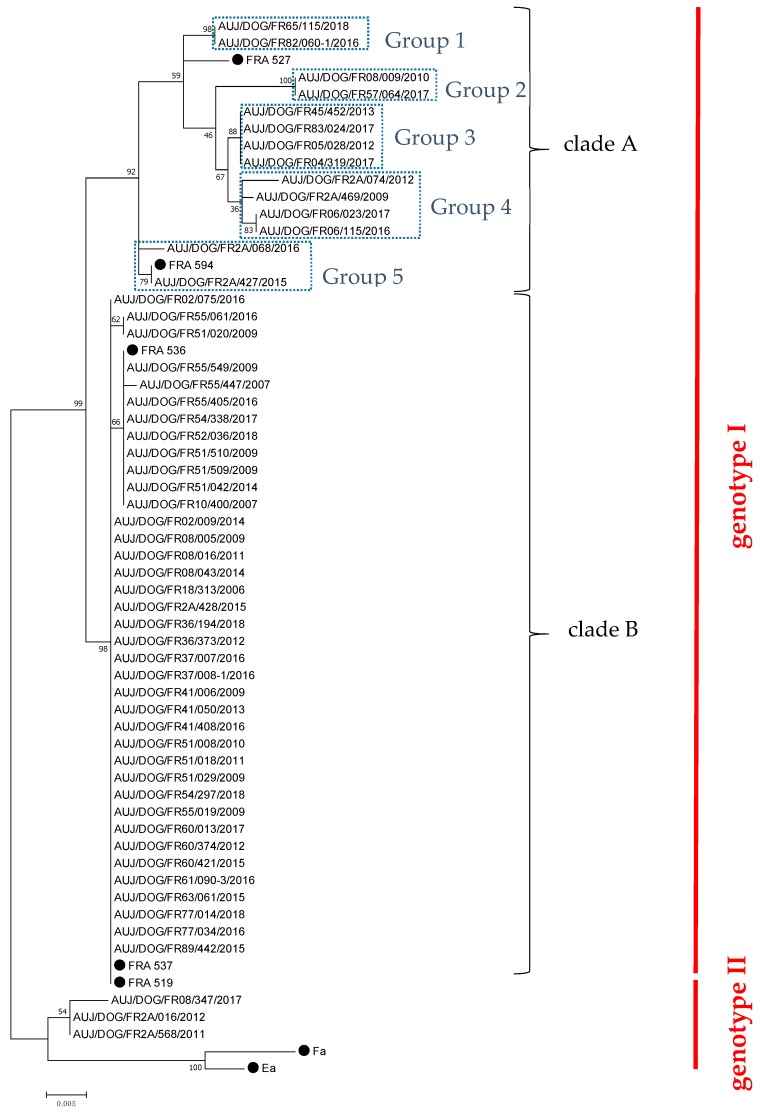
Figure 1
Figure 1
Phylogenetic tree of French canine PRV isolates based on partial nucleotide sequencing of the gC-encoding gene (UL44, 659 to 680 nt). The bootstrap percentage values are indicated at the nodes. The sequences of French PRV strains previously published [10], and sequences of two Asian PRV strains (Ea and Fa, GenBank accession numbers AF158090.1 and AF403051.1, respectively) were used to define the different genotypes and clades. These strains are indicated by a black dot.
Figure 2
Figure 2
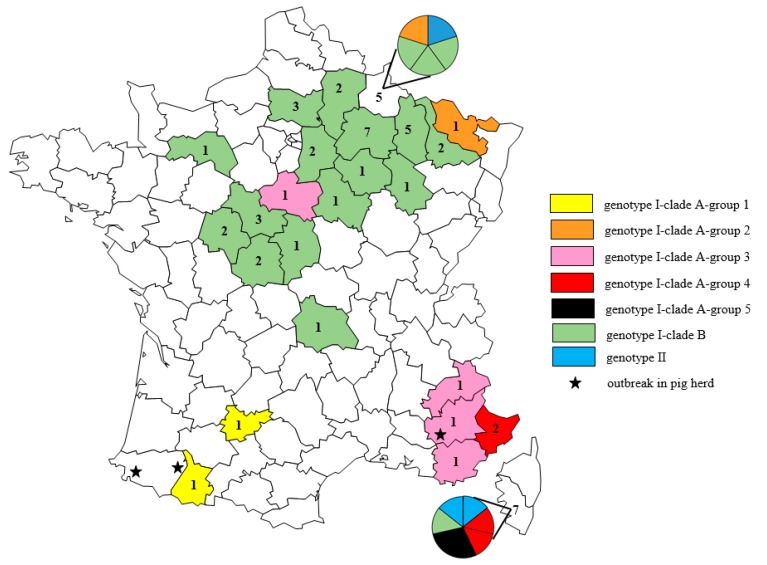
Geographical distribution of PRV strains isolated from dogs in France between November 2006 and June 2018. Black lines delineate administrative départements. The number of PRV strains isolated from dogs is shown in each colored département. The colors indicate the genotype, clade, or group that these strains belong to according to the legend provided. Index cases of outbreaks in domestic pig herds in 2010, 2018, and 2019 are indicated for information by a black star.
Figure 3
Figure 3
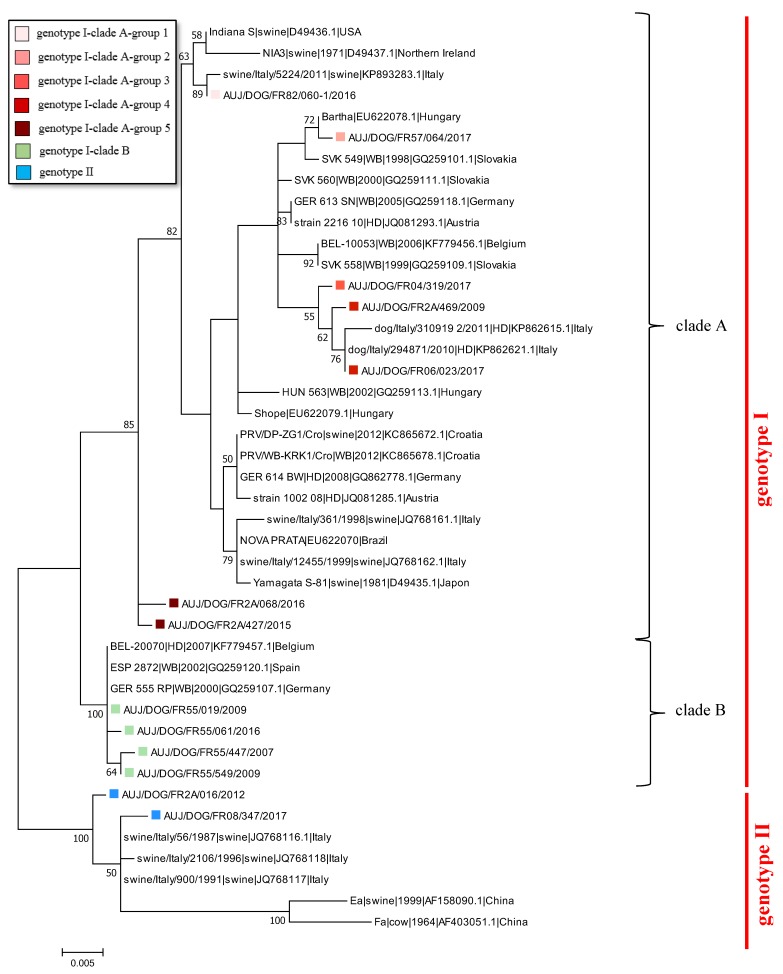
Phylogenetic tree based on the partial sequencing of the gC-encoding gene of PRV strains isolated in France and other countries. French sequences are identified by their name and indicated by a colored square. The colors indicate the genotype, clade, or group of these French strains according to the legend provided on the figure. Only a selection of French strains representative of each genogroup is indicated. The sequences of other strains are identified by their name/species/year of isolation/GenBank accession number/country (if known). Bootstrap values under 50 are not indicated. WB = wild boar, HD = hunting dog.
Figure 4
Figure 4
Alignment of the gC-deduced amino acid sequences from a selection of French canine PRV strains. Positions with deletions, insertions, or substitutions are in red. The hot spot region is indicated in yellow.

References

    1. Mettenleiter T.C., Ehlers B., Müller T., Yoon K.-J., Teifke J.P. Diseases of Swine. Wiley Blackwell; Hoboken, NJ, USA: 2019. Herpesviruses; pp. 548–575.
    1. Pomeranz L.E., Reynolds A.E., Hengartner C.J. Molecular biology of pseudorabies virus: Impact on neurovirology and veterinary medicine. Microbiol. Mol. Biol. Rev. 2005;69:462–500. doi: 10.1128/MMBR.69.3.462-500.2005. - DOI - PMC - PubMed
    1. Klupp B.G., Hengartner C.J., Mettenleiter T.C., Enquist L.W. Complete, Annotated Sequence of the Pseudorabies Virus Genome. J. Virol. 2004;78:424–440. doi: 10.1128/JVI.78.1.424-440.2004. - DOI - PMC - PubMed
    1. Goldberg T.L., Weigel R.M., Hahn E.C., Scherba G. Comparative utility of restriction fragment length polymorphism analysis and gene sequencing to the molecular epidemiological investigation of a viral outbreak. Epidemiol. Infect. 2001;126:415–424. doi: 10.1017/S0950268801005489. - DOI - PMC - PubMed
    1. He W., Auclert L.Z., Zhai X., Wong G., Zhang C., Zhu H., Xing G., Wang S., He W., Li K., et al. Interspecies Transmission, Genetic Diversity, and Evolutionary Dynamics of Pseudorabies Virus. J. Infect. Dis. 2019;219:1705–1715. doi: 10.1093/infdis/jiy731. - DOI - PubMed