Review
. 2019 Nov 5:10:1382.
doi: 10.3389/fphys.2019.01382. eCollection 2019.

Exercise Physiology Across the Lifespan in Cystic Fibrosis

Affiliations
Review

Exercise Physiology Across the Lifespan in Cystic Fibrosis

Ren-Jay Shei et al. Front Physiol. .

Abstract

Cystic fibrosis (CF), a severe life-limiting disease, is associated with multi-organ pathologies that contribute to a reduced exercise capacity. At present, the impact of, and interaction between, disease progression and other age-related physiological changes in CF on exercise capacity from child- to adult-hood is poorly understood. Indeed, the influences of disease progression and aging are inherently linked, leading to increasingly complex interactions. Thus, when interpreting age-related differences in exercise tolerance and devising exercise-based therapies for those with CF, it is critical to consider age-specific factors. Specifically, changes in lung function, chronic airway colonization by increasingly pathogenic and drug-resistant bacteria, the frequency and severity of pulmonary exacerbations, endocrine comorbidities, nutrition-related factors, and CFTR (cystic fibrosis transmembrane conductance regulator protein) modulator therapy, duration, and age of onset are important to consider. Accounting for how these factors ultimately influence the ability to exercise is central to understanding exercise impairments in individuals with CF, especially as the expected lifespan with CF continues to increase with advancements in therapies. Further studies are required that account for these factors and the changing landscape of CF in order to better understand how the evolution of CF disease impacts exercise (in)tolerance across the lifespan and thereby identify appropriate intervention targets and strategies.

Keywords: aging; cystic fibrosis; exercise capacity; exercise prescription; pediatric.


Figures

FIGURE 1
FIGURE 1
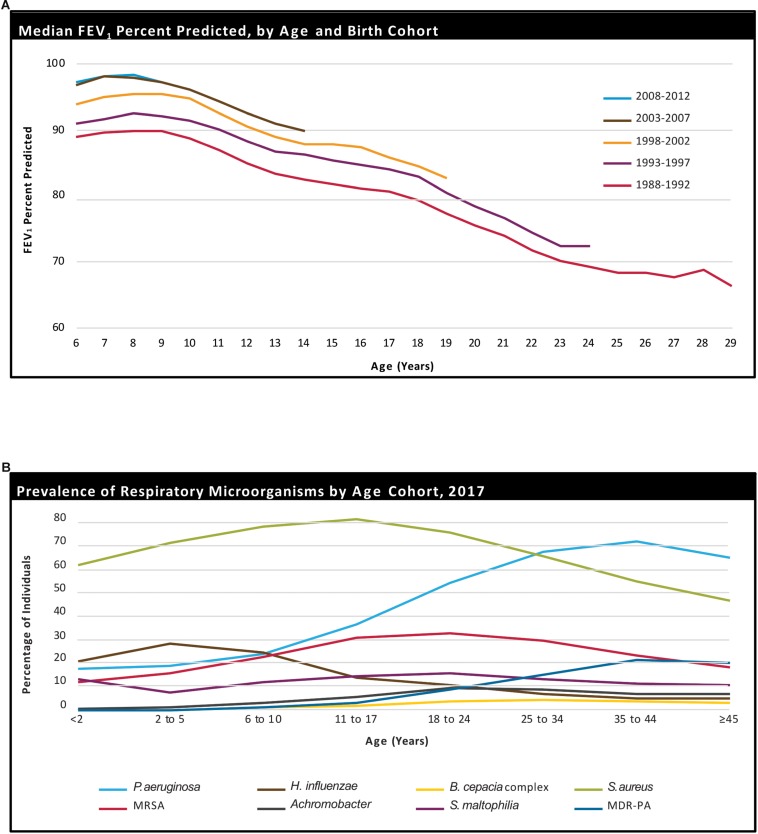
Age-related decline in percent-predicted forced expiratory volume in 1 s (ppFEV1) in people with CF, stratified by birth cohort (A). Prevalence of respiratory microorganisms by age cohort (B). Reprinted with permission from Cystic Fibrosis Foundation (2017).
FIGURE 2
FIGURE 2
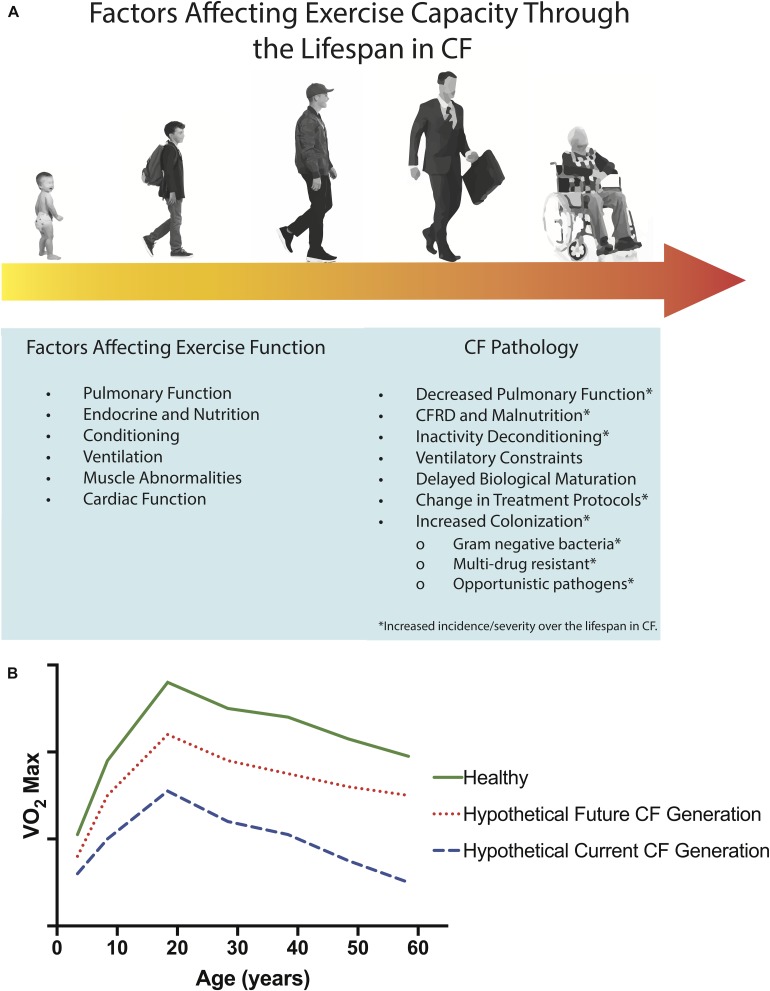
Determinants of exercise dysfunction in CF and age-related factors which may affect exercise capacity through the lifespan in CF (A). Airways in CF may be altered in structure from fetal development or from destructive events, leading to airway malacia. The incidence and severity of factors involved in CF Pathology increase over the lifespan of people with CF, as indicated by the progression from light yellow to dark orange across the lifespan in (A). Projected age-related decline in aerobic capacity (i.e., V˙O2max) for healthy populations (solid green line, adapted from Shvartz and Reibold (1990) and Booth and Zwetsloot (2010), and hypothetical age-related declines in aerobic fitness for current (dashed blue line) and future (dotted red line) CF populations (B). It is possible that with early initiation of CFTR modulator therapy and effective disease management, that in the future, individuals with CF may possess aerobic capacities more similar to healthy controls than individuals with CF today.

References

    1. Abdelbasset W. K., Soliman G. S., Elshehawy A. A., Alrawaili S. M. (2018). Exercise capacity and muscle fatiguability alterations following a progressive maximal exercise of lower extremities in children with cystic fibrosis. Afr. Health Sci. 18 1236–1242. 10.4314/ahs.v18i4.45 - DOI - PMC - PubMed
    1. Aswani N., Taylor C., McGaw J., Pickering M., Rigby A. (2003). Pubertal growth and development in cystic fibrosis: a retrospective review. Acta Paediatr. 92 1029–1032. 10.1111/j.1651-2227.2003.tb02571.x - DOI - PubMed
    1. Beaudoin N., Bouvet G. F., Coriati A., Rabasa-Lhoret R., Berthiaume Y. (2017). Combined exercise training improves glycemic control in adult with cystic fibrosis. Med. Sci. Sports Exerc. 49 231–237. 10.1249/MSS.0000000000001104 - DOI - PubMed
    1. Bellin M. D., Laguna T., Leschyshyn J., Regelmann W., Dunitz J., Billings J., et al. (2013). Insulin secretion improves in cystic fibrosis following ivacaftor correction of CFTR: a small pilot study. Pediatr. Diabetes 14 417–421. 10.1111/pedi.12026 - DOI - PMC - PubMed
    1. Booth F. W., Zwetsloot K. A. (2010). Basic concepts about genes, inactivity and aging. Scand. J. Med. Sci. Sports 20 1–4. 10.1111/j.1600-0838.2009.00972.x - DOI - PMC - PubMed

LinkOut - more resources