Review
. 2019 Nov 6:7:274.
doi: 10.3389/fcell.2019.00274. eCollection 2019.

Mitochondria, Telomeres and Telomerase Subunits

Affiliations
Review

Mitochondria, Telomeres and Telomerase Subunits

Qian Zheng et al. Front Cell Dev Biol. .

Abstract

Mitochondrial functions and telomere functions have mostly been studied independently. In recent years, it, however, has become clear that there are intimate links between mitochondria, telomeres, and telomerase subunits. Mitochondrial dysfunctions cause telomere attrition, while telomere damage leads to reprogramming of mitochondrial biosynthesis and mitochondrial dysfunctions, which has important implications in aging and diseases. In addition, evidence has accumulated that telomere-independent functions of telomerase also exist and that the protein component of telomerase TERT shuttles between the nucleus and mitochondria under oxidative stress. Our previously published data show that the RNA component of telomerase TERC is also imported into mitochondria, processed, and exported back to the cytosol. These data show a complex regulation network where telomeres, nuclear genome, and mitochondria are co-regulated by multi-localization and multi-function proteins and RNAs. This review summarizes the connections between mitochondria and telomeres, the mitochondrion-related functions of telomerase subunits, and how they play a role in crosstalk between mitochondria and the nucleus.

Keywords: TERC; TERT; aging; mitochondria; telomerase; telomere.


Figures

FIGURE 1
FIGURE 1
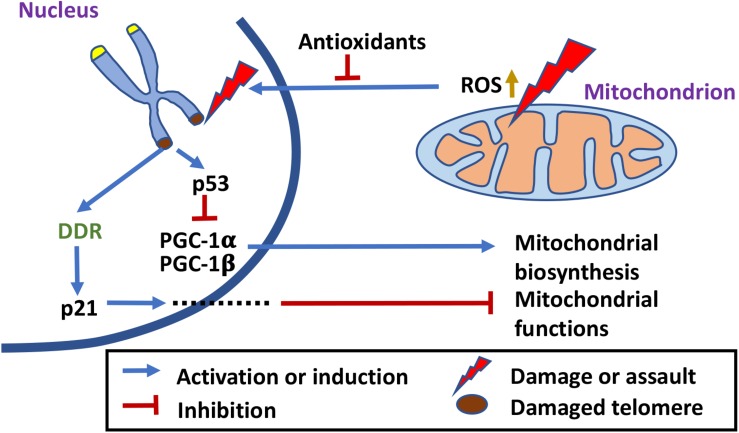
The crosstalk between mitochondria and telomeres. Mitochondrial defects increase ROS release, which has a damaging effect on telomeres (Sohal et al., 1994; von Zglinicki et al., 1995, 2000; Korshunov et al., 1997; Oikawa and Kawanishi, 1999; Liu et al., 2002; Saretzki et al., 2003). Antioxidant treatment ameliorates the negative effect (Serra et al., 2003; Stauffer et al., 2018). Telomere damages lead to mitochondrial biosynthesis reprogramming and mitochondrial dysfunction through different signaling pathways (Simpson and Russell, 1998; Biswas et al., 2005; Iwabu et al., 2010; Passos et al., 2010; Guo et al., 2011; Sahin et al., 2011; Scarpulla, 2011; Correia-Melo et al., 2016).
FIGURE 2
FIGURE 2
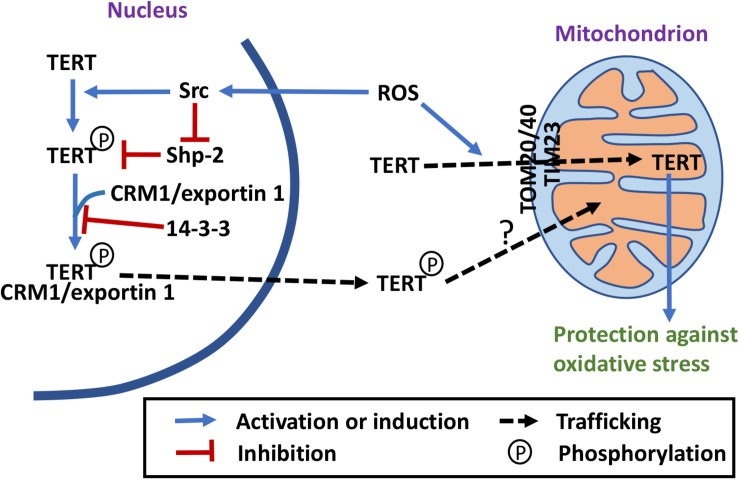
Telomerase-independent trafficking and functions of TERT. Under stress conditions, TERT is exported out of the nucleus and imported into mitochondria, where it may have a protective role (Seimiya et al., 2000; Haendeler et al., 2003, 2004, 2009; Santos et al., 2004; Yan et al., 2004; Jakob et al., 2008; Maida et al., 2009; Kovalenko et al., 2010; Sharma et al., 2012; Singhapol et al., 2013; Miwa et al., 2016; Green et al., 2019). Phosphorylation by Src and dephosphorylation by Shp-2 regulate TERT nuclear export (Haendeler et al., 2003; Jakob et al., 2008). The NES motif of TERT interacts with the nuclear export receptor CRM1/exportin, which is inhibited by 14-3-3 binding (Seimiya et al., 2000; Haendeler et al., 2003). Import of TERT into mitochondrial depends on a N-terminal MTS, TOM20 and TOM40 translocases at the outer membrane and TIM23 translocase at the inner membrane (Haendeler et al., 2009; Kovalenko et al., 2010; Sharma et al., 2012; Green et al., 2019).
FIGURE 3
FIGURE 3
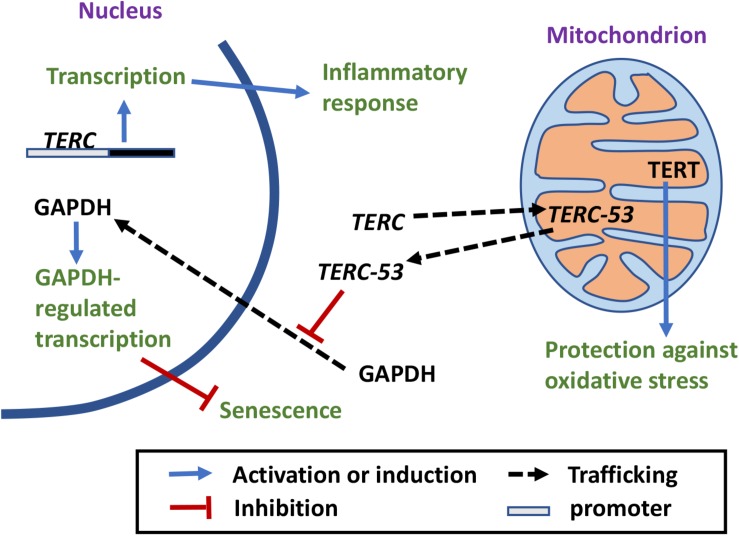
Telomerase-independent trafficking and functions of TERC. TERC is imported into mitochondria, processed to TERC-53, and then exported back to the cytosol where it inhibits nuclear translocation of GAPDH (Luhtala and Parker, 2010; Hillwig et al., 2011; Liu et al., 2017; Cheng et al., 2018; Huang et al., 2018). Cytosolic TERC-53 relays the signal of mitochondrial defects to the nucleus and is involved in cellular senescence and organismal aging. Nuclear TERC can also bind directly to the promoter regions and upregulate transcription of genes that are involved in inflammatory response (Liu et al., 2019).

References

    1. Argentino D. P., Dominici F. P., Al-Regaiey K., Bonkowski M. S., Bartke A., Turyn D. (2005). Effects of long-term caloric restriction on early steps of the insulin-signaling system in mouse skeletal muscle. J. Gerontol. A Biol. Sci. Med. Sci. 60 28–34. 10.1093/gerona/60.1.28 - DOI - PubMed
    1. Beckman J. S., Koppenol W. H. (1996). Nitric oxide, superoxide, and peroxynitrite: the good, the bad, and ugly. Am. J. Physiol. 271 C1424–C1437. - PubMed
    1. Biswas G., Guha M., Avadhani N. G. (2005). Mitochondria-to-nucleus stress signaling in mammalian cells: nature of nuclear gene targets, transcription regulation, and induced resistance to apoptosis. Gene 354 132–139. 10.1016/j.gene.2005.03.028 - DOI - PMC - PubMed
    1. Blasco M. A., Lee H. W., Hande M. P., Samper E., Lansdorp P. M., DePinho R. A., et al. (1997). Telomere shortening and tumor formation by mouse cells lacking telomerase RNA. Cell 91 25–34. 10.1016/s0092-8674(01)80006-4 - DOI - PubMed
    1. Buchner N., Zschauer T. C., Lukosz M., Altschmied J., Haendeler J. (2010). Downregulation of mitochondrial telomerase reverse transcriptase induced by H2O2 is Src kinase dependent. Exp. Gerontol. 45 558–562. 10.1016/j.exger.2010.03.003 - DOI - PubMed

LinkOut - more resources