


Increasing Frequencies of Antibiotic Resistant Non-typhoidal Salmonella Infections in Michigan and Risk Factors for Disease
- PMID: 31781566
- PMCID: PMC6857118
- DOI: 10.3389/fmed.2019.00250
Increasing Frequencies of Antibiotic Resistant Non-typhoidal Salmonella Infections in Michigan and Risk Factors for Disease
Abstract
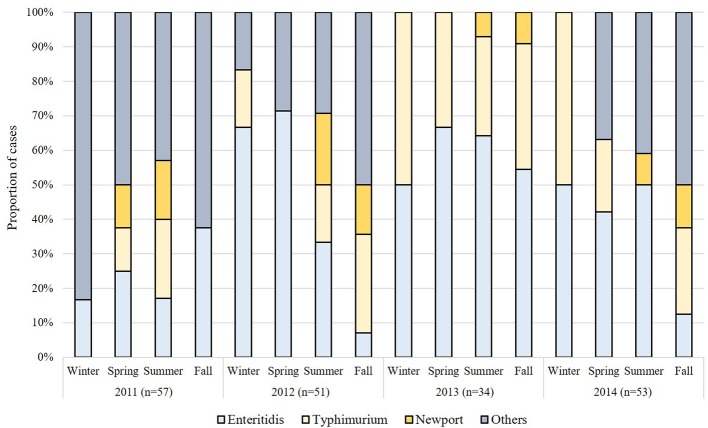
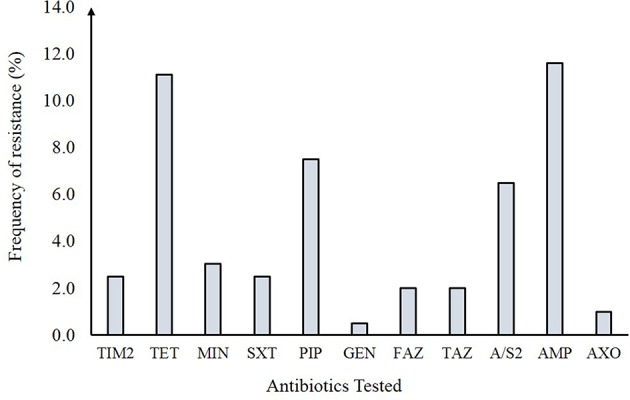
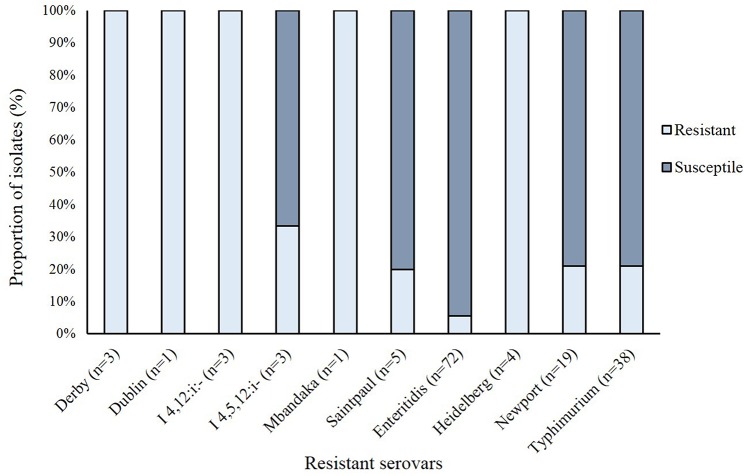
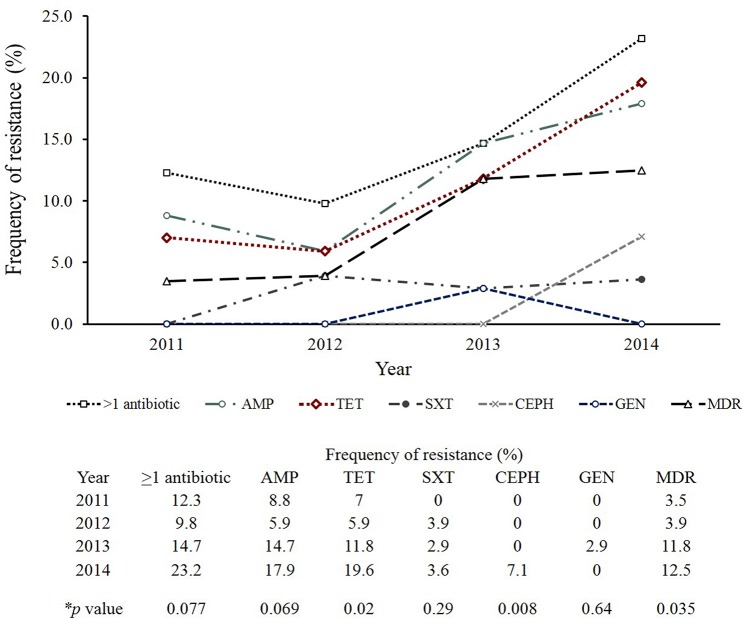
Non-typhoidal Salmonella (NTS) are important enteric pathogens causing over 1 million foodborne illnesses in the U.S. annually. The widespread emergence of antibiotic resistance in NTS isolates has limited the availability of antibiotics that can be used for therapy. Since Michigan is not part of the FoodNet surveillance system, few studies have quantified antibiotic resistance frequencies and identified risk factors for NTS infections in the state. We obtained 198 clinical NTS isolates via active surveillance at four Michigan hospitals from 2011 to 2014 for classification of serovars and susceptibility to 24 antibiotics using broth microdilution. The 198 isolates belonged to 35 different serovars with Enteritidis (36.9%) predominating followed by Typhimurium (19.5%) and Newport (9.7%), though the proportion of each varied by year, residence, and season. The number of Enteritidis and Typhimurium cases was higher in the summer, while Enteritidis cases were significantly more common among urban vs. rural residents. A total of 30 (15.2%) NTS isolates were resistant to ≥1 antibiotic and 15 (7.5%) were resistant to ≥3 antimicrobial classes; a significantly greater proportion of Typhimurium isolates were resistant compared to Enteritidis isolates and an increasing trend in the frequency of tetracycline resistance and multidrug resistance was observed over the 4-year period. Resistant infections were associated with longer hospital stays as the mean stay was 5.9 days for patients with resistant isolates relative to 4.0 days for patients infected with susceptible isolates. Multinomial logistic regression indicated that infection with serovars other than Enteritidis [Odds ratio (OR): 3.8, 95% confidence interval (CI): 1.23-11.82] as well as infection during the fall (OR: 3.0; 95% CI: 1.22-7.60) were independently associated with resistance. Together, these findings demonstrate the importance of surveillance, monitoring resistance frequencies, and identifying risk factors that can aid in the development of new prevention strategies.
Keywords: Michigan; antimicrobial resistance; epidemiology; non-typhoidal Salmonella; risk factors.
Copyright © 2019 Mukherjee, Anderson, Mosci, Newton, Lephart, Salimnia, Khalife, Rudrik and Manning.
Figures
References
-
- Global Burden of Diseases Diarrhoeal Diseases Collaborators Estimates of global, regional, and national morbidity, mortality, and aetiologies of diarrhoeal diseases: a systematic analysis for the Global Burden of Disease Study 2015. Lancet Infect Dis. (2017) 17:909–48. 10.1016/S1473-3099(17)30276-1 - DOI - PMC - PubMed
-
- Murray CJ, Vos T, Lozano R, Naghavi M, Flaxman AD, Michaud C, et al. . Disability-adjusted life years (DALYs) for 291 diseases and injuries in 21 regions, 1990-2010: a systematic analysis for the Global Burden of Disease Study 2010. Lancet. (2012) 380:2197–223. 10.1016/S0140-6736(12)61689-4 - DOI - PubMed
LinkOut - more resources
Full Text Sources
