Review
. 2020 Feb;44(2):320-339.
doi: 10.1111/acer.14253. Epub 2019 Dec 17.

A Rationale for Allopregnanolone Treatment of Alcohol Use Disorders: Basic and Clinical Studies

Affiliations
Review

A Rationale for Allopregnanolone Treatment of Alcohol Use Disorders: Basic and Clinical Studies

A Leslie Morrow et al. Alcohol Clin Exp Res. 2020 Feb.

Abstract

For many years, research from around the world has suggested that the neuroactive steroid (3α,5α)-3-hydroxypregnan-20-one (allopregnanolone or 3α,5α-THP) may have therapeutic potential for treatment of various symptoms of alcohol use disorders (AUDs). In this critical review, we systematically address all the evidence that supports such a suggestion, delineate the etiologies of AUDs that are addressed by treatment with allopregnanolone or its precursor pregnenolone, and the rationale for treatment of various components of the disease based on basic science and clinical evidence. This review presents a theoretical framework for understanding how endogenous steroids that regulate the effects of stress, alcohol, and the innate immune system could play a key role in both the prevention and the treatment of AUDs. We further discuss cautions and limitations of allopregnanolone or pregnenolone therapy with suggestions regarding the management of risk and the potential for helping millions who suffer from AUDs.

Keywords: Allopregnanolone; Corticotropin-Releasing Factor Signaling; GABA Inhibition; Neuroactive Steroid; Neuroimmune Signaling.


Figures

Figure 1.
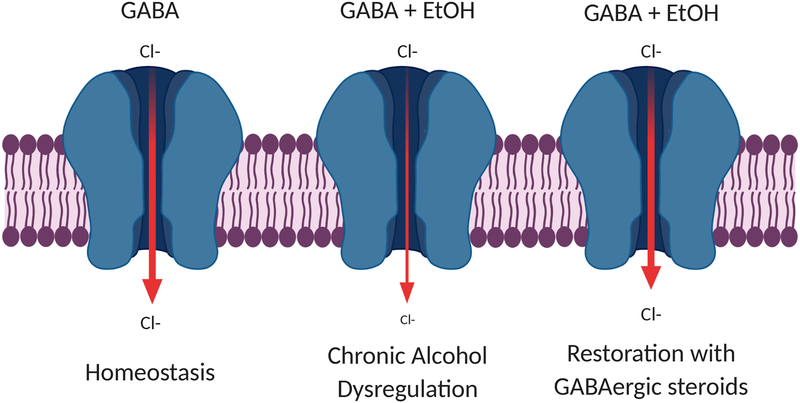
Figure 1.. Schematic representation of GABAergic steroid restoration of GABAA receptor-mediated signaling dysregulation due to chronic alcohol exposure.
Chronic alcohol exposure causes a reduction of GABA-mediated signaling through loss of GABAA receptor expression and internalization. GABAergic steroids, such as allopregnanolone, restore homeostasis by increasing GABAA receptor-mediated inhibition through both synaptic and extrasynaptic receptors. Created using BioRender.com.
Figure 2.
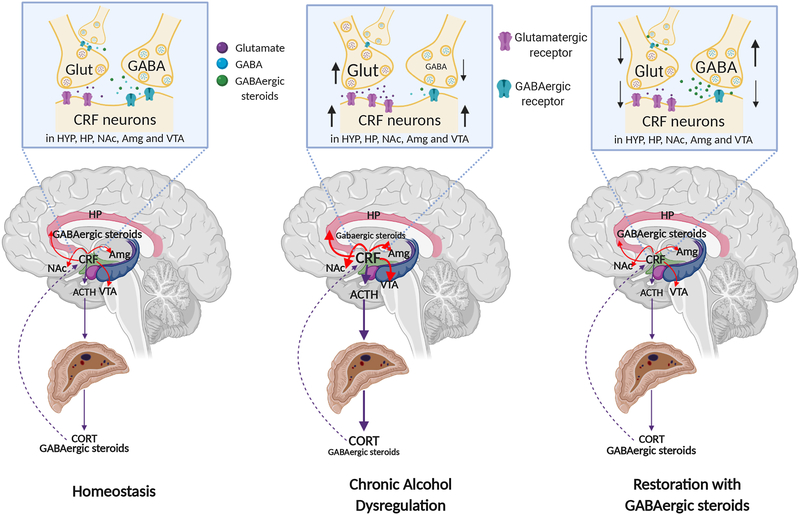
Figure 2.. Restoration of CRF dysregulation in alcohol dependence by GABAergic steroids.
Chronic alcohol abuse decreases neuroactive steroids levels and increases CRF signaling, in both hypothalamic and extrahypothalamic circuits. The effects of ethanol on CRF signaling are enhanced by the reduction of GABAA receptor-mediated transmission and enhancement of glutamatergic transmission. GABAergic steroids can restore homeostasis by reinforcing GABAergic transmission and by directly decreasing CRF levels. (HYP= hypothalamus; HP= hippocampus; NAc= nucleus accumbens; Amg= amygdala; VTA= ventral tegmental area; Glut= glutamatergic neuron; GABA= GABAergic neuron; ACTH= adrenocorticotropic hormone; CORT= cortisol/corticosterone; GABAergic steroids= neuroactive steroids positive modulators of GABAA receptors). Created using BioRender.com.
Figure 3.
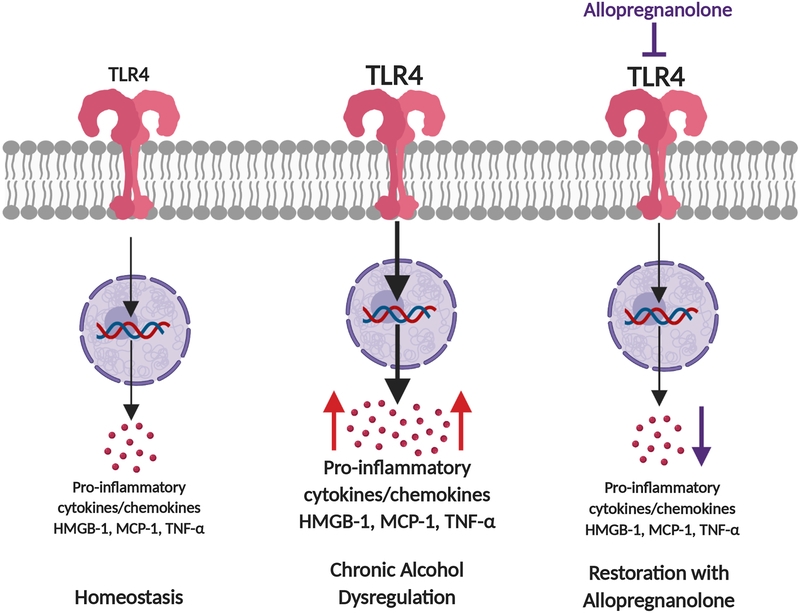
Figure 3.. Restoration of TLR pathway dysregulation due to chronic alcohol exposure.
TLR4 activation is increased by chronic alcohol abuse, causing the increase of pro-inflammatory cytokines/chemokines, such as HMGB-1, MCP-1 and TNF-α. Allopregnanolone restores homeostasis by blocking TLR4 activation to inhibit the production of the pro-inflammatory cytokines/chemokines MCP-1, HMGB-1 and TNF-α. Created using BioRender.com.
Figure 4.
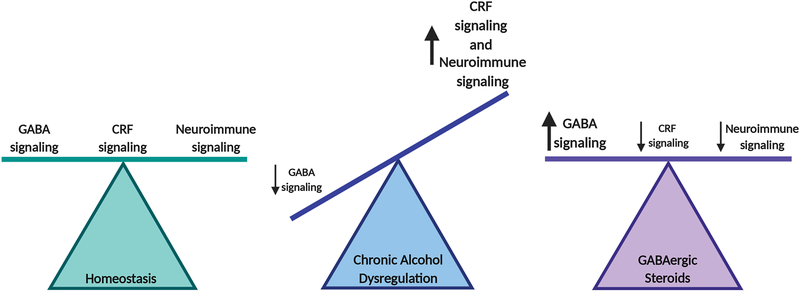
Figure 4.. Theoretical framework of the dysregulation caused by chronic alcohol abuse and restoration of homeostasis by GABAergic neuroactive steroids.
Chronic alcohol exposure decreases GABAergic signaling while increasing CRF and neuroimmune signaling. Neuroactive steroids may restore homeostasis by increasing GABAA receptor-mediated inhibition, and decreasing CRF and deleterious neuroimmune signaling, all of which contribute to the etiology of AUDs. Created using BioRender.com.

References

    1. Abrahao KP, Salinas AG, Lovinger DM (2017) Alcohol and the Brain: Neuronal Molecular Targets, Synapses, and Circuits. Neuron 96:1223–1238. - PMC - PubMed
    1. Adinoff B, Junghanns K, Kiefer F, Krishnan-Sarin S (2005a) Suppression of the HPA axis stress-response: implications for relapse. Alcohol Clin Exp Res 29:1351–1355. - PMC - PubMed
    1. Adinoff B, Krebaum SR, Chandler PA, Ye W, Brown MB, Williams MJ (2005b) Dissection of hypothalamic-pituitary-adrenal axis pathology in 1-month-abstinent alcohol-dependent men, part 1: adrenocortical and pituitary glucocorticoid responsiveness. Alcohol. Clin. Exp. Res 29:517–527. - PMC - PubMed
    1. Adinoff B, Krebaum SR, Chandler PA, Ye W, Brown MB, Williams MJ (2005c) Dissection of hypothalamic-pituitary-adrenal axis pathology in 1-month-abstinent alcohol-dependent men, part 2: response to ovine corticotropin-releasing factor and naloxone. Alcohol. Clin. Exp. Res 29:528–537. - PMC - PubMed
    1. Adinoff B, Martin PR, Bone GH, Eckardt MJ, Roehrich L, George DT, Moss HB, Eskay R, Linnoila M, Gold PW (1990) Hypothalamic-pituitary-adrenal axis functioning and cerebrospinal fluid corticotropin releasing hormone and corticotropin levels in alcoholics after recent and long-term abstinence. Arch. Gen. Psychiatry 47:325–330. - PubMed

Publication types

MeSH terms