


Sleepiness as motivation: a potential mechanism for how sleep deprivation affects behavior
- PMID: 31782961
- PMCID: PMC7294403
- DOI: 10.1093/sleep/zsz291
Sleepiness as motivation: a potential mechanism for how sleep deprivation affects behavior
Abstract
Study objectives: To determine how sleepiness and sleep deprivation drive the motivation to engage in different behaviors.
Methods: We studied the sleepiness of 123 participants who had been randomized to sleep deprivation or normal sleep, and their willingness to engage in a range of everyday behaviors.
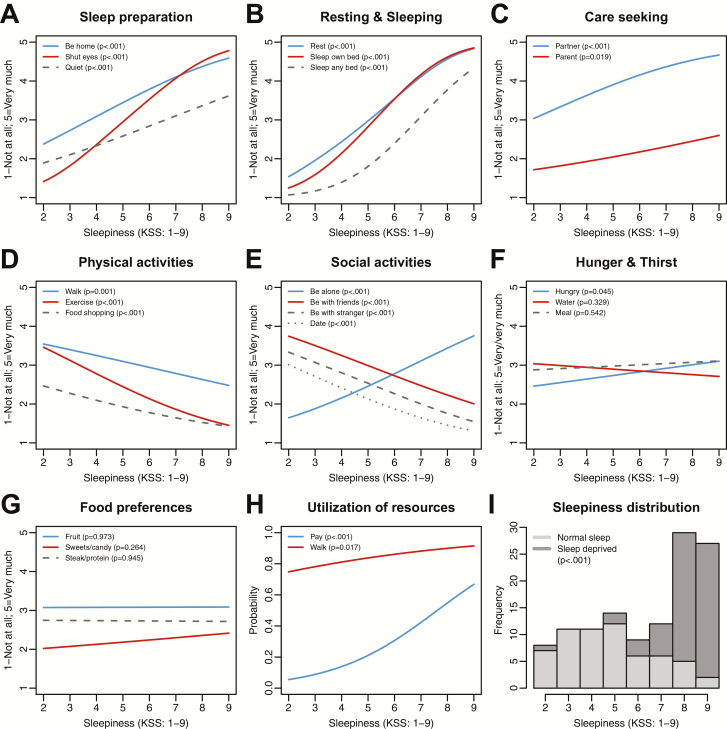
Results: Self-reported sleepiness was a strong predictor of the motivation to engage in sleep-preparatory behaviors such as shutting one's eyes (OR = 2.78, 95% CI: 2.19-3.52 for each step up on the Karolinska Sleepiness Scale) and resting (OR = 3.20, CI: 2.46-4.16). Sleepiness was also related to the desire to be cared for by a loved one (OR = 1.49, CI: 1.22-1.82), and preparedness to utilize monetary and energy resources to get to sleep. Conversely, increased sleepiness was associated with a decreased motivation for social and physical activities (e.g. be with friends OR = 0.71, CI: 0.61-0.82; exercise OR = 0.65, CI: 0.56-0.76). Sleep deprivation had similar effects as sleepiness on these behaviors. Neither sleepiness nor sleep deprivation had strong associations with hunger, thirst, or food preferences.
Conclusions: Our findings indicate that sleepiness is a dynamic motivational drive that promotes sleep-preparatory behaviors and competes with other drives and desired outcomes. Consequently, sleepiness may be a central mechanism by which impaired alertness, for example, due to insufficient sleep, contributes to poor quality of life and adverse health. We propose that sleepiness helps organize behaviors toward the specific goal of assuring sufficient sleep, in competition with other needs and incentives. A theoretical framework on sleepiness and its behavioral consequences are likely to improve our understanding of several disease mechanisms.
Keywords: behavior; health; motivation; sleep deprivation; sleepiness.
© Sleep Research Society 2019. Published by Oxford University Press on behalf of the Sleep Research Society.
Figures
References
-
- Borbély AA. A two process model of sleep regulation. Hum Neurobiol. 1982;1(3):195–204. - PubMed
-
- Horne J. Sleepiness as a need for sleep: when is enough, enough? Neurosci Biobehav Rev. 2010;34(1):108–118. - PubMed
-
- Carskadon MA, et al. . Guidelines for the multiple sleep latency test (MSLT): a standard measure of sleepiness. Sleep. 1986;9(4):519–524. - PubMed
