


A systematic review and meta-analysis of rTMS effects on cognitive enhancement in mild cognitive impairment and Alzheimer's disease
- PMID: 31783330
- PMCID: PMC6995441
- DOI: 10.1016/j.neurobiolaging.2019.08.020
A systematic review and meta-analysis of rTMS effects on cognitive enhancement in mild cognitive impairment and Alzheimer's disease
Abstract
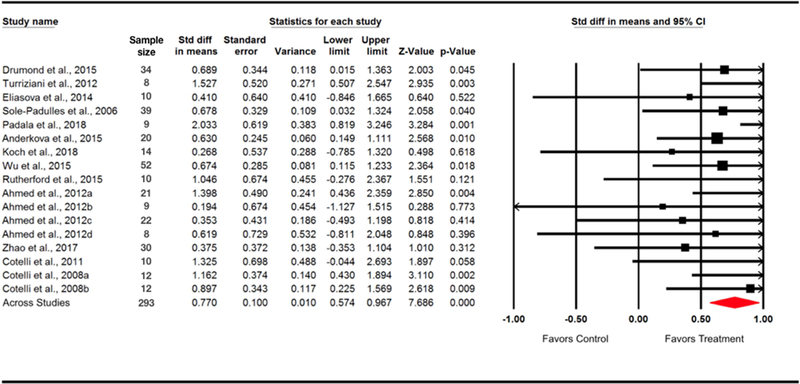
Repetitive transcranial magnetic stimulation (rTMS), a noninvasive brain stimulation technique, has emerged as a promising treatment for mild cognitive impairment (MCI) and Alzheimer's disease (AD). Currently, however, the effectiveness of this therapy is unclear because of the low statistical power and heterogeneity of previous trials. The purpose of the meta-analysis was to systematically characterize the effectiveness of various combinations of rTMS parameters on different cognitive domains in patients with MCI and AD. Thirteen studies comprising 293 patients with MCI or AD were included in this analysis. Random-effects analysis revealed an overall medium-to-large effect size (0.77) favoring active rTMS over sham rTMS in the improvement of cognitive functions. Subgroup analyses revealed that (1) high-frequency rTMS over the left dorsolateral prefrontal cortex and low-frequency rTMS at the right dorsolateral prefrontal cortex significantly improved memory functions; (2) high-frequency rTMS targeting the right inferior frontal gyrus significantly enhanced executive performance; and (3) the effects of 5-30 consecutive rTMS sessions could last for 4-12 weeks. Potential mechanisms of rTMS effects on cognitive functions are discussed.
Keywords: Alzheimer's disease; Cognition; Dorsolateral prefrontal cortex; Intervention; Memory; Mild cognitive impairment; Plasticity; Therapy; Transcranial magnetic stimulation; Treatment.
Copyright © 2019 Elsevier Inc. All rights reserved.
Figures


References
-
- Achim AM, Lepage M 2005. Dorsolateral prefrontal cortex involvement in memory post-retrieval monitoring revealed in both item and associative recognition tests. Neuroimage 24, 1113–21. - PubMed
-
- Ahmed MA, Darwish ES, Khedr EM, El Serogy YM, Ali AM 2012. Effects of low versus high frequencies of repetitive transcranial magnetic stimulation on cognitive function and cortical excitability in Alzheimer’s dementia. J Neurol 259, 83–92. - PubMed
-
- Anderkova L, Eliasova I, Marecek R, Janousova E, Rektorova I 2015. Distinct Pattern of Gray Matter Atrophy in Mild Alzheimer’s Disease Impacts on Cognitive Outcomes of Noninvasive Brain Stimulation. Journal of Alzheimer’s disease : JAD 48, 251–60. - PubMed
-
- Atkins D, Best D, Briss PA, Eccles M, Falck-Ytter Y, Flottorp S, Guyatt GH, Harbour RT, Haugh MC, Henry D, Hill S, Jaeschke R, Leng G, Liberati A, Magrini N, Mason J, Middleton P, Mrukowicz J, O’Connell D, Oxman AD, Phillips B, Schunemann HJ, Edejer T, Varonen H, Vist GE, Williams JW Jr., Zaza S, Group, G.W. 2004. Grading quality of evidence and strength of recommendations. BMJ 328, 1490. - PMC - PubMed
-
- Avery DH, Holtzheimer PE 3rd, Fawaz W, Russo J, Neumaier J, Dunner DL, Haynor DR, Claypoole KH, Wajdik C, Roy-Byrne P 2006. A controlled study of repetitive transcranial magnetic stimulation in medication-resistant major depression. Biol Psychiatry 59, 187–94. - PubMed
Publication types
MeSH terms
Grants and funding
LinkOut - more resources
Full Text Sources
Medical
