


Malnutrition as a Strong Predictor of the Onset of Sarcopenia
- PMID: 31783482
- PMCID: PMC6950107
- DOI: 10.3390/nu11122883
Malnutrition as a Strong Predictor of the Onset of Sarcopenia
Abstract
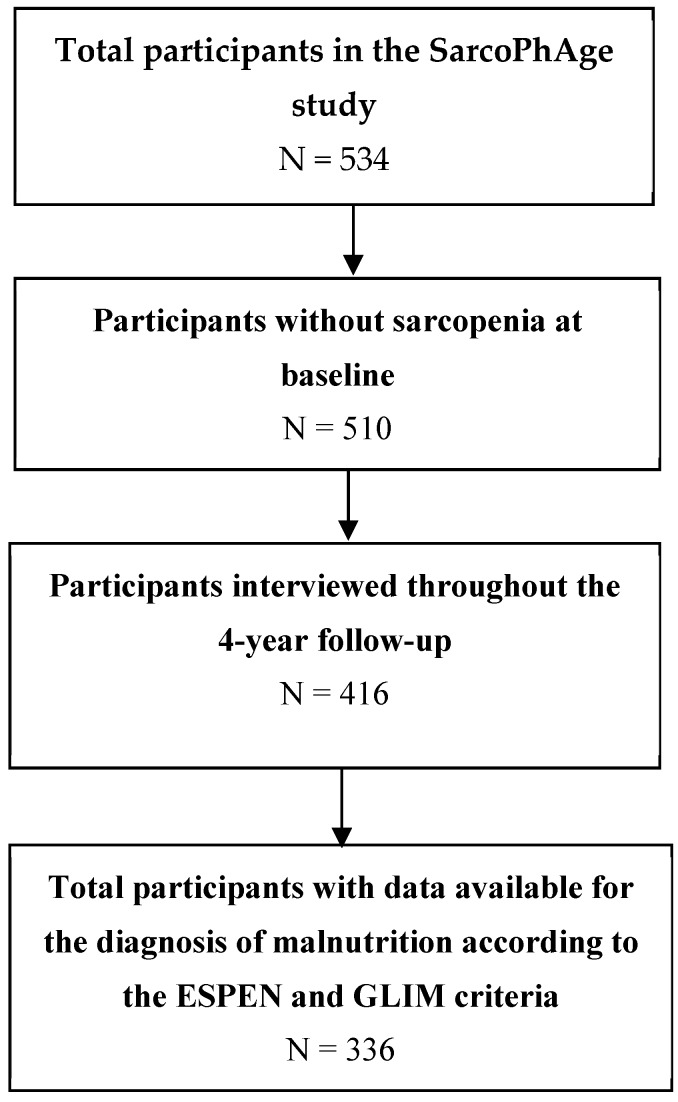
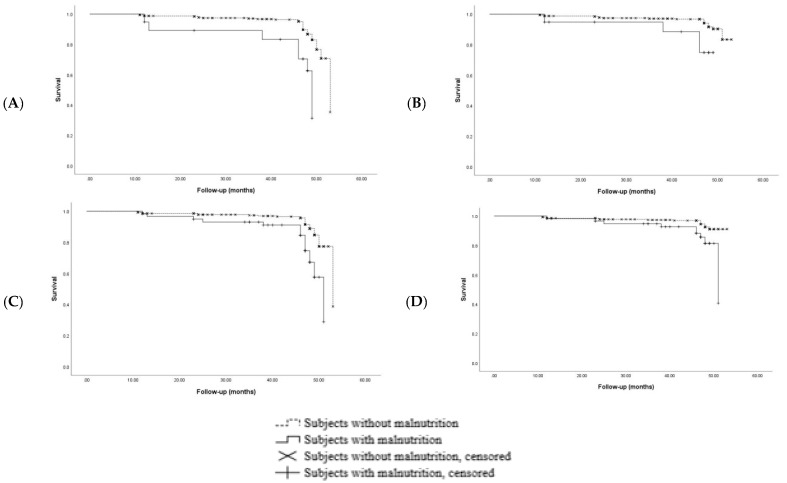
This study aims to explore the association between malnutrition diagnosed according to both the Global Leadership Initiative of Malnutrition (GLIM) and the European Society of Clinical Nutrition and Metabolism (ESPEN) criteria and the onset of sarcopenia/severe sarcopenia, diagnosed according to the European Working Group on Sarcopenia in Older People 2 (EWGSOP2) criterion, in the sarcopenia and physical impairment with advancing age (SarcoPhAge) cohort during a four-year follow-up. Adjusted Cox-regression and Kaplan-Meier curves were performed. Among the 534 community-dwelling participants recruited in the SarcoPhAge study, 510 were free from sarcopenia at baseline, of whom 336 had complete data (186 women and 150 men, mean age of 72.5 ± 5.8 years) to apply the GLIM and ESPEN criteria. A significantly higher risk of developing sarcopenia/severe sarcopenia during the four-year follow-up based on the GLIM [sarcopenia: Adjusted hazard ratio (HR) = 3.23 (95% confidence interval (CI) 1.73-6.05); severe sarcopenia: Adjusted HR = 2.87 (95% CI 1.25-6.56)] and ESPEN [sarcopenia: Adjusted HR = 4.28 (95% CI 1.86-9.86); severe sarcopenia: Adjusted HR = 3.86 (95% CI 1.29-11.54)] criteria was observed. Kaplan-Meier curves confirmed this relationship (log rank p < 0.001 for all). These results highlighted the importance of malnutrition since it has been shown to be associated with an approximately fourfold higher risk of developing sarcopenia/severe sarcopenia during a four-year follow-up.
Keywords: EWGSOP2; GLIM; SarcoPhAge; malnutrition; sarcopenia.
Conflict of interest statement
The authors declare no conflict of interest. The funders had no role in the design of the study; in the collection, analyses, or interpretation of data; in the writing of the manuscript; or in the decision to publish the results.
Figures
References
-
- Sánchez-Rodríguez D., Annweiler C., Ronquillo-Moreno N., Vázquez-Ibar O., Escalada F., Duran X., Muniesa J.M., Marco E. Prognostic Value of the ESPEN Consensus and Guidelines for Malnutrition: Prediction of Post-Discharge Clinical Outcomes in Older Inpatients. Nutr. Clin. Pract. 2019;34:304–312. doi: 10.1002/ncp.10088. - DOI - PubMed
-
- Sanz-París A., Gómez-Candela C., Martín-Palmero Á., García-Almeida J.M., Burgos-Pelaez R., Matía-Martin P., Arbones-Mainar J.M. Application of the new ESPEN definition of malnutrition in geriatric diabetic patients during hospitalization: A multicentric study. Clin. Nutr. 2016;35:1564–1567. doi: 10.1016/j.clnu.2016.02.018. - DOI - PubMed
-
- Sánchez-Rodríguez D., Marco E., Schott A.-M., Rolland Y., Blain H., Vázquez-Ibar O., Escalada F., Duran X., Muniesa J.M., Annweiler C. Malnutrition according to ESPEN definition predicts long-term mortality in general older population: Findings from the EPIDOS study-Toulouse cohort. Clin. Nutr. 2018;38:2652–2658. doi: 10.1016/j.clnu.2018.11.016. - DOI - PubMed
-
- Muscaritoli M., Krznarić Z., Singer P., Barazzoni R., Cederholm T., Golay A., Van Gossum A., Kennedy N., Kreymann G., Laviano A., et al. Effectiveness and efficacy of nutritional therapy: A systematic review following Cochrane methodology. Clin. Nutr. 2017;36:939–957. doi: 10.1016/j.clnu.2016.06.022. - DOI - PubMed
MeSH terms
LinkOut - more resources
Full Text Sources
Medical
