. 2020 Jan;68(1):45-51.
doi: 10.1136/jim-2019-001010. Epub 2019 Nov 28.

Multiple myeloma-derived exosomes inhibit osteoblastic differentiation and improve IL-6 secretion of BMSCs from multiple myeloma

Affiliations

Multiple myeloma-derived exosomes inhibit osteoblastic differentiation and improve IL-6 secretion of BMSCs from multiple myeloma

Zhaoyun Liu et al. J Investig Med. 2020 Jan.

Abstract

Bone marrow stromal cells (BMSCs) play a critical role in multiple myeloma (MM) pathogenesis by cell contact, and secretion of cytokines, growth factors and extracellular vesicles. Exosomes are secreted by almost all cell types and are recently reported to mediate local cell-to-cell cross-talk by transferring messenger RNAs, LncRNAs, and proteins. Compelling studies have identified BMSC-derived exosomes induce proliferation, migration, survival, and drug resistance of MM cells. However, whether MM cell-derived exosome also plays a role in function in BMSC remains unclear. Here we investigated the effect of MM cell-derived exosomes on the interleukin (IL)-6 secretion and osteoblastic differentiation capability of BMSC from patients with MM. Furthermore we investigated the IL-6 secretion relative regulation protein APE1 and NF-kB and osteoblastic differentiation protein Runx2 (runt-related gene 2), Osterix and osteocalcin (OCN). Our results showed that MM cell-derived exosomes promoted IL-6 secretion and suppressed osteoblastic differentiation and mineralization of BMSCs. Mechanistically, we demonstrated that MM cell-derived exosomes lead to an increase in APE1 and NF-kB and a reduction in Runx2, Osterix and OCN in BMSCs. Taken together, MM cell-derived exosomes induce the secretion of IL-6 and poor osteoblastic differentiation of BMSCs.

Keywords: hematology.


Conflict of interest statement

Competing interests: None declared.

Figures
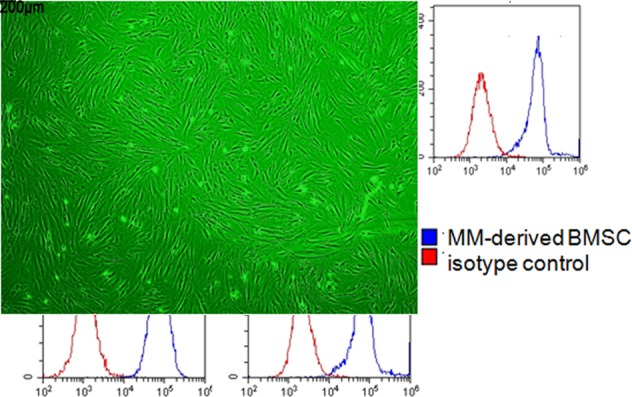
Figure 1
Figure 1
Characterization of exosomes derived from MM cells and MM-derived BMSCs. (A)Transmission electron microscopy image of isolated exosomes from MM cells of patients and RPMI-8226 cells. Exosomes range in size from 20 nm to 80 nm. (B) Western blotting analysis of CD63, Hsp70 and CD138 in MM cells from patients with MM and RPMI-8226 cell line-derived exosomes and cellular lysates. (C) Mean fluorescence intensity of CD34, CD45, CD90, CD105 and CD73 was determined on MM-derived BMSC by flow cytometric analysis. Representative histograms are shown. The red line represents the respective isotype control, and the blue line represents patients with MM-derived BMSC. (D) Representative micrograph depicts morphology of patients with MM-derived BMSC. BMSC, bone marrow stromal cell; Exo, exosomes; MM, multiple myeloma; FITC, fluorescein isothiocyanate; APC, allophycocyan in PE, phycoerythrin.
Figure 2
Figure 2
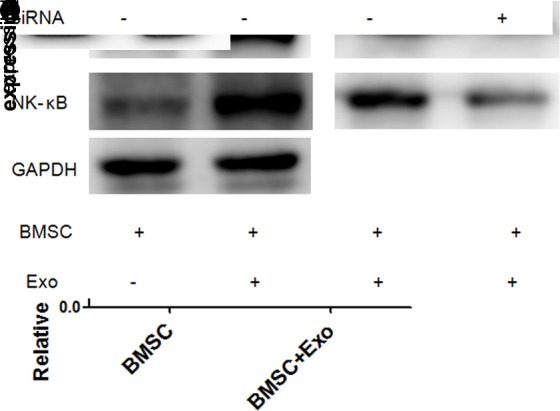
MM cell-derived exosomes induced IL-6 secretion of BMSCs via the Ape1/NF-kB pathway. (A) The level of IL-6 in BMSC and culture media in RPMI-8226 cell-derived exosomes group (200 μg/mL) was significantly higher than the BMSC alone. (B, C) The messenger RNA levels of IL-6 and Ape1 in BMSC and RPMI-8226 cell-derived exosomes (200 μg/mL) coculture were higher than the BMSC alone. (D) RPMI-8226 cell-derived exosomes (200 μg/mL) inhibit the expression of Ape1 and NF-kB. The level of NF-kB was downregulated, followed by a decrease in Ape1 siRNA. BMSC, bone marrow stromal cell; Exo, exosome; IL-6, interleukin 6; MM, multiple myeloma;GAPDH, glyceraldehyde-3-phosphate dehydrogenase; siRNA, small interfering RNA.
Figure 3
Figure 3
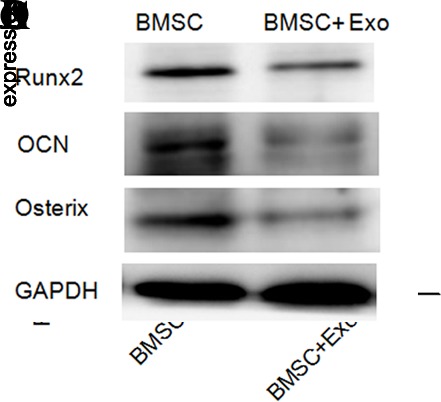
The level of Osterix, OCN and Runx2 in the BMSCs. (A–C) mRNA levels of Osterix, OCN and Runx2 in BMSC and RPMI-8226 cell-derived exosomes (200 μg/mL) coculture were lower than the BMSC alone. (D) RPMI-8226 cell-derived exosomes (200 μg/mL) inhibit the expression of osteoblast differentiation relative factors—Runx2, Osterix and OCN. BMSC, bone marrow stromal cell; Exo, exosome; mRNA, messenger RNA; OCN, osteocalcin, Runx2, runt-related gene 2, GAPDH, glyceraldehyde-3-phosphate dehydrogenase.
Figure 4
Figure 4
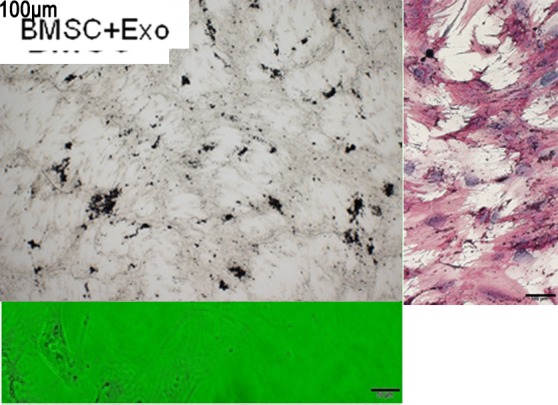
MM cell-derived exosomes suppressed BMSC osteoblast formation and mineralization. (A) The quantity of OB decreased in RPMI-8226 cell-derived exosomes group. (B) The amount of mineralized nodules (von Kossa staining) was decreased in RPMI-8226 cell-derived exosomes (200 μg/mL) + BMSC group compared with the BMSC group. (C) Alkaline phosphatase became weakly after the BMSCs were cultured for 3 weeks in RPMI-8226 cell-derived exosomes (200 μg/mL) compared with the BMSC group. BMSC, bone marrow stromal cell; MM, multiple myeloma.

References

    1. Uchiyama H, Barut BA, Mohrbacher AF, et al. Adhesion of human myeloma-derived cell lines to bone marrow stromal cells stimulates interleukin-6 secretion. Blood 1993;82:3712–20. - PubMed
    1. Gupta D, Treon SP, Shima Y, et al. Adherence of multiple myeloma cells to bone marrow stromal cells upregulates vascular endothelial growth factor secretion: therapeutic applications. Leukemia 2001;15:1950–61. 10.1038/sj.leu.2402295 - DOI - PubMed
    1. Tai YT, Li XF, Breitkreutz I, et al. Role of B-cell-activating factor in adhesion and growth of human multiple myeloma cells in the bone marrow microenvironment. Cancer Res 2006;66:6675–82. 10.1158/0008-5472.CAN-06-0190 - DOI - PubMed
    1. Vallet S, Mukherjee S, Vaghela N, et al. Activin A promotes multiple myeloma-induced osteolysis and is a promising target for myeloma bone disease. Proc Natl Acad Sci U S A 2010;107:5124–9. 10.1073/pnas.0911929107 - DOI - PMC - PubMed
    1. Théry C. Exosomes: secreted vesicles and intercellular communications. F1000 Biol Rep 2011;3:15 10.3410/B3-15 - DOI - PMC - PubMed

Publication types