


Method effects associated with negatively and positively worded items on the 12-item General Health Questionnaire (GHQ-12): results from a cross-sectional survey with a representative sample of Catalonian workers
- PMID: 31784441
- PMCID: PMC6924827
- DOI: 10.1136/bmjopen-2019-031859
Method effects associated with negatively and positively worded items on the 12-item General Health Questionnaire (GHQ-12): results from a cross-sectional survey with a representative sample of Catalonian workers
Abstract
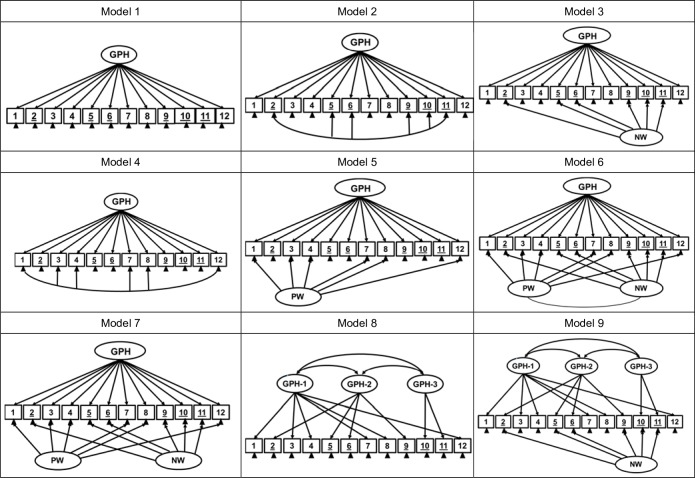
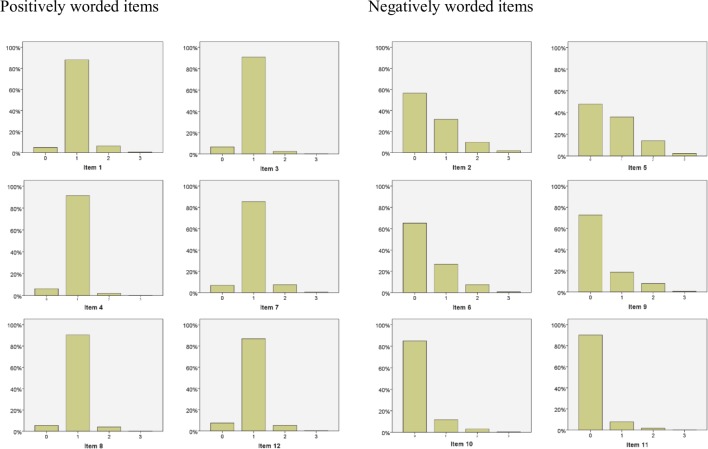
Objective: Recent studies into the factorial structure of the 12-item version of the General Health Questionnaire (GHQ-12) have shown that it was best represented by a single substantive factor when method effects associated with negatively worded (NW) items are considered. The purpose of the present study was to examine the presence of method effects, and their relationships with demographic covariates, associated with positively worded (PW) and/or NW items.
Design: A cross-sectional, observational study to compare a comprehensive set of confirmatory factor models, including method effects associated with PW and/or NW items with GHQ-12 responses.
Setting: Representative sample of all employees living in Catalonia (Spain).
Participants: 3050 participants (44.6% women) who responded the Second Catalonian Survey of Working Conditions.
Results: A confirmatory factor analysis showed that the best fitting model was a unidimensional model with two additional uncorrelated method factors associated with PW and NW items. Furthermore, structural equation modelling (SEM) revealed that method effects were differentially related to both the sex and age of the respondents.
Conclusion: Individual differences related to sex and age can help to identify respondents who are prone to answering PW and NW items differently. Consequently, it is desirable that both the constructs of interest as well as the effects of method factors are considered in SEM models as a means of avoiding the drawing of inaccurate conclusions about the relationships between the substantive factors.
Keywords: General Health Questionnaire (GHQ–12); confirmatory factor analysis; item wording effects; method effects; psychological health.
© Author(s) (or their employer(s)) 2019. Re-use permitted under CC BY-NC. No commercial re-use. See rights and permissions. Published by BMJ.
Conflict of interest statement
Competing interests: None declared.
Figures
References
-
- Goldberg DP. The detection of psychiatric illness by questionnaire. London: Oxford University Press, 1972.
-
- Goldberg DP, Williams P. A user’s guide to the General Health Questionnaire. Windsor, United Kingdom: NFER-Nelson, 1988.
-
- Gelaye B, Tadesse MG, Lohsoonthorn V, et al. Psychometric properties and factor structure of the general health questionnaire as a screening tool for anxiety and depressive symptoms in a multi-national study of young adults. J Affect Disord 2015;187:197–202. 10.1016/j.jad.2015.08.045 - DOI - PMC - PubMed
Publication types
MeSH terms
LinkOut - more resources
Full Text Sources
