


Isolation distance between municipal solid waste landfills and drinking water wells for bacteria attenuation and safe drinking
- PMID: 31784644
- PMCID: PMC6884615
- DOI: 10.1038/s41598-019-54506-2
Isolation distance between municipal solid waste landfills and drinking water wells for bacteria attenuation and safe drinking
Abstract
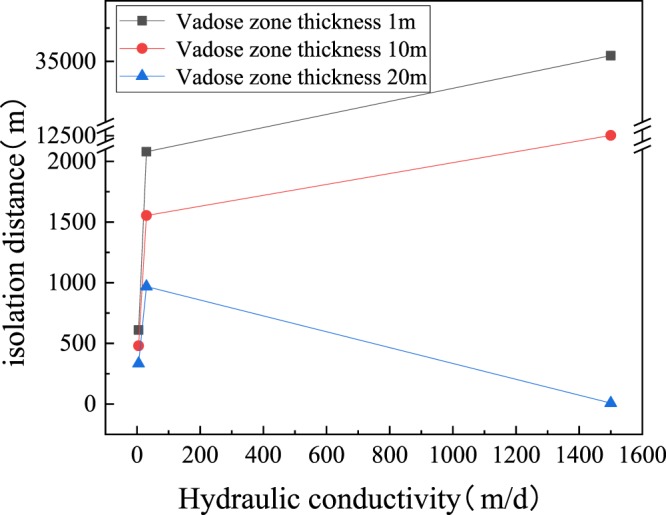
Groundwater pollution and human health risks caused by leachate leakage have become a worldwide environmental problem, and the harm and influence of bacteria in leachate have received increased attention. Setting the isolation distance between landfill sites and groundwater isolation targets is particularly important. Firstly, the intensity model of pollutant leakage source and solute transport model were established for the isolation of pathogenic Escherichia coli. Then, the migration, removal and reduction of bacteria in the aerated zone and ground were simulated. Finally, the isolation distance was calculated based on the acceptable water quality limits, and the influence of hydrogeological arameters was analyzed based on the parameter uncertainty. The results of this study suggest that the isolation distances vary widely ranging from 106 m-5.46 km in sand aquifers, 292 m-13.5 km in gravel aquifers and 2.4-58.7 km in coarse gravel aquifers. The gradient change of groundwater from 0.001 to 0.05 resulted in the isolation distance at the highest gradient position being 2-30 times greater than that at the lowest gradient position. There was a difference in the influence of the thickness of the vadose zone. For example, under the same conditions, with the increase of the thickness of the aeration zone, the isolation distance will be reduced by 1.5-5 times, or under the same thickness of the aeration zone, the isolation distance will be significantly shortened. Accordingly, this needs to be determined based on specific safety isolation requirements. In conclusion, this research has important guiding significance for the environmental safety assessment technology of municipal solid waste landfill.
Conflict of interest statement
Dr. R. X’s work has been funded by the National Key R&D Projects of China (No. 2018YFC1800902) and the National Nature Science Foundation of China (No. 51708529) which provided financial support. All authors declare no potential conflict of interest.
Figures


References
-
- D A, et al. Removal of heavy metals from synthetic landfill leachate in lab-scale vertical flow constructed wetlands. Science of the Total Environment. 2017;584:742–750. - PubMed
Publication types
MeSH terms
Substances
LinkOut - more resources
Full Text Sources
Medical
