. 2019 Nov 29;9(1):17966.
doi: 10.1038/s41598-019-54399-1.

Open-Source Remote Gait Analysis: A Post-Surgery Patient Monitoring Application

Affiliations

Open-Source Remote Gait Analysis: A Post-Surgery Patient Monitoring Application

Reed D Gurchiek et al. Sci Rep. .

Abstract

Critical to digital medicine is the promise of improved patient monitoring to allow assessment and personalized intervention to occur in real-time. Wearable sensor-enabled observation of physiological data in free-living conditions is integral to this vision. However, few open-source algorithms have been developed for analyzing and interpreting these data which slows development and the realization of digital medicine. There is clear need for open-source tools that analyze free-living wearable sensor data and particularly for gait analysis, which provides important biomarkers in multiple clinical populations. We present an open-source analytical platform for automated free-living gait analysis and use it to investigate a novel, multi-domain (accelerometer and electromyography) asymmetry measure for quantifying rehabilitation progress in patients recovering from surgical reconstruction of the anterior cruciate ligament (ACL). Asymmetry indices extracted from 41,893 strides were more strongly correlated (r = -0.87, p < 0.01) with recovery time than standard step counts (r = 0.25, p = 0.52) and significantly differed between patients 2- and 17-weeks post-op (p < 0.01, effect size: 2.20-2.96), and controls (p < 0.01, effect size: 1.74-4.20). Results point toward future use of this open-source platform for capturing rehabilitation progress and, more broadly, for free-living gait analysis.


Conflict of interest statement

The authors declare no competing interests.

Figures
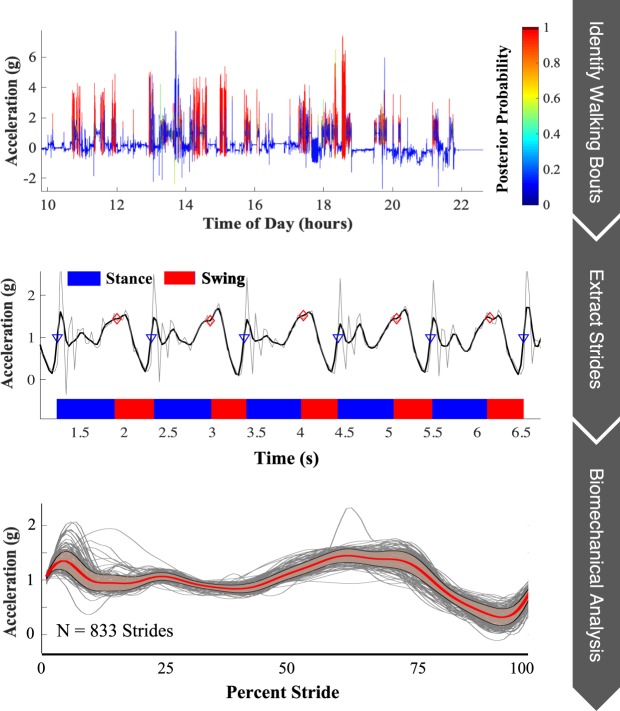
Figure 1
Figure 1
Graphical summary of the proposed remote gait analysis. The proposed approach is comprised of three basic steps: (1) walking bout identification, (2) stride extraction and gait phase segmentation, and (3) biomechanical analysis of individual strides.
Figure 2
Figure 2
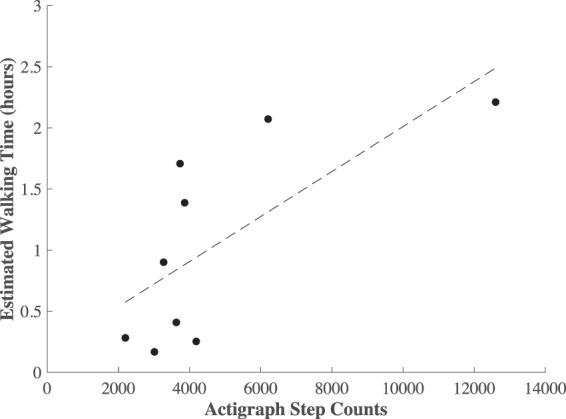
Scatter plot of the total time spent walking from the proposed method vs step counts estimated by Actigraph activity monitors.
Figure 3
Figure 3
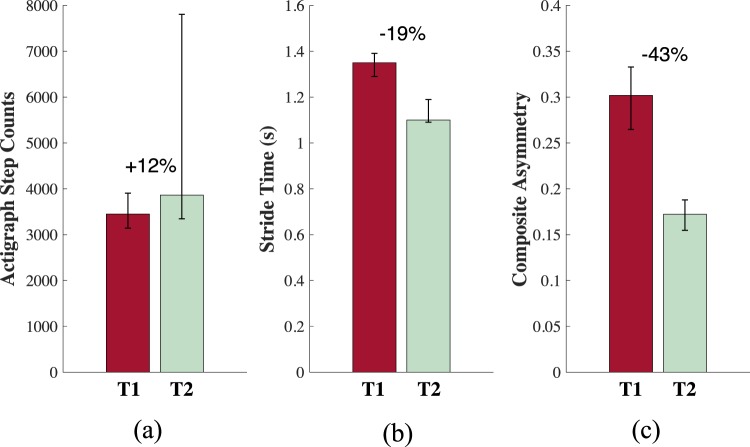
Percent difference in the median Actigraph step counts (a), strides times (b), and composite asymmetry scores (c) between the T1 (red) and T2 (green) groups. Error bars denote the 25th and 75th quantiles.
Figure 4
Figure 4
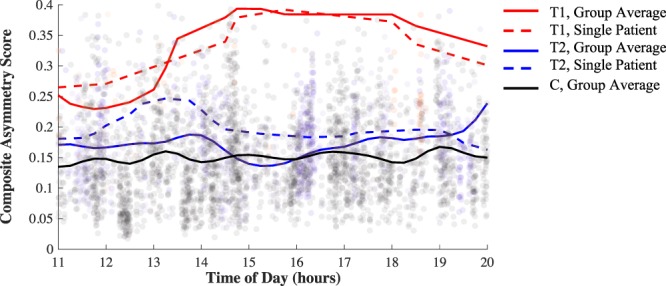
Composite asymmetry score throughout the day (averaged over every 15-minute bin) for a patient with longitudinal observations: 2.1 weeks post-surgery (red dashed line) and 19.1 weeks post-surgery (blue dashed line). The solid lines illustrate the average trends for the T1 (red), T2 (blue), and C (black) groups. The longitudinal patient’s data was not included in the group means.
Figure 5
Figure 5
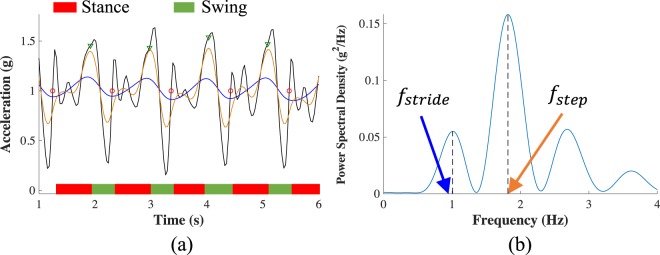
Stride detection and segmentation example. (a) Foot contact (red circles) and foot off (green triangles) events are identified using the CC-axis accelerometer time-series lowpass filtered with a 5 Hz cutoff (black trace) and with cutoff frequencies equal to the approximate step frequency (orange trace) and stride frequency (blue trace). Step and stride frequencies are approximated using the power spectral density of the raw accelerometer signal (b).

References

    1. Fisher, E. S. et al. Evaluating Efficiency Across Patient-Focused Episodes of Care (2009).
    1. Naylor MD, Aiken LH, Kurtzman ET, Olds DM, Hirschman KB. The care span: The importance of transitional care in achieving health reform. Health Aff. Proj. Hope. 2011;30:746–754. doi: 10.1377/hlthaff.2011.0041. - DOI - PubMed
    1. Konetzka RT, Spector W, Limcangco MR. Reducing hospitalizations from long-term care settings. Med. Care Res. Rev. MCRR. 2008;65:40–66. doi: 10.1177/1077558707307569. - DOI - PubMed
    1. Stauffer BD, et al. Effectiveness and Cost of a Transitional Care Program for Heart Failure: A Prospective Study With Concurrent Controls. Arch. Intern. Med. 2011;171:1238–1243. doi: 10.1001/archinternmed.2011.274. - DOI - PubMed
    1. Kourtis, L. C., Regele, O. B., Wright, J. M. & Jones, G. B. Digital biomarkers for Alzheimer’s disease: the mobile/wearable devices opportunity. Npj Digit. Med. 2 (2019). - PMC - PubMed

Publication types