


Understanding, treating, and renaming grandiose delusions: A qualitative study
- PMID: 31785077
- PMCID: PMC7984144
- DOI: 10.1111/papt.12260
Understanding, treating, and renaming grandiose delusions: A qualitative study
Abstract
Background: Grandiose delusions are arguably the most neglected psychotic experience in research.
Objectives: We aimed to discover from patients: whether grandiose delusions have harmful consequences; the psychological mechanisms that maintain them; and what help patients may want from clinical services.
Design: A qualitative interview design was used to explore patients' experiences of grandiose delusions.
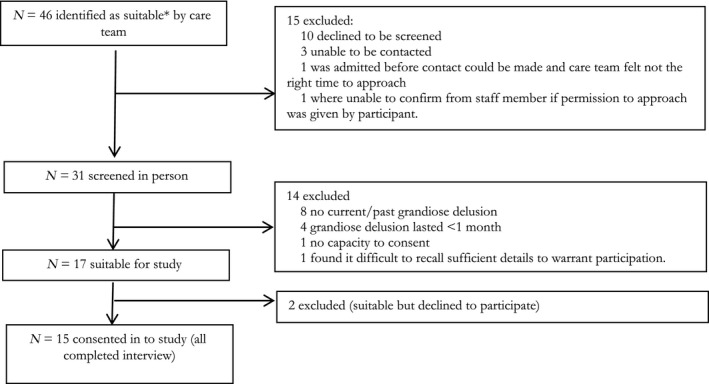
Method: Fifteen patients with past or present experiences of grandiose delusions who were attending psychiatric services were interviewed. Thematic analysis and grounded theory were used to analyse the data.
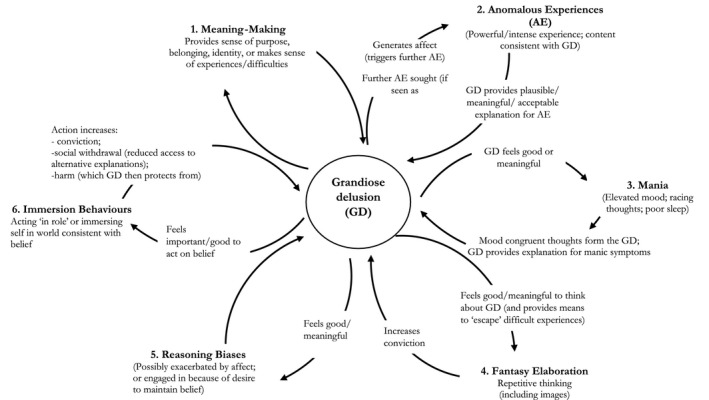
Results: Participants reported physical, sexual, social, occupational, and emotional harms from grandiose delusions. All patients described the grandiose belief as highly meaningful: it provided a sense of purpose, belonging, or self-identity, or it made sense of unusual or difficult events. The meaning from the belief was not synonymous with extreme superiority or arrogance. The meaning obtained appeared to be a key driver of the persistence of the beliefs. Other maintenance factors were subjectively anomalous experiences (e.g., voices), symptoms of mania, fantasy elaboration, reasoning biases, and immersive behaviours. Participants described insufficient opportunities to talk about their grandiose beliefs and related experiences and were generally positive about the possibility of a psychological therapy.
Conclusions: We conclude that grandiosity is a psychologically rich experience, with a number of maintenance factors that may be amenable to a targeted psychological intervention. Importantly, the term 'grandiose delusion' is an imprecise description of the experience; we suggest 'delusions of exceptionality' may be a credible alternative.
Practitioner points: Harm from grandiose delusions can occur across multiple domains (including physical, sexual, social, occupational, and emotional) and practitioners should assess accordingly. However, grandiose delusions are experienced by patients as highly meaningful: they provide a sense of purpose, belonging, or self-identity, or make sense of unusual or difficult events. Possible psychological maintenance mechanisms that could be a target for intervention include the meaning of the belief, anomalous experiences, mania, fantasy elaboration, reasoning biases, and immersive behaviours. Patients are keen to have the opportunity to access talking therapies for this experience. Taking extra time to talk at times of distress, 'going the extra mile', and listening carefully can help to facilitate trust.
Keywords: delusions of exceptionality; harm; maintenance mechanisms; qualitative; therapy.
© 2019 The Authors. Psychology and Psychotherapy: Theory, Research and Practice published by John Wiley & Sons Ltd on behalf of British Psychological Society.
Conflict of interest statement
All authors declare no conflict of interest.
Figures
References
-
- Bazeley, P. (2013). Qualitative data analysis: Practical strategies. Evaluation and program planning (Vol. 1). London: Sage.
Publication types
MeSH terms
Grants and funding
LinkOut - more resources
Full Text Sources
Medical
Miscellaneous
