. 2019 Nov 26:7:e8069.
doi: 10.7717/peerj.8069. eCollection 2019.

A rapid spread of the stony coral tissue loss disease outbreak in the Mexican Caribbean

Affiliations

A rapid spread of the stony coral tissue loss disease outbreak in the Mexican Caribbean

Lorenzo Alvarez-Filip et al. PeerJ. .

Abstract

Caribbean reef corals have experienced unprecedented declines from climate change, anthropogenic stressors and infectious diseases in recent decades. Since 2014, a highly lethal, new disease, called stony coral tissue loss disease, has impacted many reef-coral species in Florida. During the summer of 2018, we noticed an anomalously high disease prevalence affecting different coral species in the northern portion of the Mexican Caribbean. We assessed the severity of this outbreak in 2018/2019 using the AGRRA coral protocol to survey 82 reef sites across the Mexican Caribbean. Then, using a subset of 14 sites, we detailed information from before the outbreak (2016/2017) to explore the consequences of the disease on the condition and composition of coral communities. Our findings show that the disease outbreak has already spread across the entire region by affecting similar species (with similar disease patterns) to those previously described for Florida. However, we observed a great variability in prevalence and tissue mortality that was not attributable to any geographical gradient. Using long-term data, we determined that there is no evidence of such high coral disease prevalence anywhere in the region before 2018, which suggests that the entire Mexican Caribbean was afflicted by the disease within a few months. The analysis of sites that contained pre-outbreak information showed that this event considerably increased coral mortality and severely changed the structure of coral communities in the region. Given the high prevalence and lethality of this disease, and the high number of susceptible species, we encourage reef researchers, managers and stakeholders across the Western Atlantic to accord it the highest priority for the near future.

Keywords: Coral mortality; Disease prevalence; Long-term data, Reef functioning; Reef monitoring; SCTLD; White plague; White syndrome.


Conflict of interest statement

The authors declare that they have no competing interests.

Figures

Figure 1
Figure 1. Susceptible species affected by Stony Coral Tissue Loss Disease during the outbreak.
(A) Two colonies of Pseudodiploria strigosa observed on July 3, 2018 at a fore-reef reef site in Puerto Morelos, Mexico. One colony (front) shows the classic symptoms of the Stony Coral Tissue Loss Disease, while the other one died shortly before the photo was taken (recent and transient mortality). A Foureye butterflyfish (Chaetodon capistratus) is feeding on the edge of the lesion on the colony at the front. (B) Diseased colony of Montastraea cavernosa in direct contact with an apparently healthy colony of the same species observed in Cozumel on July 3, 2019. The close-up shows the touching-boundaries between the two colonies. Photo credits: Lorenzo Álvarez-Filip.
Figure 2
Figure 2. Prevalence of the Stony Coral Tissue Loss Disease for the 11 most susceptible species across 82 reef sites in the Mexican Caribbean (n = number of colonies).
For this figure, we include coral colonies with total mortality but for which death could be attributable to the SCTLD (exposed bright white skeletons; see Fig. 1).
Figure 3
Figure 3. Prevalence of the Stony Coral Tissue Loss Disease in the Mexican Caribbean.
Dots represent the location of the 82 surveyed reefs and the colors represent the SCTLD prevalence for the 11 most afflicted species (see methods and Fig. 2). Data on this figure was collected by the Healthy Reefs Initiative, the Comisión Nacional de Áreas Naturales Protegidas (Mexican Commission for Protected Areas; CONANP) and the Biodiversity and Reef Conservation Laboratory, UNAM. Please note that reef sites were surveyed at different times (between July 2018 and April 2019).
Figure 4
Figure 4. Disease prevalence of the 11 most susceptible species to the Stony Coral Tissue Loss Disease (STCLD) from 2005/2006 to 2018/2019 in the Mexican Caribbean.
From 2009 to 2014 black-band disease was the most abundant coral disease and was mainly recorded in Siderastrea siderea in Cozumel.
Figure 5
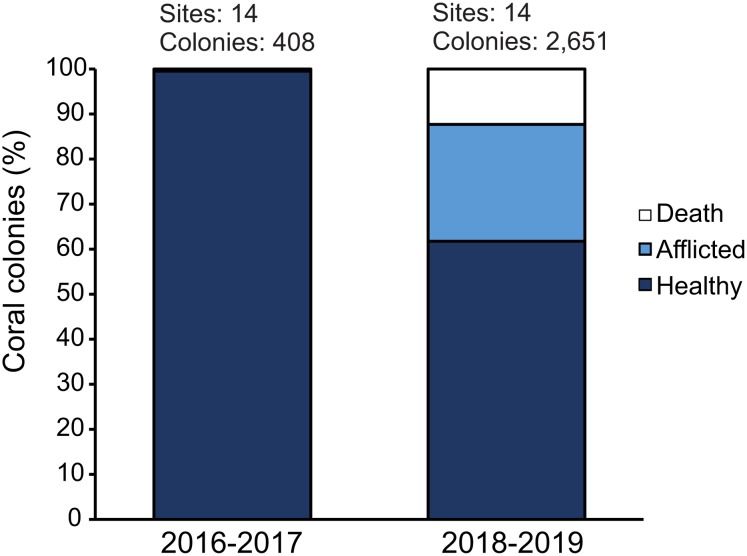
Figure 5. Proportion of healthy, afflicted and dead colonies of the highly susceptible species in 2016/2017, before the onset of the Stony Coral Tissue Loss Disease Outbreak (SCTLD) in the Mexican Caribbean, and in 2018/2019 when the SCTLD was spread across many sites in the region.
Figure 6
Figure 6. Coral community composition for the study sites before and after the disease.
Non-metric multi-dimensional scaling (nMDS) analysis displaying degree of similarity of the community composition across 14 sites in the Mexican Caribbean for the coral cover by species. The blue color represent the sites before the disease (2016–2017) and the gray color represent the sites after the disease (2018–2019). The circles represent the back-reef sites and the triangles the fore-reef sites. Dotted lines: convex hull total area (TA). Solid lines: standard ellipse area corrected for small sample sizes (SEAc).

References

    1. AGRRA Coral disease outbreak, stony coral tissue loss disease. 2019. http://www.agrra.org/coral-disease-outbreak/ http://www.agrra.org/coral-disease-outbreak/
    1. Alvarez-Filip L, Carricart-Ganivet JP, Horta-Puga G, Iglesias-Prieto R. Shifts in coral-assemblage composition do not ensure persistence of reef functionality. Scientific Reports. 2013;3(1):3486. doi: 10.1038/srep03486. - DOI - PMC - PubMed
    1. Alvarez-Filip L, Dulvy NK, Gill JA, Côté IM, Watkinson AR. Flattening of Caribbean coral reefs: region-wide declines in architectural complexity. Proceedings of the Royal Society B: Biological Sciences. 2009;276(1669):3019–3025. doi: 10.1098/rspb.2009.0339. - DOI - PMC - PubMed
    1. Aronson RB, Precht WF. Stasis, biological disturbance, and community structure of a Holocene coral reef. Paleobiology. 1997;23(3):326–346. doi: 10.1017/S0094837300019710. - DOI
    1. Aronson RB, Precht WF. White-band disease and the changing face of Caribbean coral reefs. Hydrobiologia. 2001;460:25–38.

LinkOut - more resources