


The Role of Noninvasive Tests for Differentiating NASH From NAFL and Diagnosing Advanced Fibrosis Among Patients With NAFLD
- PMID: 31789757
- PMCID: PMC7945957
- DOI: 10.1097/MCG.0000000000001284
The Role of Noninvasive Tests for Differentiating NASH From NAFL and Diagnosing Advanced Fibrosis Among Patients With NAFLD
Abstract
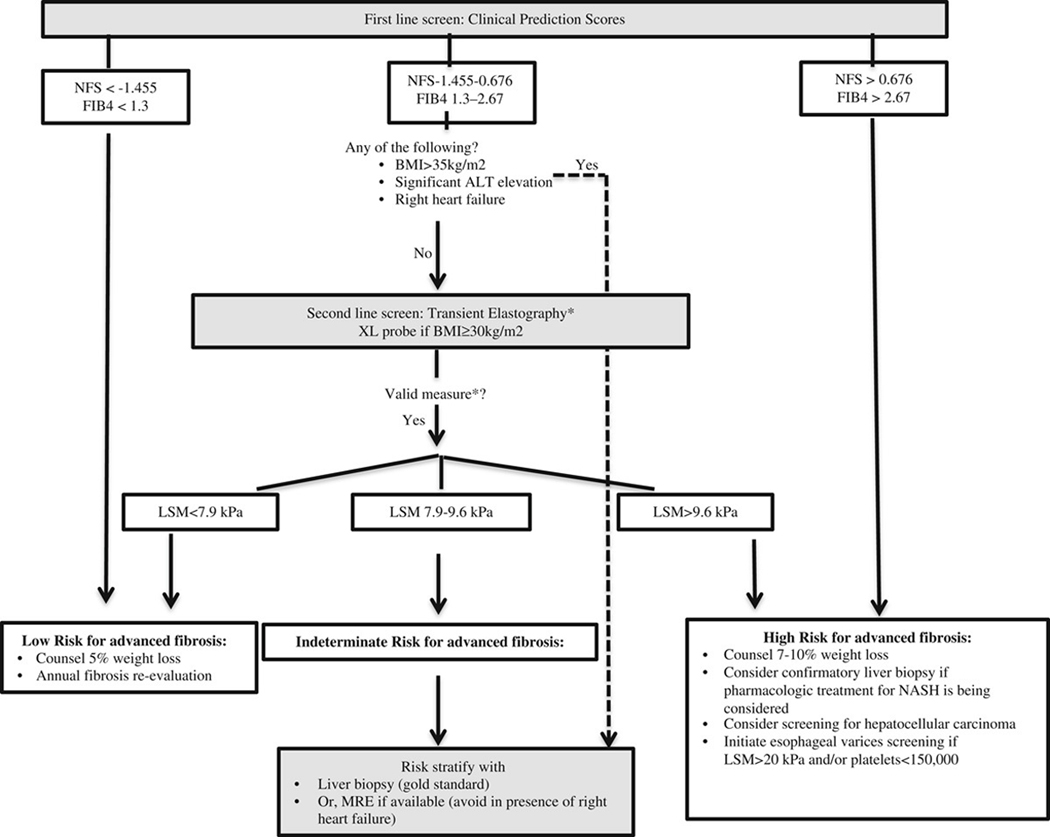
Assessing for the presence of non-alcoholic steatohepatitis (NASH) and the presence of advanced fibrosis is vital among patients with non-alcoholic fatty liver disease (NAFLD) as each is predictive of disease outcomes. A liver biopsy is the gold standard method for doing so but is impossible to perform among all patients with NAFLD. Reliable methods for noninvasively detecting for the presence of NASH and advanced fibrosis are thus a pressing need. The search for noninvasive tests has been more successful for advanced fibrosis than for NASH. Clinical prediction models and elastography have acceptable accuracy for ruling out advanced fibrosis; when used together, as in a fibrosis prediction algorithm presented in this review, it can avoid the need for liver biopsy among many patients with NAFLD. Several biomarkers for identifying the presence of NASH have been studied but none are sufficiently accurate or validated. Of those studied, the most promising include CK-18 fragments, lipodomic and metabolomics candidates, and magnetic resonance elastography with proton density fat fraction. However, none are ready for clinical use and ultimately large multicenter prospective cohort studies are needed to validate select novel biomarkers.
Figures
References
-
- Younossi ZM, Koenig AB, Abdelatif D, et al. Global epidemiology of nonalcoholic fatty liver disease—meta-analytic assessment of prevalence, incidence, and outcomes. Hepatology. 2016;64:73–84. - PubMed
-
- Byrne CD, Targher G. NAFLD: a multisystem disease. J Hepatol. 2015;62(suppl 1):S47–S64. - PubMed
-
- Adams LA, Lymp JF, St Sauver J, et al. The natural history of nonalcoholic fatty liver disease: a population-based cohort study. Gastroenterology. 2005;129:113–121. - PubMed
-
- Rinella ME. Nonalcoholic fatty liver disease: a systematic review. JAMA. 2015;313:2263–2273. - PubMed
